
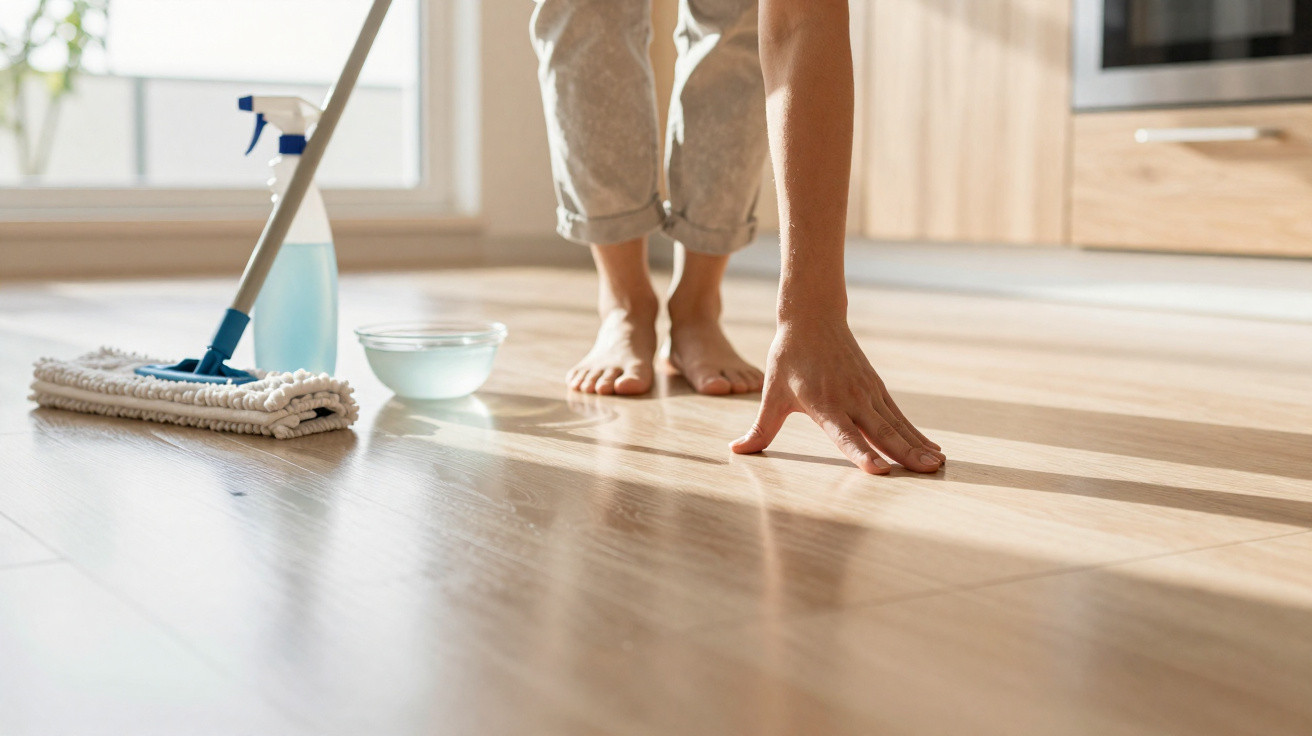
The floor has just been washed, the room smells fresh and clean, and the light is even catching the tiles… then your socks make that unpleasant little sound as you walk through the kitchen. That sticky feeling is not merely irritating: it makes it seem as though cleaning was pointless. Very often, though, the issue is not the floor itself.
We all know the moment when you go over the floor with the mop for a second time, sometimes a third, convinced you must have missed something. The water turns grey, the cleaner foams, and the wood or tiled floor looks spotless to the eye, yet it still sticks underfoot. A friend recently said she had blamed her children for walking through the house in trainers, before realising her scented cleaner was the real culprit. The floor was not dirty: it was covered in an invisible film. That small detail changes everything.
A sticky floor is rarely random: the invisible film that builds up
A floor that feels sticky after cleaning often points to too much product, even if you feel you have used a sensible amount. Floor cleaners are formulated to create a fresh feeling and sometimes a slight sheen, but an overly generous dose leaves behind cleaning agents that do not evaporate like water. They remain on the surface and attract dust, crumbs and footprints. By the following day, the kitchen can already look dull. It is not always dirt: it is often residue.
This is especially common with concentrated cleaners. A family of four may pour a full capful into a 5-litre bucket when the label may recommend only half that amount for 10 litres of water; the result smells pleasant, but the surface can become almost soapy. On dark tiles, dull marks soon show up. On pale flooring, they are less immediately visible. You notice them beneath your shoes.
Water also plays a part. Very hard water does not rinse products away in the same way and can leave a mineral haze, while a poorly washed mop spreads kitchen grease around with each pass. Let us be honest: nobody really does this every day. Yet a mop head saturated with cleaner, or left damp in a bucket, is enough to turn an ordinary clean into a sticky coating. The issue develops gradually, wash after wash.
The method that genuinely removes the sticky feeling
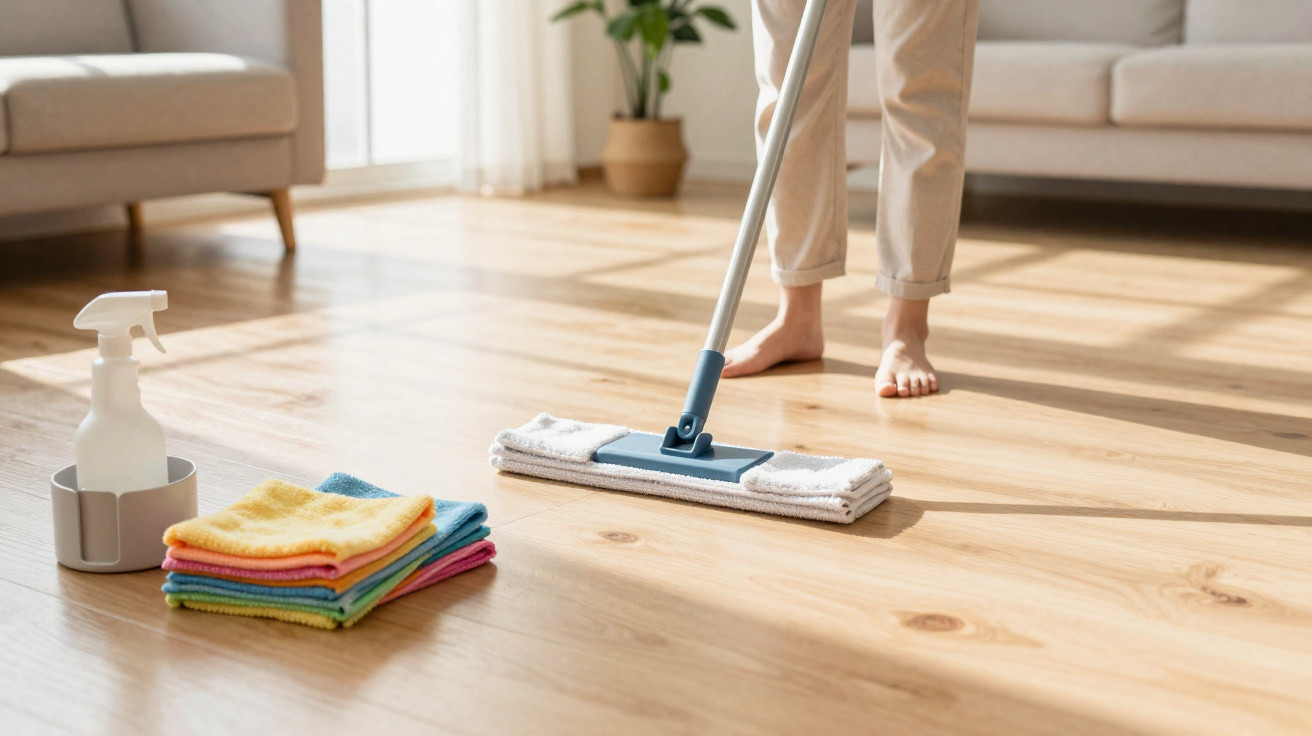
The lasting solution starts with an almost overly simple step: wash once without any cleaner. Use clean, hot water and a thoroughly rinsed, well-wrung mop, changing the water as soon as it becomes cloudy. For hard-wearing tiled floors, a little diluted white vinegar - around one glass per 5 litres of water - may help lift the film, provided it is never used on marble, natural stone or certain waxed floors. The aim is not to add fragrance. It is to rinse.
Once this deep clean is complete, return to a much lighter routine: the smallest dose of neutral cleaner, or simply hot water for frequently cleaned areas that are not very dirty. The most common mistake is assuming that more product cleans better, as with laundry detergent. In fact, too much makes rinsing harder and feeds the cycle of sticky floors. A clean floor should not leave a sensation underfoot. If it still feels sticky, focus on rinsing rather than adding more cleaner.
Before replacing all your products, watch the surface for two or three days: when it starts to feel sticky again often provides the most reliable clue. Areas near the hob, bin or entrance may sometimes need spot treatment, rather than a detergent bath for the whole house.
“Good cleaning is not measured by the smell of the product, but by the absence of film after drying.”
- Rinse the mop until the water runs clear.
- Halve the amount of cleaner used for the next wash.
- Clean greasy areas separately, particularly around the kitchen.
- Allow the floor to dry completely before assessing the result.
The right product also depends on the floor in your home
The same approach does not suit every surface. Tiles cope reasonably well with a deep clean, whereas sealed wood flooring does not tolerate puddles, oily products or overly acidic homemade solutions. On laminate flooring, excess water can seep into the joins and cause subtle, sometimes irreversible swelling. Vinyl, meanwhile, can become sticky when a glossy or waxing product creates a coating. The label “suitable for all floors” does not always tell the full story.
The genuinely lasting solution therefore comes down to a little discipline: identify the flooring, remove existing residue, then reduce the number of products you use. Many households alternate between disinfectant, degreaser, scented cleaner and wipes without realising that their formulas are layering up. A mix of good intentions can sometimes leave the worst kind of film. In most cases, one suitable product used in the right quantity is enough. For greasy marks, treat them before the main wash using a sponge and a little mild soap.
If the floor remains sticky after two thorough rinses, investigate old wax, a floor restorer or an anti-slip treatment. These layers may require a stripper that is compatible with the material, or even professional advice for old wooden flooring or natural stone. This is not about stripping everything blindly: testing in an inconspicuous corner prevents plenty of regret. Your home does not need to be perfect. It simply needs to feel pleasant to walk through barefoot again.
Getting a clean floor again without overdoing it
A floor that no longer sticks changes the feel of a room in a surprisingly noticeable way. You open the windows, walk around without watching your socks, and let children play on the floor without that vague sense that something is catching. That feeling of cleanliness does not rely on a powerful fragrance or dramatic foam. It often comes from a less visible step: rinsing, the one skipped when the day is already too busy.
It can help to examine your habits without judging yourself. The capful poured “by feel”, the mop used one time too many, the bucket filled with too little water: these are universal habits, and they explain a large proportion of sticky floors. A simpler routine costs less, rarely takes any longer, and delivers a far clearer result. Perhaps your next clean will start not with a new bottle, but with a bucket of clean water.
| Key point | Detail | Benefit for the reader |
|---|---|---|
| Reduced dosage | Use the minimum recommended quantity of cleaner | Prevents an invisible sticky film from forming |
| Proper rinsing | Go over the floor with a clean mop and clear water | Removes product residue and grease |
| Suitable product | Take account of tiles, wood flooring, vinyl or stone | Protects the surface and extends its lifespan |
Comments
No comments yet. Be the first to comment!
Leave a Comment