
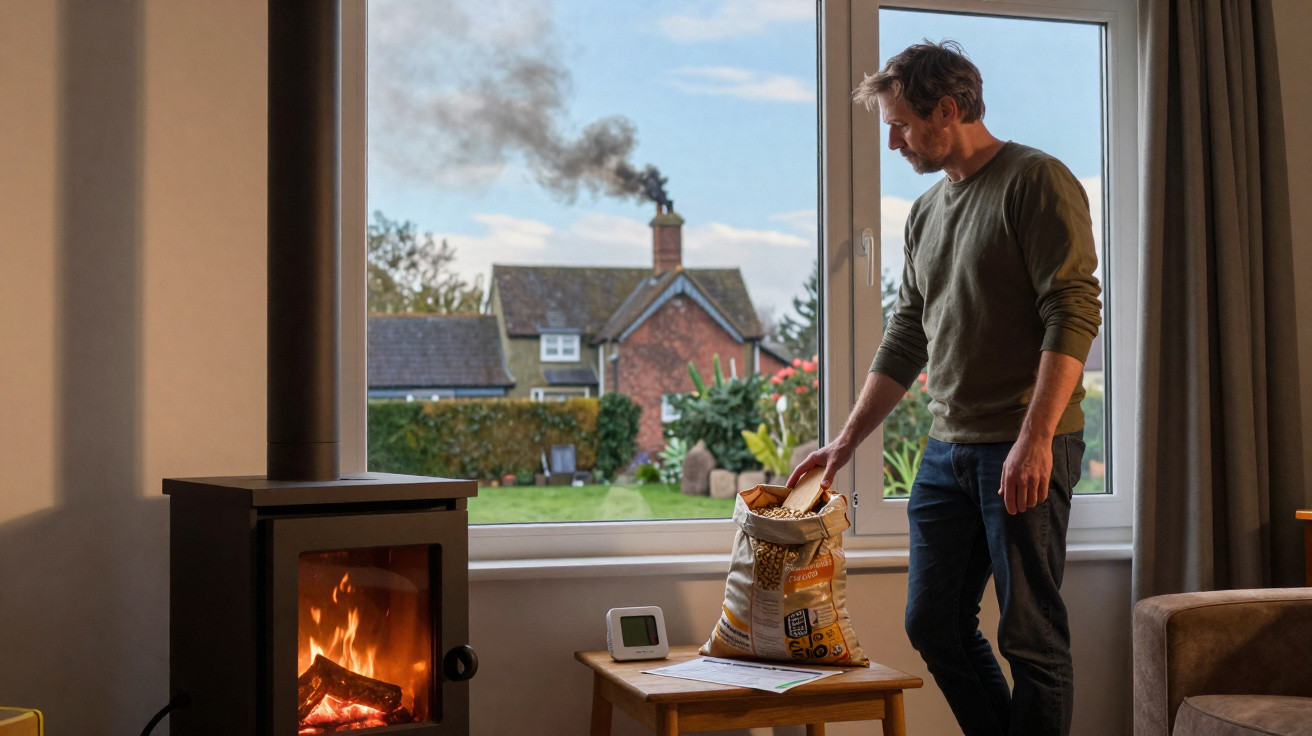
That faint sweetness in the cold air, mixed with a sharp sting that scratches at the throat. I was standing on my balcony, looking towards the neighbouring house, when I noticed that the chimney was not releasing a clear plume of smoke but a thick grey cloud. Down in the yard were stacks of sawn chipboard, old shelving and leftover varnish-coated wood. “It’s only wood,” my neighbour called when I challenged him. Somewhere inside, part of me thought: fair enough, recycling saves money and sounds rather clever.
But my head was pounding, my eyes were watering, and my weather app said “Air quality: poor”.
Sometimes, only a thin trail of smoke separates smart reuse from a dangerous shortcut.
When fireplace romance becomes toxic smog
Anyone who has walked through a suburban neighbourhood on a still winter evening will recognise the sensation. The air feels heavy, chimneys are glowing everywhere, and the smell shifts between a cosy mountain cabin and a building-site waste fire. In recent years, many households have moved from conventional logs to pellets. Efficient, standardised and easy to store, they appear to offer a modern way to heat a home.
Alongside this, another habit has emerged: people put their “leftover wood” into the stove. Old cabinets, coated boards and pallets from online deliveries all end up in the fire. On social media, users proudly explain how they “waste nothing” and “use everything”. It may sound like a circular economy, yet it is increasingly smelling like something very different.
Consider an everyday scenario repeated across the country. A tradesperson has a garage full of timber offcuts: OSB boards, varnished doors and cut-to-size chipboard panels. Officially, these should be disposed of as chargeable hazardous waste. Instead, a sizeable portion goes into the home fireplace. “It burns brilliantly,” he says as blue-yellow flames flicker and sparks fly.
In the same town, a mother is sitting by her child’s bed in the evening. The child is coughing despite not having a cold. Outside, the air is stagnant and the neighbourhood smell lingers in the room. She searches for particulate readings and finds a monitoring network run by a citizens’ initiative. Its graph rises sharply every evening, at exactly the same time as the neighbourhood’s burning hour. Numbers and instinct are telling her the same thing this time.
Naturally, statistics on “illegally burned waste wood” are incomplete. Nobody voluntarily ticks a box saying, “I burn my old Pax wardrobe.” Even so, environmental authorities estimate that in some regions, as much as 10–20 percent of what enters small combustion installations is not permitted fuel at all. Chipboard, old chemically treated pallets and varnished strips: in short, wood that stopped being a natural product long ago.
Why is this happening? One reason is straightforward: cost. Pellet prices have risen, while logs were virtually sold out in some winters. Anyone looking into the yard and seeing old furniture as “free energy” can feel almost foolish for not using it. There is also the satisfying sense of throwing nothing away. We all know the pleasure of finding one more supposedly useful purpose for something.
At the same time, pellets have given wood heating a highly polished image: automation, clean combustion chambers and attractive efficiency figures. That impression rubs off on anything else that looks like wood. Pallets, boards and offcuts all seem similar enough. What looks like wood is quickly assumed to be suitable fuel. In day-to-day life, it is easy to overlook the fact that glues, varnishes and preservatives can create a toxic cocktail of pollutants at high temperatures.
The unvarnished truth is that a chimney does not end in the sky.
Every pollutant that leaves it enters somewhere else: lungs, building façades and gardens. Burning waste merely shifts the cost from the householder’s wallet to neighbours, health services and the climate. Calorific value is not a material’s only value. Some waste appears cheap until it is measured against hospital statistics.
Pellet heating, waste wood and air quality
Pellet systems are often presented as climate saviours, but that view is incomplete. Yes, pellets made from certified residual wood can form part of a sensible transition in home heating, provided they are cleanly produced, filters are fitted and modern technology is used. Yet once a stove becomes an all-purpose incinerator, the calculation changes. Emissions of particulate matter, nitrogen oxides, heavy metals and organic pollutants can then rapidly reach levels with nothing to do with sustainable heating.
Anyone wanting to use wood without turning neighbours and the climate into an involuntary dumping ground should begin with one simple rule: burn only fuels that are explicitly approved for the purpose. That means untreated, dry logs, certified pellets and possibly clearly labelled briquettes. No chipboard, no stained boards and no pallets carrying stamps you do not understand.
A useful rule of thumb is this: if you cannot say with certainty how the wood was treated, it does not belong in the stove. Full stop. The supposed recycling trick can quickly become nothing more than hot air. Those who take the issue seriously sort materials consistently and plan their wood supply generously, rather than panicking in February and sawing up the old coffee table.
Correct stove operation matters
What many people fail to appreciate is that most modern wood and pellet stoves operate even reasonably cleanly only when used correctly. Wood that is too damp, insufficient draught and keeping the fire permanently smouldering at low output all result in incomplete combustion and dense smoke. A stove quietly chugging away may seem cosy, but it can be a serious pollution machine.
The most common mistake is trying to keep the fire low all the time in order to save fuel. It sounds sensible, but it produces excessive smoke and soot. A better approach is to heat strongly, briefly and at a high temperature, then allow the system to cool. Yes, that takes more effort, attention and routine. Let’s be honest: nobody enjoys getting up every 40 minutes to add logs. Many people still do it only halfway out of convenience, and that is where the problem for neighbours begins.
It helps to set aside time once a year to examine your own heating routine properly. What actually goes into the stove? What does the smoke look and smell like when I step outside to check it? Do I discuss it with my neighbours, or simply hope that nobody complains? These small, uncomfortable questions are often more effective than any new regulation.
“Heating with wood is not a romantic campfire but a small industrial facility in a residential area – just without a shift manager,” says an air-quality expert I spoke to by phone.
Anyone who does not want their heating system to become the street’s source of conflict can follow a few simple safeguards:
- Use only certified pellets and untreated, dry wood.
- Never burn varnished, glued or treated wood, including “offcuts”.
- Do not merely put up with the chimney sweep; ask specifically for advice on improving the system.
- Step outside occasionally and deliberately look at and smell your own smoke.
- Speak with neighbours before resentment builds up.
Ultimately, one uncomfortable realisation remains: what seems like brilliant upcycling in your own shed can appear as thoughtlessness to everyone else in the street. The distance between clever resource use and a social imbalance can sometimes be no more than a chimney draught. And yes, the state can filter, regulate and subsidise. But the decision over whether an old chest of drawers belongs at the recycling centre or in the stove is still made in our own hands.
Perhaps responsible heating begins precisely when your instinct says: “Really, I know this is not a good idea.”
| Key point | Detail | Added value for the reader |
|---|---|---|
| Burn only approved fuels | Certified pellets and untreated, dry logs | Readers can immediately review and adjust how they heat their homes |
| Waste wood is not “free” fuel | Glued, varnished and treated wood releases toxic substances | Explains why apparent recycling transfers health and climate costs elsewhere |
| How the stove is used makes a difference | Heat quickly and hot, rather than letting it smoulder “forever at low output” | A practical way to directly reduce particulate pollution and odours |
Frequently asked questions
- Question 1 Is it permitted to burn pallet wood in a fireplace?
- Answer 1 Only untreated pallets without preservatives or special markings could even be considered, but many transport pallets are chemically treated. In practice, pallet wood generally does not belong in a fireplace and should be disposed of properly.
- Question 2 How can I tell whether my smoke is a problem?
- Answer 2 A correctly adjusted stove using dry wood produces only a brief white plume, particularly while lighting it. Dark, dense grey or acrid-smelling smoke that remains in the air for a long time is a clear warning sign: either the fuel or the combustion process is wrong.
- Question 3 Is pellet heating automatically “climate-friendly”?
- Answer 3 It can be one element of the solution if the pellets come from sustainable production and the appliance is modern and well maintained. However, if residual materials of questionable origin are burned or filtration technology is neglected, the climate balance quickly deteriorates and local air pollution rises significantly.
- Question 4 What should I say to a neighbour whose chimney smells strongly?
- Answer 4 Keep calm and be specific: explain when and how you notice the nuisance rather than making accusations straight away. Many people simply do not know how their smoke affects the outdoors. Suggesting a chimney sweep or sharing information from the local council can help without immediately creating opposing sides.
- Question 5 Are there alternatives if I no longer want to use wood?
- Answer 5 Yes: options range from heat pumps and district heating to hybrid systems with solar thermal technology. The right choice depends on the building, location and budget. The common thread is that every option avoiding combustion in a residential area improves the air we all breathe.


Comments
Смотреть здесь
[url=https://tripscans77.co]tripskan[/url]
Наша компания предоставляет индивидуальный подход, что позволяет создать уникальную атмосферу и удовлетворить особые потребности клиентов, предлагая индивидуальный дизайн и адаптацию мебели под конкретные требования и стиль заведения https://www.dlyaudachi.ru/product/el-iskustvennaya-tsar-elka-smayl-180-sm
Подушки из олефина — грязе- и водоотталкивающие, не впитывают запахи, легко чистятся https://www.dlyaudachi.ru/product/obedennyy-komplekt-iz-akatsii-karo-joygarden
Качество и гарантии
Она должна сочетать износостойкость, эргономику и продуманный дизайн https://www.dlyaudachi.ru/collection/stoly-dlya-kafe?page=2
Stool Group предлагает решения для сегмента HoReCa: мебель для кафе, ресторанных пространств и мебель для бара, рассчитанную на интенсивную эксплуатацию https://www.dlyaudachi.ru/product/detskaya-eyp-1-belyydub-belyy-2
Комфорт хорошо спроектированного интерьера усиливает впечатления от еды, позволяя гостям расслабиться и полностью погрузиться в предлагаемые кулинарные изыски https://www.dlyaudachi.ru/product/ergonomichnoe-kreslo-y-4db-b2-9d-ym93-kb00nb00d04ph15mm-2dm06b11g22w03
Удобные столы и стулья способствуют продолжительным беседам, превращая трапезу в приятное времяпрепровождение https://www.dlyaudachi.ru/product/el-iskusstvennaya-tsar-elka-kremlevskaya-zelenaya-160-sm
Алюминиевый каркас — не ржавеет, не гниёт и не рассыхается, выдерживает интенсивную нагрузку https://www.dlyaudachi.ru/product/tent-sadovyy-green-glade-1036-3h3h25m-poliester-2
1xbet промокод на сегодня 2026. Чтобы удовлетворить игроков, букмекеры постоянно добавляют новые функции и предложения. Одним из лидеров является 1хБет. Ввод промокода при регистрации позволяет получить увеличенную сумму бонуса. После создания аккаунта внеси первый депозит (до 32 500 рублей) — и получи вознаграждение. Абсолютно бесплатный бонус при регистрации 1хБет доступен всем новичкам, чтобы активировать дополнительные преимущества. Игнорировать поле «Введите промокод» — значит потерять выгоду. Оно присутствует при трёх из четырёх способов регистрации (в 1 клик).
посмотреть в этом разделе
[url=https://tripscan77.us/]трип скан[/url]
Leave a Comment