
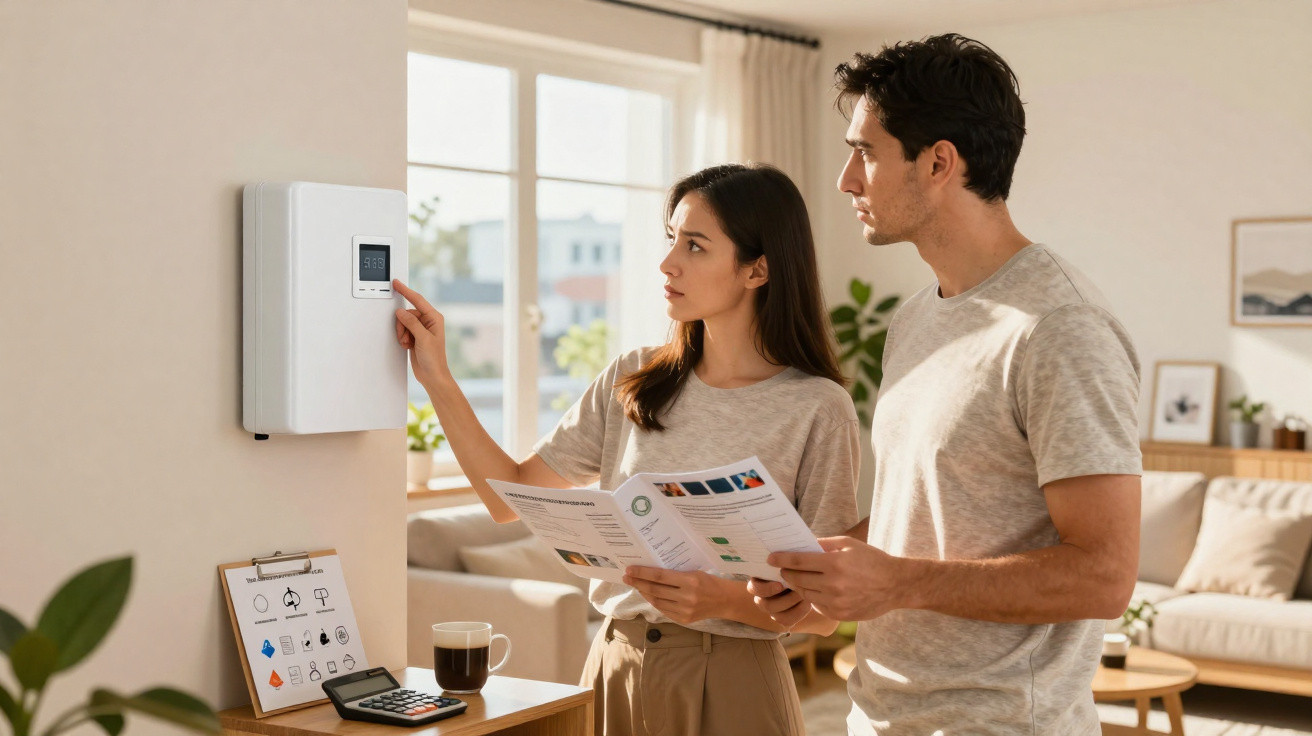
In a country facing high electricity bills and ambitious climate targets, one technology has emerged as a promise of “clean”, modern heating.
Heat pumps have acquired a reputation as the ideal answer for warming homes, cutting emissions and lowering costs. Yet in reality, enthusiasm has turned into scepticism in many European households, particularly in France, where reports of disappointment are mounting and raising an awkward question: was this technology marketed with promises beyond what it can actually deliver?
What exactly is a heat pump?
A heat pump does not ‘make’ heat; it moves it from one place to another. It works like an air conditioner in reverse, drawing heat from the air, ground or water and transferring it into the home.
- Air-to-air or air-to-water (aerothermal): extracts heat from outside air.
- Ground-to-water (ground-source): uses heat from the ground through buried probes.
- Water-to-water: draws on groundwater or aquifers.
In principle, the idea is straightforward: for every 1 kWh of electricity used, the system supplies 2, 3 or even 4 kWh of heat. This apparent ‘miracle’ is measured through the COP, or coefficient of performance. Actual results, however, rely on a lengthy list of conditions.
The very same unit that performs impressively in a new, well-insulated house can be a complete disappointment in an older property with plenty of draughts.
The upfront price that cools enthusiasm
The first shock is financial. In France, where take-up has progressed more quickly, fitting a domestic heat pump generally costs between €10,000 and €20,000, including labour. Even with government subsidies, prices at this level put many households off.
Anyone considering replacing a gas boiler or oil-fired heater with a heat pump has to account for:
- the unit itself, which uses more complex technology;
- alterations to the heating system, including radiators and underfloor heating;
- possible electrical upgrades to the property;
- a design assessment and sizing calculation carried out by a qualified professional.
Where budgets are tight, the result can feel like an ‘all or nothing’ choice. Many homeowners end up taking on debt in expectation of future savings that do not always materialise as anticipated.
Energy savings: convincing in theory, not always in practice
Manufacturers’ brochures highlight high COP figures, often above 3. Put simply, that means three times as much heat as the electricity consumed. These figures, though, are usually based on laboratory testing in close-to-ideal conditions.
During a real winter, with severe cold and a poorly insulated home, the picture changes. An air-source heat pump becomes less efficient when outside temperatures drop too far. To maintain indoor comfort, more energy-hungry electric backup heaters then come into use.
In many cold regions, the promise of “guaranteed savings” has turned into greater dependence on electricity - and, consequently, higher bills.
Another issue that receives little attention is performance during periods of peak demand. In neighbourhoods where many homes installed heat pumps at once, electricity networks have required reinforcement, with those costs ultimately spread across the tariffs paid by everyone.
When the sums add up - and when they do not
Experts identify several typical scenarios:
| Property situation | Likelihood of a good outcome | Risk of disappointment |
|---|---|---|
| New, well-insulated house | High, with substantially lower consumption | Low, if correctly sized |
| Older house with little refurbishment | Medium, dependent on adjustments | High, with a risk of rising electricity bills |
| Mild climate with gentle winters | High, with a COP close to the promised level | Low, as the system is under less strain |
| Very cold region | Medium to low, due to high demand | High, with intensive use of electric backup |
Maintenance: the hidden cost of this type of investment
Maintenance is another factor affecting perceptions of reliability. A heat pump is a system made up of a compressor, refrigerant, control electronics and heat exchangers. Each of these requires regular attention.
In practical terms, homeowners face:
- scheduled servicing every one or two years;
- checks for refrigerant leaks;
- cleaning filters and coils;
- potential replacement of costly parts, such as the compressor.
Many consumers were drawn in by long-term savings without receiving a clear warning that ‘energy savings’ rely on regular maintenance costs.
Reports from France also point to concern about real-world lifespan. Some systems have begun showing signs of wear well before the two decades suggested by marketing campaigns, whether because of poor installation or use in conditions for which they were not genuinely sized.
Exaggerated promises and trust under pressure
Some users’ frustration stems not only from technical faults, but also from the way the product was sold. The dominant message focused on swift financial gains and guaranteed comfort, without clearly explaining that a heat pump is not a magic solution but equipment highly sensitive to its setting.
In France, consumer associations report that some complaints arise from sizing mistakes: undersized systems that cannot cope with cold weather, or oversized systems that are expensive and inefficient. The outcome is a knock-on effect of frustration and mistrust.
According to specialists, what was missing was a more honest screening process: identifying the types of homes where a heat pump makes sense, and the cases where money would be better spent on improved insulation or hybrid solutions.
What may work better for each type of home
Against this backdrop, the discussion is shifting from ‘heat pump: yes or no?’ to a more precise question: ‘heat pump: where, how and alongside what?’
Several approaches are gaining ground in countries with greater experience of the technology:
- Insulation first: efficient windows, upgraded walls and fixing draughts reduce the required output and improve the likelihood of a heat pump working well.
- Hybrid systems: combining a heat pump with a gas or biomass boiler, using each source where it is most efficient.
- Integration with solar photovoltaics: using solar power to cover part of the heat pump’s electricity use, reducing the impact on the bill.
- Tailored designs: detailed heat-loss calculations rather than ‘one-size-fits-all’ solutions.
A heat pump is more likely to work well as one part of an energy jigsaw, rather than as an isolated, universal answer.
Terms worth checking before signing a contract
Anyone assessing this technology will encounter abbreviations and concepts that are not always clear. Some have a direct effect on household costs:
- COP (coefficient of performance): measures efficiency under a specific test condition. A COP of 3.5 does not mean the unit will always perform at that level.
- SCOP: the seasonal average COP across the full heating period. This measure is closer to real-life use.
- Heating curve: determines how the system responds when external temperatures fall. Poor settings cause either discomfort or unnecessary spending.
- Backup capacity: the output of the supplementary electric heaters. In certain designs, these can end up operating more than the heat pump itself.
Two practical scenarios to understand the risk and potential
Consider an older 120 m² house in a cold area, with little thermal refurbishment. The family installs a high-performance air-source heat pump after being persuaded by optimistic projections. During the first harsh winter, outside temperatures fall well below the ideal range. The heat pump begins relying on electric backup heaters almost every night. Energy bills rise, and the investment appears to have been a costly mistake.
Now take a well-insulated semi-detached house in an area with a moderate climate. The same technology, this time, operates for most of the year within favourable temperature ranges. Its real COP comes close to the figures in the technical brochure, the family cuts consumption compared with gas heating, and regular maintenance fits within their financial planning.
Both examples use the same technology but lead to opposite outcomes. This contrast underlines the point now repeated by many experts across Europe: the heat pump has not failed as a concept, but in many cases it was sold as an easy shortcut to an ‘efficient home’ before the rest of the system - insulation, electrical network and household habits - was ready to accommodate it.





Comments
No comments yet. Be the first to comment!
Leave a Comment