
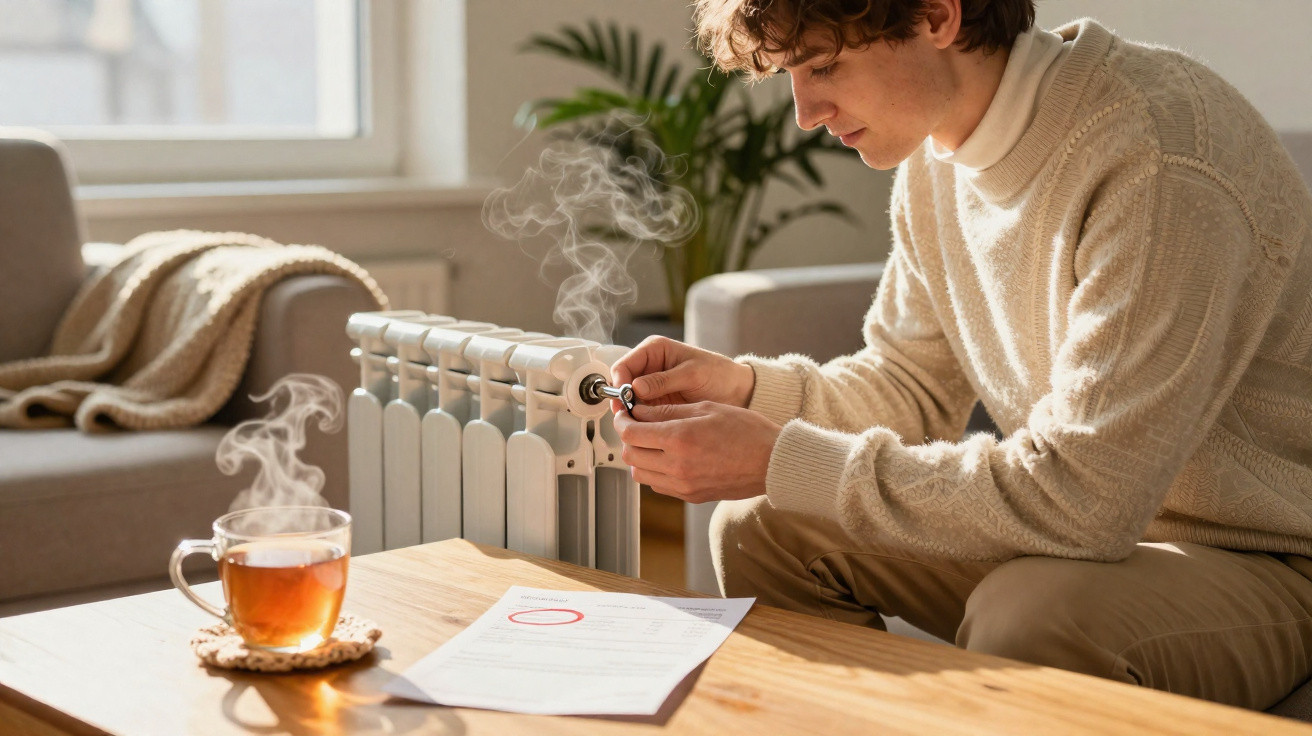
One minute, you are comfortable in a jumper; the next, you are prodding the thermostat with freezing fingers and praying the boiler will not make that ominous clunk. Then the bill arrives. You open the app or tear open the envelope, and your stomach sinks – how has it become so expensive when you have been “trying to be careful”? Suddenly, you are counting radiators and joking about selling an organ.
The odd thing is, your energy supplier is not always the one taking you for a ride. Sometimes your own radiators are quietly undermining you from their spot against the wall. They are running, but only doing half the job while wasting your money. The answer is not an expensive smart device or a complete heating-system replacement. It is a small silver key, a tea towel and five mildly apprehensive minutes on a Tuesday evening.
The day my living room let me down
I first realised my heating was practically setting fire to money because my toes were cold. The radiator in the living room was switched on and hot at the bottom, yet the top stayed determinedly cold. I did that slightly ridiculous thing of running my palm over the metal, certain I must have got it wrong. Then I checked a second radiator. Exactly the same: cool at the top and hot below. Frozen feet, boiling bill.
A friend – the kind of person who genuinely reads appliance manuals – asked the obvious: “When did you last bleed your radiators?” My expression was probably somewhere between confused and guilty. Honestly, hardly anyone does this annually, as though we all feature in a responsible DIY advert. We turn the heating on, cross our fingers and complain once the bill resembles a telephone number.
As people do, I disappeared into a small internet rabbit hole. Somewhere among energy-saving advice and debates over the perfect room temperature, I kept seeing the same assertion: bleeding radiators could save up to £100 a year. It was not magic; it simply allowed the boiler to work as it should. It seemed almost too straightforward, which was exactly why I gave it a go.
Why your radiators secretly hate you – and your wallet
Radiators are supposed to be full of hot water. That is essentially their entire purpose. The boiler warms the water, it travels through the pipes, the radiators heat up and you feel rather pleased with yourself in your dressing gown. But when air is trapped inside, the water cannot circulate as it should. Sections of the radiator remain cold, forcing the boiler to work harder and for longer to bring the room to the same temperature.
That extra work and time is where the money disappears. You might think, “I’ll just turn the thermostat up by one degree,” without realising the system is already losing the fight. You are paying to heat water that never gets the opportunity to pass that warmth into your home. The boiler continues burning gas or using electricity while you sit beneath a blanket, wondering why this winter seems pricier than the last.
Every autumn, energy experts repeat the same advice: radiators that are warm at the bottom but cool at the top have air in the system. Air does not warm up; it simply occupies space, rather like the person on the bus who places their bag on the seat beside them. Pockets of nothing are pushing out the heat you are paying for.
The £100 nobody notices leaving the bank
Heating makes up more than half of the average UK household energy bill. Most people are aware of that. Less apparent is that an underperforming system can add 10–15% to those costs without any major change in your behaviour. No extreme thermostat settings or marathon showers – just ordinary, everyday waste. That is why the potential “up to £100 a year” saving can add up for a typical home.
Naturally, you do not watch the money leave. It is not like losing a £20 note down a drain. It goes in small increments: ten additional minutes of heating here, another thermostat degree there, an extra hour because the room never properly feels warm. Once you spot it, the bill has already been issued or the direct debit has already risen.
The reality is that efficient heating does not always require a dramatic gesture. At times, it simply means enabling hot water to reach the top of the metal box on your wall. It is not glamorous, but it works.
The tiny radiator key that makes all the difference
Bleeding a radiator for the first time feels unexpectedly important. There is a tiny valve in its top corner, often partly covered in paint, as though the house is trying to conceal its own secret. Take out a radiator key – the inexpensive one from the hardware shop, or the forgotten keyring attachment in a kitchen drawer – and suddenly you feel like the heating engineer.
I stood there with the key in my hand, towel carefully positioned, listening to the boiler’s low hum. There was that faint warm-dust smell radiators get when they first come back to life for winter. I felt an odd combination of determination and nerves. You know it is not complicated plumbing, but there remains a small fear of flooding the whole street.
This is the very simple method I used, if you are standing there too, key poised and feeling a little sweaty:
- Switch the heating off and leave the system to cool for a while. You need it warm, not scorching.
- Locate the bleed valve – generally a small square or slotted fitting at the top side of the radiator.
- Place a cloth or small container underneath it, as the first dribble can catch you out.
- Slowly turn the key anti-clockwise. You will hear air hissing out – that is the money-wasting part escaping.
- Once water begins to flow in a steady trickle, turn the valve clockwise to close it again.
There is something surprisingly satisfying about that hiss. It is as though the radiator is breathing out after holding its breath for months. I made my way around the house, radiator by radiator, hearing each sharp little sigh as trapped air came out. Every room brought a small domestic triumph.
The five-minute test that transforms the evening
The real proof comes later. Put the heating back on, make a well-earned cup of tea and return to the first radiator. Run your hand across its top edge. It is hot all the way along – not merely lukewarm or uneven, but genuinely and reassuringly hot. That is when you understand just how half-hearted your heating may have been for who knows how long.
The living room heated more quickly, and the cold patch that normally lingered by the window simply was not there. I did not adjust the thermostat or turn up the boiler. I had only stopped the system wasting its effort. It was a little like cleaning your glasses after spending hours squinting, then suddenly seeing the room properly.
A friend messaged me a few days after trying it herself: “I’ve been living like a mug for three winters.” A touch dramatic, perhaps, but not wholly inaccurate.
We all want to save money, but overlook the dull jobs
By now, most of us know the obvious ways to save. We put on jumpers. We tell the children off for leaving doors open. We debate whether “18 degrees is actually fine if you move around more.” We change supplier when prices rise, dread smart-meter updates and watch government announcements in the hope of support schemes.
What many people miss is the unglamorous upkeep. Those tedious five-minute tasks that do not seem pressing until the figures appear. Bleeding radiators fits firmly into that group. Nobody boasts about it on Instagram. There is no aesthetic satisfaction, no newly painted wall or replacement sofa. Only a little key, a hiss, a towel and a modestly smug feeling afterwards.
Still, these measures quietly build up. One bled radiator, a draught excluder, curtains shut a little earlier, furniture moved away from radiators. None will make you wealthy, but collectively they can stop quite so much of your pay disappearing into the boiler. There is a quiet sort of power in that.
That “oh no” moment when the bill arrives
Everyone knows the moment: the energy app sends a notification and you pause before opening it. You know the heating has been on more this week. You remember the particularly cold spell, the children’s baths and the evenings when you left it running because the home felt damp. You are already bracing yourself for a painful number.
Bleeding your radiators does not create magical savings on top of excessive use. What it does provide is the reassurance that, whatever you pay, it is not being needlessly squandered. When the bill comes, you know the system is working as effectively as it can with the energy you provide. It does not make the cost painless, but it can make it feel a little more manageable.
There is something genuinely reassuring about that. During a winter when prices can still seem completely out of proportion, even a small degree of control is worth taking with both hands.
A small ritual for each cold season
I used to think bleeding radiators was one of those things only serious homeowners did, alongside inspecting loft insulation and understanding what “balancing the system” meant. It sounded like an activity requiring a notebook, a toolbox and a dad who had worked in the trade. Now, it has become a small seasonal routine: kettle on, heating off, key out, then five minutes spent moving from room to room.
There is an unexpected comfort in it. Rather than simply waiting for the next price rise or cold snap to hit, you are meeting the season halfway. You do your part so that your home can do its part in return. It is a small action, but when so much is beyond our control, small can feel surprisingly significant.
And yes, the possible saving is important. For many households, £100 is not spare change; it could cover a weekly food shop, a school trip, winter shoes or the difference between “we’re managing” and “we’re stressed.” If a five-minute task using a £2 key can cut even some of that from your energy spending, it starts to look much less like a chore and much more like common sense.
So, is bleeding radiators actually worth it?
No, bleeding your radiators will not magically cut your bill in half. It will not single-handedly beat spiralling energy prices, nor will it revive a boiler nearing the end of its life. What it can do is prevent you from paying for heat that never quite gets to you. It allows the system to work as it was intended, rather than battling trapped air and silent inefficiency.
Consider it a quick health check for your heating before winter properly takes hold. A few careful turns of the key, a hiss, a trickle and it is done. You may not spot a difference in one day, but over weeks and months of chilly mornings and long evenings, your boiler will. Your bill will too.
The wider point is this: reclaiming small amounts of control over your home is one of the few ways we can defend ourselves against rising costs. You do not need to be an engineer, obsessed with DIY or the kind of person who owns a label maker and a multimeter. You simply need to be willing to stand in front of a radiator for a few minutes and hear it sigh.
The next time your heating bill makes you wince, do not only blame the energy company and turn the thermostat down another notch. Pick up the little key, open the valve and let your radiators finally do their share. Your future self, sitting beneath a warm blanket with a slightly less frightening bill, will quietly thank you.


Comments
No comments yet. Be the first to comment!
Leave a Comment