
The first truly cold week of the year always seems to come with the same background noise: the stove ticking away, the hoover droning… and the dull thump of 15 kg pellet bags landing on the floor. You lift the garage door, edge past the bikes, and start rummaging for the last sack you were certain you’d left “right there”. The plastic bites with cold, your back protests, and a scatter of pellets skitters across the tiles like marbles that have escaped.
You mutter at the mess, swear you’ll sort it out “next weekend”, and haul another heavy bag into the living room.
Then, one evening, you pop round to a friend’s. No sacks stacked in the hallway. No dust halo by the stove. Just a smart, quiet unit beside it, feeding pellets by itself, as if it’s nothing.
A small, sharp thought lands: “So I’ve been doing winter wrong all this time?”
From ugly piles of bags to a sleek pellet station
Step into most homes heated by pellets in December and it jumps out straight away: a heap of plastic sacks in the porch or garage-half-open, ripped, sometimes teetering beside the pushchair or the toolbox. It isn’t that anyone can’t be bothered. It’s simply day-to-day life, and pellets spill wherever they please.
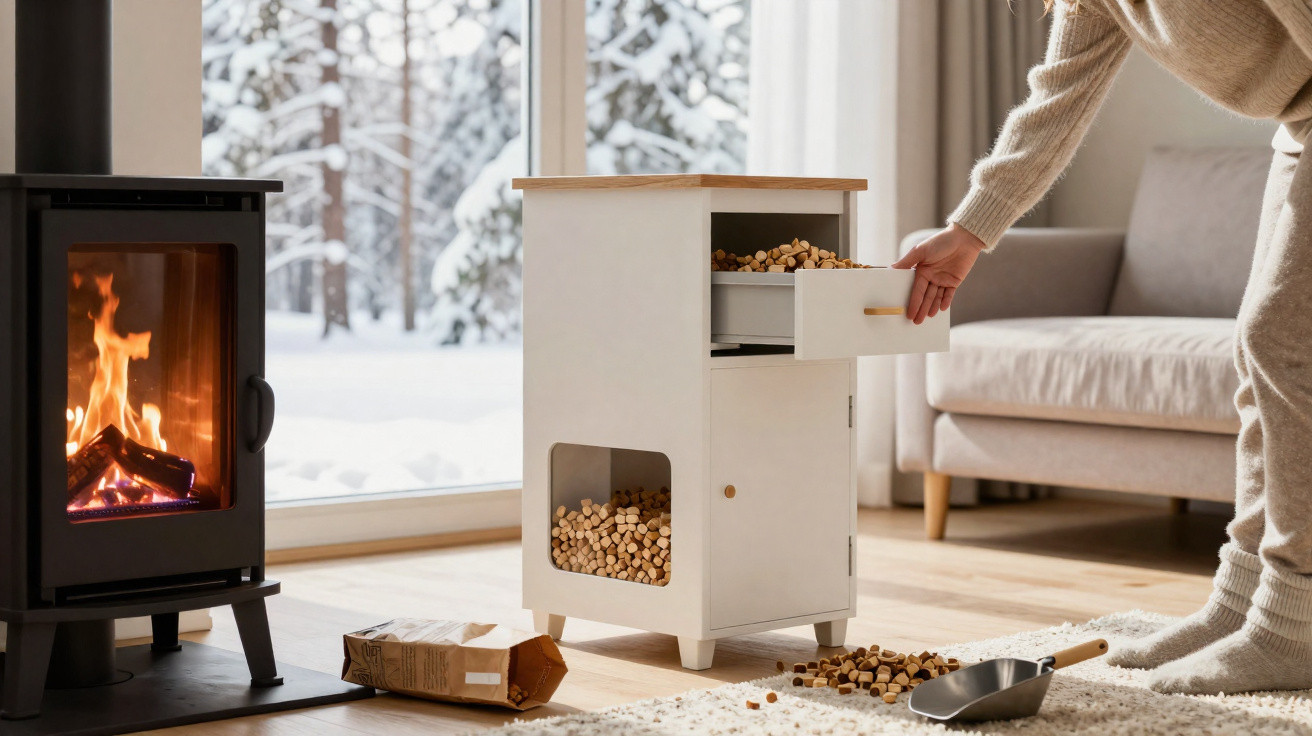
What surprises you the first time you see a dedicated pellet storage unit is how quiet and tidy the whole setup feels. No rustling bags, no visual clutter. Instead, there’s a tall container with clean lines-often metal or timber, sometimes fitted with subtle castors-placed neatly next to the stove. You tip the pellets in once, close the lid with a gentle “clack”, and the winter chaos seems to… vanish.
Ana and Louis, for example, live in a small town house with two children. Their Saturdays used to begin with what felt like a gym session: three runs to the garage to rebuild the living-room pile, then sweeping every time because a few pellets always found their way under the sofa. By February, they’d grown to resent the whole heating routine.
Last year, they went for a design-led storage unit that suited their black stove and oak furniture. It takes the equivalent of several bags, and a bottom trapdoor releases pellets straight into a scuttle. Now they top it up every few days, in about two minutes, without even leaving the room. The children have stopped playing “kick the pellet” on the floor, and the garage finally looks like a garage again-not a grain store.
The real shift with these units isn’t only aesthetic; it’s how they change the pace of your days. Rather than repeating the same fiddly, irritating job again and again, you turn it into one straightforward action. Your body registers it first: fewer bends, fewer cold carries, less dust in your lungs.
Then your mind catches up. The stove becomes a cosy centrepiece again, not a nagging reminder of bags waiting out back. A clever storage unit doesn’t just hide pellets, it gives back mental space you didn’t realise you’d lost to those plastic sacks. That’s the quiet part that feels genuinely game-changing.
The storage unit that feeds your stove and your free time
The first sensible move is picking a unit for how you truly live, not the ideal version of you who restocks every evening like a Pinterest photo. Be honest about your routine. Are you someone who does a quick top-up before bed, or do you prefer one big Sunday job and then forget about it? Capacity, height and access all hinge on that.
Most good pellet storage units use gravity: you pour pellets in at the top and they drop down to a scoop area or a small built-in drawer. More advanced options link straight to the stove via a flexible hose and an automatic feed system. You fill the reservoir once and the mechanism takes over. Instead of you serving the stove, it finally starts serving you.
Where many people go wrong is obsessing over looks and ignoring how they actually move around their own home. A tall, beautiful column can look perfect in a brochure, but if you’re 1.60 m tall and have shoulder pain, lifting a 15 kg bag above head height is asking for trouble. Consider the space above the unit, the clear width of the route to it, and whether children or pets will constantly be weaving around it.
Go easy on yourself here. Most of us have had that moment: you order the “ideal” item online and then realise it doesn’t suit the corner, the socket, or your everyday rhythm. And the truth is, nobody keeps up a flawless routine every single day. Winter is tiring enough. The right unit should remove friction, not create another thing to manage.
“Since we installed the new storage, I don’t even think about pellets anymore,” confides Marc, 47, who heats a renovated barn. “I just see the level through the small window when I pass by. When it’s low, I refill once, and that’s it. We stopped arguing about who forgot the bags in the car.”
- Pick a look that suits your stove
Metal with an industrial feel, timber with a Scandinavian touch, or a discreet white finish for a minimalist space. - Be realistic about capacity
How long do you want to go without handling a bag-two days, five, ten? Buy for that rhythm, not for an imagined one. - Plan placement before you commit to a model
Close to the stove, but not in the way of doors, sockets, or the route to the patio. - Look out for genuinely useful extras
Castors, an anti-dust seal, a transparent level strip, a child-safe latch, an integrated scoop. - Don’t over-engineer it
If a highly automated setup makes you anxious, a simple gravity-fed unit that still works during a power cut may be the better choice.
A different way to live winter at home
What people remember after switching to a proper pellet storage unit isn’t only the tidier room or the lack of crunchy bits underfoot. It’s the way winter evenings stop beginning with a chore. You get in, drop your things, press the stove button, and reach almost absent-mindedly for a clean, dry hatch-rather than wrestling with a heavy, damp plastic sack.
Gradually, this one practical object starts to soften household dynamics. Children can safely help fill a small bucket from the unit; grandparents don’t have to tackle slippery steps carrying 15 kg; and the person who used to be “responsible for the pellets” no longer bears that invisible burden alone. The stove becomes what it was supposed to be all along: a warm, shared centre-not a logistical headache.
There’s also a surprisingly soothing feeling in no longer seeing branded plastic bags building up in your space. In their place is a calm, elegant container that seems to say, without any fuss: “You’re ready. You’re warm. You can switch off.” And these days, that feeling is worth nearly as much as the heat.
| Key point | Detail | Value for the reader |
|---|---|---|
| Design-forward pellet storage | Clean lines, materials matching the stove and furniture, discreet integration in the living area | A living room that looks less like a warehouse and more like a cosy, intentional space |
| Time and effort saved | Larger capacity, grouped refills, gravity feed or semi-automatic systems | Fewer trips to the garage, less bending and lifting, more calm evenings by the fire |
| Daily comfort and safety | Less dust, fewer bags on the floor, easier access for all ages | A cleaner home, fewer arguments about chores, and safer movement around the stove area |
FAQ:
- Question 1 What capacity should a pellet storage unit have for an average household?
- Question 2 Can a design pellet storage unit work in a small flat?
- Question 3 Are automatic pellet feed systems dependable in the long term?
- Question 4 Does a storage unit genuinely protect pellets from damp and dust?
- Question 5 Is it worth spending the money compared with leaving pellets in their bags?



Comments
No comments yet. Be the first to comment!
Leave a Comment