
The pile begins with one envelope you’ll “deal with tonight”.
Then there is a delivery box you may need for returns.
Then come a jumper you tried on, a catalogue, your child’s drawing, and the random cable that “must be important”.
By Friday, the table corner has become its own little mountain range, and you are eating dinner with your plate wedged between a laptop and a pile of receipts.
You look at it with that familiar, muted combination of guilt and exhaustion.
It is not exactly dirty. It is simply… stuff.
Multiplying quietly while you are not paying attention.
You clear every last thing away on Saturday.
By Sunday night, another small pile has already started to grow.
There is a reason this pattern keeps repeating.
Why things pile up again (even when you just tidied)
Take an honest walk around your home and you will spot the pattern: piles form precisely where life is at its busiest.
On the hall console, because that is where you arrive each evening.
On the kitchen worktop, because you open post while the pasta is cooking.
On the sofa arm, because that is where you empty your pockets while watching Netflix.
These piles are not appearing by chance.
They are the footprints of your everyday routine, showing where life really takes place rather than where you would like everything to be perfectly organised.
So long as every category of item lacks a clear “home” at the point where you use it, the pile will reliably return.
Imagine this.
You declutter your desk on Sunday afternoon, put everything tidily into a drawer, and perhaps even label a box “misc”.
On Monday morning, you switch back into work mode at speed, throw down your headphones, and leave two pens, a coffee loyalty card and your pass on the newly clear surface.
By Wednesday, the beautifully cleared desk looks as though you never touched it.
A 2023 survey by a major storage brand found that almost 70% of people who “did a big tidy” saw clutter reappear within two weeks.
The reason mentioned most often? “I didn’t have time to put things away properly.”
In other words, the system they had put in place did not suit the pace and disorder of real life.
Clutter is seldom caused by too little storage.
It is caused by a disconnect between where items are supposed to live and where you genuinely use them.
If your reusable bags are stored in a box at the back of the pantry, they will not somehow make their way to the door when you head to the supermarket.
Your belongings continue to gather in piles because your existing organisation system demands too much from you.
There are too many steps, too much distance and too much thought involved.
A home that remains tidy is one in which objects can “fall” into their place with almost no effort.
When you begin to treat clutter as a design issue rather than a moral failing, everything changes.
How to stop the cycle of piles for good
Begin with a single “problem zone”, rather than attempting to tackle the whole house.
It could be the kitchen island, your bedside table or the chair that has become a coat rack.
Stand in that spot and think back over the previous three days.
What really lands there? Keys, post, receipts, masks, chargers, hair ties, or all of them?
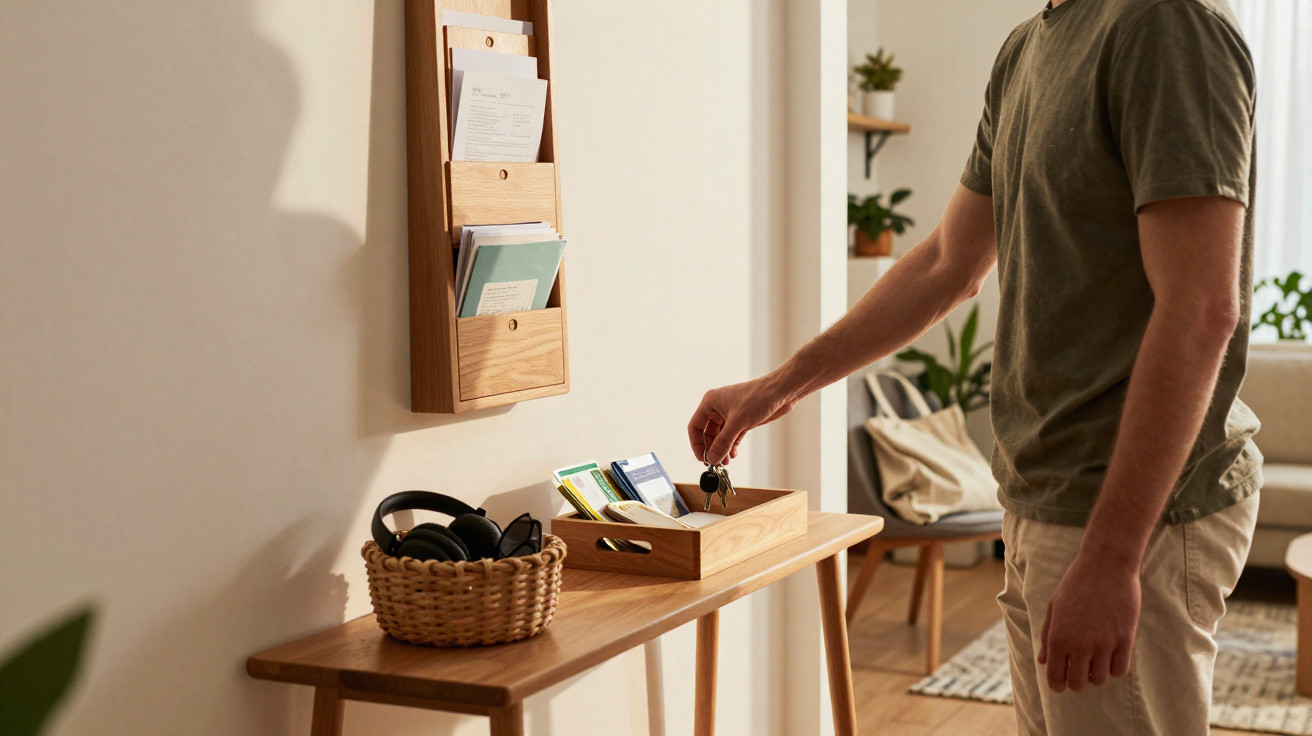
Next, do what almost nobody does: assign every type of item a default landing place within arm’s reach.
Use a shallow tray for post that still needs opening.
Add a hook for keys.
Keep a slim box for chargers and cables.
The aim is straightforward: when you put something down, it should already be landing in the correct place rather than merely ending up “somewhere on the surface”.
The usual error is trying to tidy as though your home were a magazine spread, rather than as a person who hurries, forgets things and gets home tired.
You buy attractive baskets, store items far away, and stay impressively disciplined for three days.
Then life intervenes, and the old routines quietly return.
Let us be realistic: nobody actually manages this every single day.
The routine of “I’ll just take two minutes to put everything back in its room every evening” sounds excellent in theory.
In reality, you need systems that still partly work when you are worn out, the children are shouting, work has overrun and you are having cereal for dinner.
When planning your storage, be considerate of that version of yourself.
One simple principle makes all the difference: your storage must be as easy as dropping things on a surface.
If it requires more effort, the pile will win.
“Clutter is not a cleaning problem, it’s a decision problem,” says a professional organiser I interviewed.
“Every object without a clear decision attached to it will naturally drift into a pile.”
- Place “transit zones” where piles tend to form: trays, bowls, small boxes and hooks.
- Label those zones in plain language: “Stuff to return”, “Bills to pay”, “To read this week”.
- Give every zone a physical limit; once the tray is full, it is time to deal with it.
- Choose shallow containers: deep baskets conceal clutter, whereas flat ones make it visible.
- Design for one lazy move only: toss, drop or slide, rather than stack, fold and walk.
Building habits that quietly keep clutter away
After the physical “landing zones” are established, move on to micro-habits.
These are tiny actions that are almost imperceptible.
They are not major routines or heroic cleaning sessions.
Test the “30-second rule”: if something genuinely takes less than 30 seconds, do it immediately.
Hang up your coat rather than leaving it on the chair.
Put your mug straight into the dishwasher instead of setting it “near the sink”.
Slide a receipt directly into the “finance” tray, rather than leaving it on the worktop.
Each action may seem insignificant alone, but repeated over a week, they are exactly what stops a new pile from starting.
Another effective step is to establish one realistic “decision ritual” each day: five minutes, no longer.
Just before dinner, or immediately after brushing your teeth, go to your worst clutter hotspot.
You are not there to clean deeply; you are simply answering small questions:
Keep, toss or move? Today, not someday.
We all know that moment when you look at a random cable, think “this might be useful”, then put it straight back in the pile.
Next time, say aloud: “Either I use this within a week, or it goes.”
That small deadline converts endless uncertainty into a clear choice.
As you look around your home now, you may realise that each pile is really a group of undecided matters.
Items that should be somewhere else.
Promises you made to yourself but never scheduled.
Memories you have not yet worked out what to do with.
The change begins when you stop battling piles and start interpreting them.
What does that recurring stack of papers reveal about your paperwork system?
What does that heap of clean clothes reveal about how realistic your wardrobe is?
At times, the answer is not “I need more willpower”.
It is “I need fewer clothes, fewer bills, fewer things that depend on me.”
The moment you arrange your home for the real you instead of the ideal you, the piles begin to shrink by themselves.
| Key point | Detail | Value for the reader |
|---|---|---|
| Design landing zones | Put trays, hooks and shallow boxes exactly where clutter forms | Items “fall” into place instead of creating new piles |
| Match storage to real habits | Keep belongings close to where they are used, requiring one simple action | Makes tidying nearly automatic, even on exhausting days |
| Use micro-decisions | Follow the 30-second rule and a 5-minute daily “decision ritual” | Stops build-up and keeps items moving rather than stagnating |
FAQ:
Why do my piles always come back after a big declutter?
A one-off clear-out does not alter the everyday route your belongings take. Without new landing zones and habits, daily life naturally fills the same places again.How many “landing zones” should I have?
Begin with 3 to 5 in your busiest areas: the entrance, kitchen, desk and bedroom. Too many zones become confusing, so make them straightforward and clearly labelled.What if other people in my home don’t follow the system?
Make the system as effortless as dropping things anywhere. Use obvious containers in natural locations, and explain the rule in one sentence: “Everything lands in a tray, never loose on the surface.”Do I need to get rid of lots of stuff first?
Decluttering is helpful, but you can begin with structure. Create zones, then let them show you which things you never use, and gradually let those go.How long until the piles really stop?
You should notice a difference within a week if you use your new landing zones and complete the daily 5-minute check-in. Stability generally arrives after a month of repeating the same small actions.


Comments
No comments yet. Be the first to comment!
Leave a Comment