
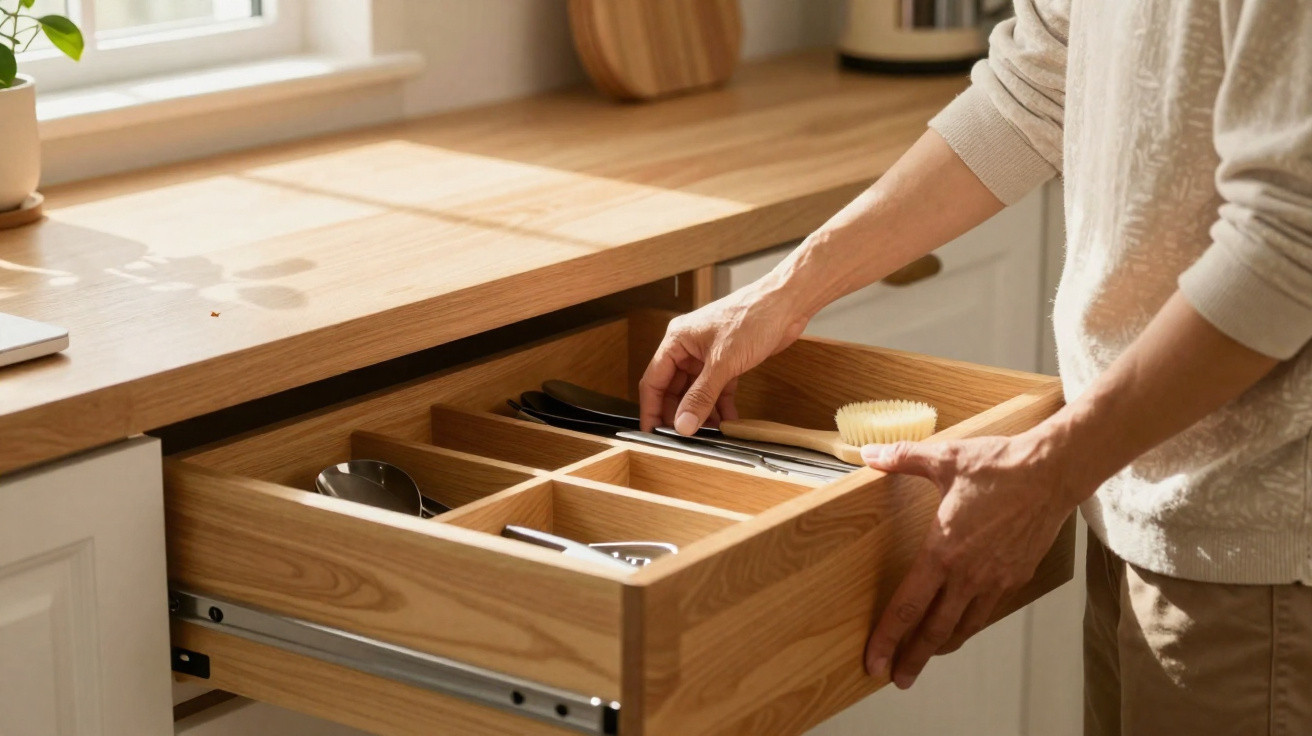
It often begins with a petty, absurd battle against a piece of furniture. You open a drawer to fetch a T-shirt or a fork, only for it to halt halfway like a stubborn mule. You pull more firmly, the entire unit shakes, something clatters at the back, and there you are: bent over, annoyed, and wondering how your home has somehow got the better of you.
You can already guess what is inside: socks crammed at the rear, assorted chargers, an unidentified pen, and a notebook from three years ago. Everything is squashed together in a way that seems to ignore both physics and common sense.
Still, each week you push the drawer closed and tell yourself, “I’ll deal with it later.”
One very small habit quietly determines whether that drawer slides smoothly or gets stuck.
The real reason drawers jam isn’t what you think
When a drawer sticks, most people blame the runners, poor-quality furniture, or a single misplaced item blocking it. It seems like a mechanical issue: failed hardware or flawed design.
Yet most jammed drawers are not caused by bad furniture. They result from the way we load them. We put things in “for now”, shove a pile slightly aside, then give the drawer an extra push to close it. Over the following weeks, items move, lean and collapse against one another. The drawer never has much chance.
The problem really begins the first time we shut a drawer full of disorder.
Think of a standard kitchen “everything” drawer. It may begin with cutlery alone. Then come a takeaway menu, scissors, a tape roll, elastic bands, a lighter, three unidentifiable keys, and that plastic piece you hesitate to discard in case it turns out to be essential.
One evening, before guests arrive, you close it a little too forcefully. A wooden spoon turns over. The tape roll shifts. The scissors slide on the diagonal. The following morning, you pull the handle and the drawer stops two-thirds open. You tug harder. The spoon catches against the frame, while the runners scrape and protest.
A drawer is not ruined by one enormous mess. It is undone by the small, quiet avalanches happening inside it.
As soon as a drawer is even slightly too full, every opening and closing rearranges its contents. Objects lift and tilt like tectonic plates. Soft items climb over hard ones, taller things fall over, and one minor movement can make something catch on the frame or runner.
From the outside, all you see is a stuck drawer front. Inside, however, a slow-motion chain reaction of badly positioned belongings is taking place. The biggest culprits are usually items that should not be in that drawer at all: cables with socks, or tools with tea towels.
The habit that prevents drawers jamming is not about buying improved runners. It begins in the three seconds before you shut them.
The simple “last glance” habit that keeps drawers sliding
This is the small action that makes the difference: before closing a drawer, stop for one second and use your hand to flatten the top layer. That is all.
It is not a major tidy-up or a 30-minute decluttering task. Simply sweep your palm lightly across the items on top, pressing down anything standing upright, moving loose corners back into position, and clearing the front edge so that nothing rests against it.
Perfection is not the aim. You are merely giving gravity a helpful reset, so that the next time you open the drawer, nothing tumbles into the runners.
A reader told me she began doing this with her children’s chest of drawers. Each evening, after they had taken out pyjamas and socks, she gently passed her hand over the pile. T-shirts were nudged into a roughly flat stack, socks were moved away from the front lip, and stray toys were taken out rather than crushed inside.
After three weeks, she noticed something unusual: the drawers had not jammed once. There was no more pulling or small hands getting trapped as they tried to force drawers open. Even the runners sounded smoother, because nothing was rubbing against them from within.
She had not bought any new furniture. She had simply introduced a three-second “hand sweep” while standing in the very same place as usual.
The reasoning is straightforward. Drawers jam when loose or tall items tip upwards or forwards into the frame. Smoothing the surface before closing stops that tipping process before it begins.
It is much like a suitcase that zips more easily after you press down its lid. You compress the disorder just enough to allow it to move. There is no fuss, no major task, only a small reset.
Realistically, nobody does this without fail every day. But on the days you remember, your drawers tend to work as they did when new.
How to turn this tiny move into an everyday reflex
To make the habit automatic, connect it with something you already do. Whenever you take a T-shirt, put away cutlery, or store batteries in the “junk” drawer, finish in the same way: one look, one sweep.
Check the front row of items. If anything rises above the rest, press it down or move it sideways. If a taller object is leaning against the front, shift it to the side or towards the back. Shut the drawer gently, rather than creating another miniature avalanche.
Within a few days, this one-second check can become as instinctive as switching off the light when you leave a room.
Most of us get caught by two habits. First, we treat drawers as hidden caves where mess somehow does not matter: out of sight, out of mind. Secondly, we wait until a drawer has completely jammed before we give ourselves permission to sort it out. At that stage, it has become a full project rather than a small gesture.
A more forgiving approach is to accept that drawers will always collect miscellaneous things. A filling drawer does not mean you have failed. You simply need to adjust the closing routine. One gentle press of your hand can often prevent the need for a full-body tug later.
The aim is not a Pinterest-perfect interior; it is a drawer that opens when you need a clean spoon at 7 a.m.
“Changing how a drawer behaves is rarely about buying a new one,” says a professional organizer friend of mine. “It’s about the tiny moves you repeat without noticing. A one-second reset beats a once-a-year purge every time.”
- Before closing, flatten the top layer with your hand.
- Store tall or rigid objects at the sides or back, never at the front.
- Keep a small “empty zone” along the front edge to act as a sliding lane.
- Take out obvious intruders, such as tools, cables and random junk, rather than forcing them in.
- Close the drawer carefully instead of slamming it and sending everything forwards.
When small habits quietly change how your home feels
There is something unexpectedly pleasing about a drawer that glides open without resistance. It is a small luxury, suggesting that your home is not working against you. And it comes from one of the tiniest habits imaginable.
This “last glance, quick sweep” does more than stop jams. It changes how you view concealed storage spaces. Rather than seeing them as dumping grounds, you begin to see them as small systems that you can guide lightly every day, without any drama.
With time, you may spot a wider effect. You become slightly more deliberate about what you put inside. The spare battery finds a home, while the lone screw no longer lies loose among pens and receipts. One drawer starts behaving, then another, then another.
Try it for a week and you will soon know whether it suits you. Your hands may remember the routine before your mind does. Then, the next time a drawer opens in one smooth, quiet movement, you will have that small private victory that nobody else needs to notice.
| Key point | Detail | Value for the reader |
|---|---|---|
| One-second “hand sweep” | Flatten the top layer and clear the front edge before closing | Reduces jams and protects runners without major decluttering |
| Place items by height | Keep taller or rigid objects at the sides or back, not against the front | Prevents objects from catching on the frame when opening |
| Gentle closing ritual | Close drawers calmly instead of slamming, to avoid internal landslides | Extends furniture life and keeps drawers sliding smoothly |
FAQ:
- Why do my drawers keep jamming even when they’re not full? Usually, it is not about the amount inside but the height and placement of a few objects. Even in a half-empty drawer, one tall item leaning forwards can catch on the frame and prevent it from sliding.
- Do I need special organisers or dividers? They can be useful, but they are not necessary. For standard drawers, the one-second “hand sweep” and placing taller items at the sides or rear already address most jamming problems.
- What should I do with junk drawer chaos? Begin by removing only the clearly misplaced things: tools, loose hardware and cables you never use. Then use the quick flatten-and-close routine each day instead of waiting for a major clear-out.
- My runners are already damaged. Will this still help? This habit will not repair broken runners, but it can prevent further strain because you will avoid pulling and forcing the drawer whenever something catches.
- How long before I notice a difference? Most people find that drawers feel smoother within a few days, as objects stop moving forwards or upwards into the path of the slide whenever the drawer is opened and closed.


Comments
No comments yet. Be the first to comment!
Leave a Comment