
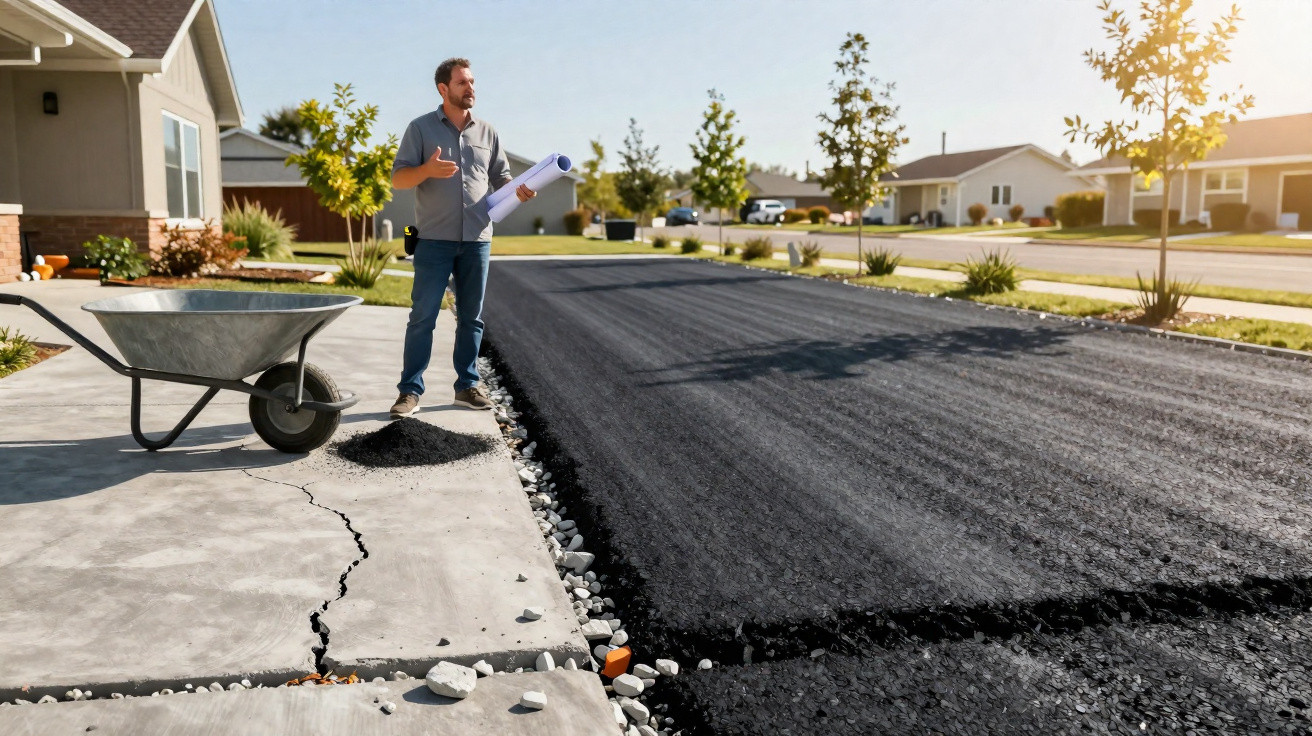
Many driveways look more like car parks than gardens – grey, cracked and hot.
A cheaper, greener alternative is now steadily pushing concrete aside.
Anyone planning to renew their driveway will almost automatically consider the traditional option: a new grey concrete slab. It is expensive, impermeable and supposedly built to last forever. Yet rising prices, overflowing drains during heavy rain and new environmental rules are increasingly undermining that model. Two recycled surfacing materials are quietly moving to the fore: they reuse existing resources, allow rainwater to soak away and can ease the pressure on household budgets considerably.
Why traditional concrete slabs now seem outdated
For decades, concrete was seen as the safe choice: hard-wearing, supposedly low-maintenance and “permanent”. Today, however, its climate and cost impacts matter far more. Cement, concrete’s main ingredient, generates huge quantities of CO₂. Industry sources estimate that cement production accounts for just under ten per cent of global emissions, for a material often chosen simply because it appears “practical”.
Sealed surfaces create a second major issue. Large, solid concrete slabs do not allow water to penetrate the ground. Heavy rainfall runs across the surface, flooding driveways and roads and, in extreme cases, basements. Cities and local authorities are under intense pressure from targets such as “net-zero land sealing” to reduce impermeable areas or design them more intelligently.
Concrete slabs are expensive, impermeable and carbon-intensive – and are becoming less compatible with current requirements for properties and local authorities.
Concrete is also becoming more financially complicated. In some countries, a properly installed concrete driveway costs around €85 to €160 per square metre, including formwork, reinforcement and extensive groundwork. There is also the risk of cracking. Once a slab splits, repairs are often costly and visually obvious, or the entire surface may need replacing.
Recycling asphalt: a hard-wearing driveway made from old roads
One of the most promising alternatives is recycling asphalt, known in technical terminology as RAP (Reclaimed Asphalt Pavement). The principle is straightforward: old road surfacing is milled off, crushed and reprocessed with a binder. The result is a durable dark surface that closely resembles a conventional asphalt driveway.
The environmental advantage is clear: instead of sending old road material to landfill, it is returned to the material cycle. This reduces the raw materials, energy and water otherwise required to produce new asphalt mixes. Reuse also puts less pressure on gravel pits and quarries because less virgin aggregate needs to be extracted.
Durability and everyday performance
Depending on use and installation quality, asphalt surfaces – including recycling asphalt – generally last between 15 and 30 years. They respond more flexibly to changing temperatures than rigid concrete slabs, making major stress cracks less common. In many cases, smaller cracks can be repaired without digging up the whole area.
This makes it an appealing option for domestic driveways. The surface can carry the weight of cars, is easy to clean and remains relatively resistant to frost. Its load-bearing capacity is particularly useful for households that regularly manoeuvre vehicles or use motorhomes, trailers or delivery vehicles.
The cost of a recycling asphalt driveway
Recycling asphalt is clearly less expensive than solid concrete. In many areas, professionally installed asphalt driveways, including excavation work, typically cost roughly €26 to €72 per square metre. Standard surfacing usually falls in the middle of that range, while specialist versions cost somewhat more.
- Standard asphalt (hot-laid): mid-range pricing, stable and well proven
- Porous asphalt: a permeable surface that absorbs rainwater more effectively, generally from around €50 per square metre
- Plant-based binder: replaces part of the petroleum-based binder; usually costs up to around 20% more, but offers a better CO₂ balance
Compared with a high-quality concrete slab, this can save roughly one third to one half of the cost while offering similar day-to-day usability.
Crushed concrete: an affordable, permeable option for long driveways
The second alternative may sound less exciting, but it has considerable potential: crushed concrete. Old concrete slabs or structural components are completely broken up, stripped of reinforcing steel, cleaned and crushed into aggregates of different sizes. The finished material often contains remnants of sand, natural stone and mortar – a mix that becomes stable once compacted.
Unlike a continuous slab, crushed concrete creates a layer of broken aggregate with voids between the particles. Rainwater drains through these gaps rather than flowing over the surface towards the road. For people living in areas affected by recurring heavy rain or overloaded drainage systems, it can actively help reduce the burden.
Crushed concrete combines recycled content, permeability and low cost – making it ideal for long driveways or those where appearance is less of a priority.
A price advantage over gravel and natural stone
As it is made from demolished concrete, the material is often considerably cheaper than new gravel or crushed natural stone. Depending on regional availability, crushed concrete can cost up to 50 per cent less. This makes it especially attractive for long access roads, yards or parking areas, where every square metre adds to the bill.
A layered construction is typical: coarser aggregate forms the bottom layer, followed by a finer upper layer that compacts more effectively. This creates a relatively even surface that remains easy to drive over.
Maintenance, daily use and one drawback: dust
Maintenance is closer to that of a gravel drive than an asphalt surface. Regularly sweep or blow away leaves and twigs, fill any holes that develop with fresh material, then compact it using a vibrating plate or hand tamper – that is usually all that is required.
One disadvantage remains: dust. Particularly with frequent use and at higher speeds, vehicles can stir up fine particles. They settle on wheel arches, in garages and sometimes even in entrance halls. Anyone who finds this troublesome should ensure the top layer is very well compacted, compact it more often, or plan a small paved area immediately outside the front door.
For weed control, many people turn to household mixtures containing vinegar, coarse salt and washing-up liquid. Experts particularly warn against the salt: it acts like a soil steriliser and can permanently damage plants. Using such mixtures only on completely sealed surfaces, such as asphalt or stabilised aggregate, substantially reduces the risk to neighbouring beds and lawns.
Which surface suits which property?
There is no outright winner between recycling asphalt and crushed concrete. The best choice depends heavily on use, appearance and budget. Several key questions can help with the decision:
- How heavily will the driveway be used? Several cars, delivery traffic or motorhomes generally favour asphalt.
- How important is a tidy appearance? Smooth, dark surfaces look calmer and more finished than loose aggregate.
- How long is the driveway? For very large areas, low per-square-metre prices matter most – and crushed concrete performs well here.
- How critical is surface water? Properties prone to puddles and flooding should consider permeable options.
- How much noise is acceptable? Gravel-like surfaces are generally noisier under vehicles than asphalt.
Keep legal requirements and technical details in view
Many local authorities now award points or offer incentives for unsealed or partly permeable surfaces. In some new-build developments, concepts such as rainwater management, infiltration basins and rainwater tanks already matter more than the driveway’s appearance alone. Anyone undertaking renovation work can factor in these requirements from the outset and avoid costly alterations later.
Technically, the sub-base is crucial. Whether choosing asphalt or crushed concrete, every driveway will become a continual repair project without a load-bearing, frost-resistant foundation. Frost heave, settlement and potholes can be greatly reduced through proper excavation, compacted aggregate layers and, where necessary, a separating geotextile layer. Cutting costs in the wrong place quickly proves expensive.
Practical examples: useful combinations for greater comfort
In practice, mixed solutions often combine cost, appearance and comfort effectively. Options include:
- Asphalt wheel tracks with a planted central strip: the wheels run on a firm surface, while grass or ground cover between them adds greenery and drainage.
- Crushed concrete for the long approach, paving at the entrance: more expensive materials are concentrated where they are most visible and important for walking.
- Porous asphalt with an adjacent rain garden: some water drains away directly, while excess flows into a planted hollow that helps absorb heavy rainfall.
Planning these combinations allows investment to be targeted precisely and often creates a far more pleasant microclimate outside the home: less heat-retaining surface in summer, fewer icy patches in winter and more greenery instead of a grey slab.
Key terms explained briefly
Permeable surface: A surface finish that lets rainwater soak into the ground or releases it gradually, rather than allowing it all to run off across the surface.
Recycling asphalt (RAP): Reprocessed road surfacing made from milled old asphalt. After crushing and mixing with binders, it becomes a new wearing course for roads, yards and driveways.
Crushed concrete: Broken recycled concrete from demolition work, used as a substitute for aggregate in road and path construction, for driveways or as a sub-base.
Anyone wanting to get rid of the grey concrete wasteland outside their home no longer faces a simple either-or choice. Recycling asphalt and crushed concrete offer two materials that reduce costs, manage water more effectively and significantly shrink a driveway’s environmental footprint – without forcing the car to stay outside.



Comments
No comments yet. Be the first to comment!
Leave a Comment