
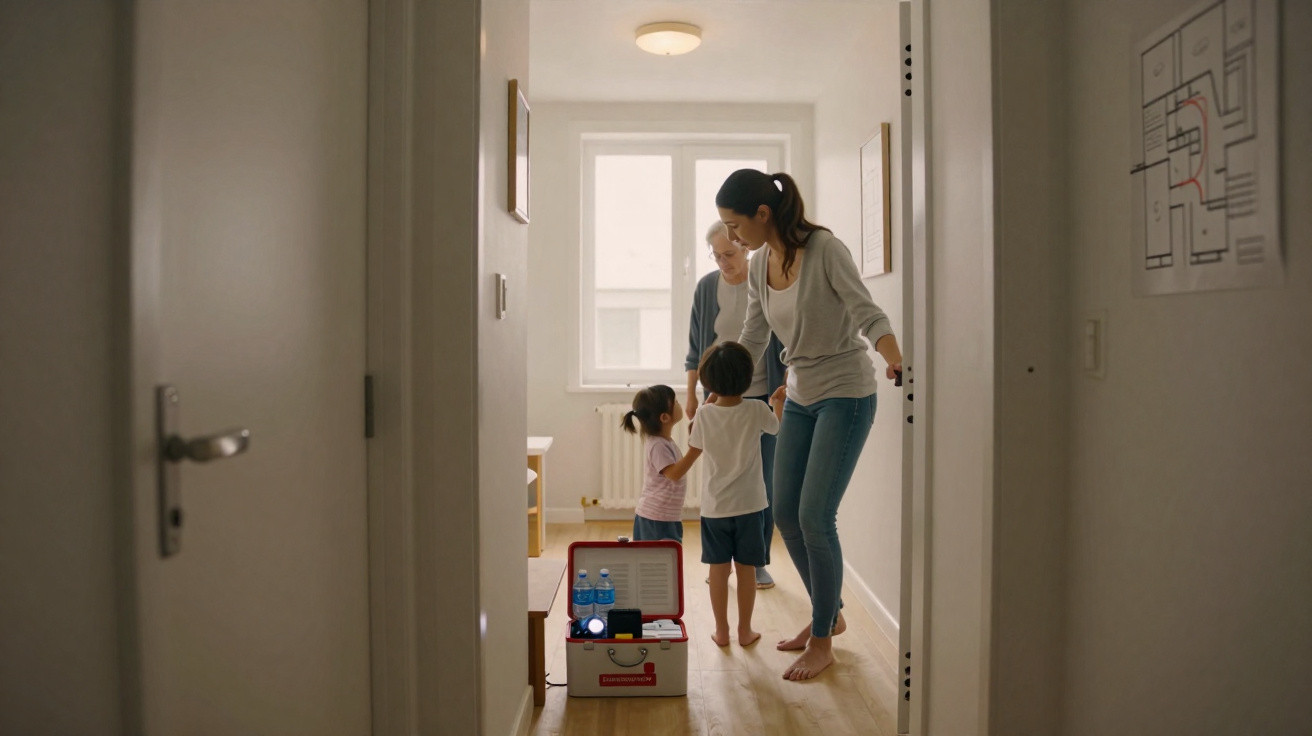
Rushing off blindly wastes crucial seconds – and can often compromise your safety in your own home.
In an emergency, every action matters. Civil protection experts advise taking shelter inside the building rather than sprinting outdoors. Close doors, switch off ventilation and follow updates via radio or a warning app. Yet one question remains at home: which room offers the best protection against blast waves, debris and radioactive fallout?
Why the basement is often not a safe refuge
An ordinary basement is not armoured against blast waves. It often lacks sufficient load-bearing structures, while the weight above may give way during severe vibrations. Small ground-level windows can easily become entry routes for blast pressure and flying fragments.
Sealed basement rooms can also allow heavy gases to accumulate. Smoke, CO₂ and other contaminants sink downwards and remain there for longer. In poorly ventilated basements, completely sealing every opening can noticeably increase the risk of suffocation.
Shelters operate differently. A genuine bunker has reinforced walls, pressure-resistant doors and its own filtered air supply. An improvised storage cellar cannot replace this equipment.
A basement only provides reliable protection when it has been designed and equipped as a shelter. In an alarm situation, a standard domestic basement should not be the first choice.
How the building core offers better protection
Researchers at the University of Nicosia modelled the blast wave from a nuclear detonation of around 750 kilotonnes occurring several kilometres above ground. No room can be survived in the immediate vicinity of the explosion. Further away, however, a person’s position within the building affects the likelihood of injury.
Areas near windows, external doors and long corridors accelerate the air blast. Fragments travel farther and strike with greater force in these locations. Corners away from such openings noticeably weaken the wave because they do not provide it with a direct path.
Mass also matters for radiation protection. Every solid brick or concrete wall reduces the dose of ionising gamma radiation. The more material there is between your body and the outside air, the lower the exposure. A thick concrete wall measuring 15–20 centimetres, or several internal walls in succession, can reduce the dose by orders of magnitude compared with being outdoors.
The aim inside a building: increase your distance from windows, place several walls between yourself and the outside, and stay within the inner building core.
Finding the safest room in seconds
The term for this area is the building core. It means the central part of the floor plan, away from exterior walls. In many homes, windowless bathrooms, storage rooms, walk-in cupboards or a central hallway are suitable.
- Eliminate every room with windows or large glazed areas.
- Picture the floor plan as crosshairs and aim for its centre.
- Select a small room with solid walls, ideally near a water source.
- In a block of flats, favour a middle floor rather than the top floor or a level at street height.
- Shut all doors and windows in the home, then turn off ventilation, air conditioning and the extractor fan.
- Seal the shelter area’s door gap with damp towels, but do not cut off the air supply completely for hours.
- Crouch in a room corner opposite the door, with your back against an internal wall and clothing cushioning your head.
| Room type | Protection from blast wave | Protection from radiation | Risks | Recommendation |
|---|---|---|---|---|
| Windowless bathroom | Good: short surfaces and no windows | Reduced by several walls | Confined space | Highly suitable |
| Central hallway | Good if short and without an external connection | Sound if surrounded by rooms | Open ends can act as channels | Suitable; close off the ends |
| Ordinary basement | Uncertain due to structural weaknesses | Partly reduced by surrounding earth | Gases, collapse loads, ground-level windows | Not the first choice |
| Shelter/bunker | Very good: pressure-resistant structure | Very good: substantial enclosure | Only available where designated | Best choice |
| Top floor | Poor: close to the building exterior | Limited shielding | Heat, fragments, risk of collapse | Avoid |
What to keep in a small emergency kit
- A wind-up or battery radio with spare batteries for official announcements.
- Drinking water for 48 hours and high-energy snack bars.
- A torch, power bank and a paper list of important telephone numbers.
- Adhesive tape, bin bags and cloths for sealing door gaps.
- A first-aid kit, personal medicines and a spare pair of glasses.
- FFP2 masks to reduce dust inhalation during a brief move between rooms.
- Take iodine tablets only on the explicit instruction of the authorities.
What matters after the detonation: hours one to twelve
Remain in the shelter room until the authorities advise otherwise. Every extra hour spent indoors significantly lowers your dose compared with being outside.
Avoid looking outside. Curtains and low furniture positioned in front of window fronts can stop fragments if a pane does break.
If you must briefly leave the shelter area, plan every movement. Keep the time spent outside it as short as possible and stay within the interior of the building.
When returning from outdoors, remove your clothing at the entrance. Seal the items in an airtight bag, then shower using lukewarm water and soap. Do not scrub your skin raw.
Keep pets indoors and gently brush their fur. Feed animals only packaged food and water from sealed containers.
Choose packaged foods wherever possible. Wait for advice on drinking-water safety before using tap water.
Planning your building core today
Mark the best room on your home’s floor plan. Keep a small mat and blanket there. Store the radio, torch and water within easy reach rather than in the basement.
Check how to quickly switch off ventilation, air conditioning and the extractor fan. Place cloths or sealing tape in the shelter room to seal door gaps.
Key terms for quick decisions
A blast wave is the rapid air surge that follows a detonation. It shatters windows, forces doors open and throws fragments through rooms. Ionising radiation is produced directly at the point of explosion and as fallout from material thrown up by the blast. Gamma radiation penetrates deeply, but loses strength with every wall it passes through.
The building core is the centre of the floor plan. It is located far from the façade, behind several internal walls, often around the bathroom, kitchen or storage room.
A short thought exercise for your home
Imagine you live on the third floor of a reinforced-concrete building. The windowless bathroom is centrally located, separated from the stairwell by two internal walls and from the street by three. Exposure in this room is drastically lower than in the balcony area because there are no windows to shatter and several layers of walls reduce radiation. Here, a cramped space offers better protection than a large living room with a glass frontage.
These principles are useful not only in nuclear emergencies. During chemical incidents or serious fires, the building core can also provide an effective place of refuge until emergency services issue specific instructions.

Comments
No comments yet. Be the first to comment!
Leave a Comment