
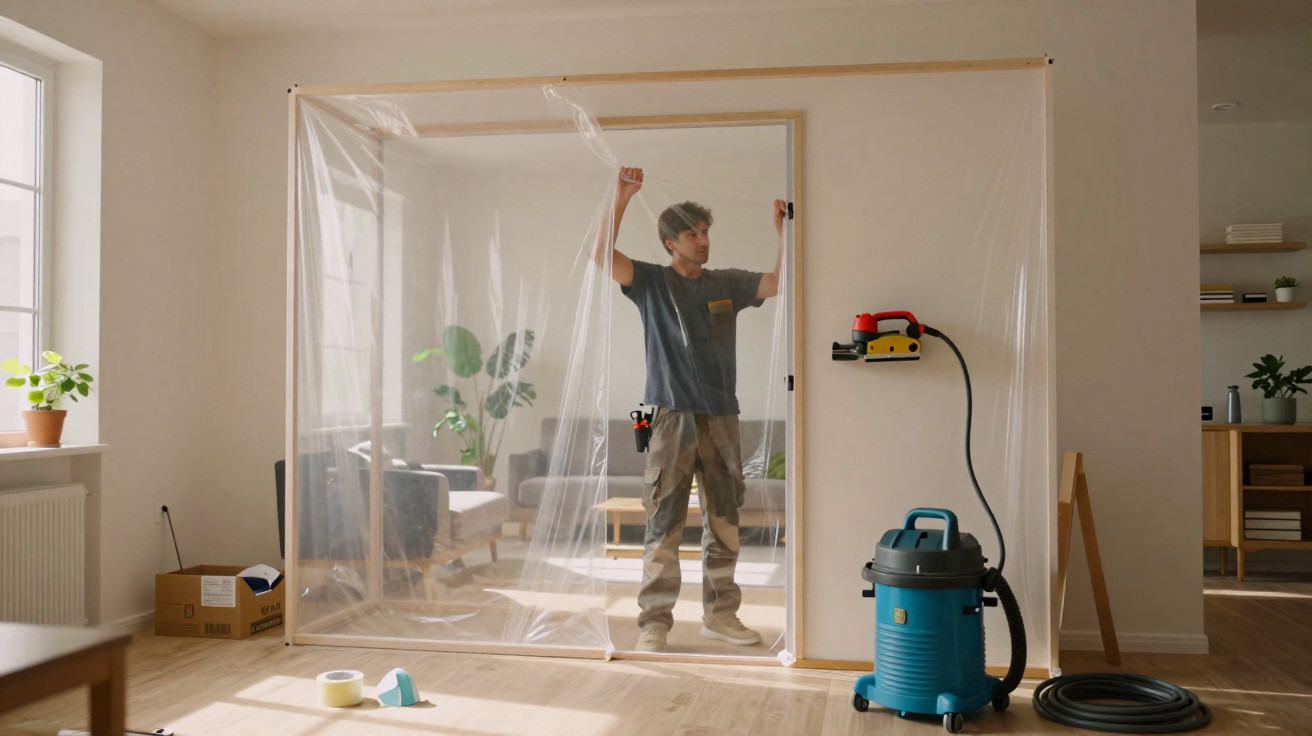
On building sites in France, some tradespeople have devised a remarkably simple way to sand surfaces without turning an entire home into a cloud of dust.
The specialist website behind the video showcases a practical technique used by construction professionals. Its purpose is to keep sanding dust to an absolute minimum – a major nuisance for both occupants and tradespeople. The publication explains how a basic arrangement, made with everyday equipment, can make indoor renovation work far more comfortable.
A job-site solution for keeping the home breathable
The footage was recorded during a French renovation project in a flat being repainted. Before the final coat can be applied, the professionals need to sand filler and walls. This is the messiest stage: plaster and paint dust spreads everywhere, works its way into adjoining rooms, settles on furniture and floors, and can remain airborne for a long time.
The specialist construction outlet demonstrates how tradespeople created a straightforward device in just a few minutes to reduce this indoor pollution without buying expensive machinery. The aim is not to eliminate every trace of dust, but to retain as much as possible at the point where sanding takes place.
“On the site shown, the tradespeople manage to sand an entire wall while leaving the rest of the flat virtually untouched, thanks to a simple makeshift set-up.”
Professionals have shared this kind of tip amongst themselves for years. However, the footage published by the outlet makes it especially easy to understand for a wider audience, including DIY homeowners, self-employed tradespeople, painting firms and plastering companies.
The simple set-up for sanding without coating the whole flat
A contained work area made with an ordinary plastic sheet
The first rule is to establish a clearly defined “dirty zone”, rather than allowing dust to travel through the entire property. The tradespeople stretch a lightweight plastic sheet, like the protective sheeting used for painting. It is secured from floor to ceiling to separate the room, or the section of wall, being sanded.
- The sheet is unrolled from the ceiling down to the floor.
- It is taped to the walls and around the doorway.
- Openings are kept as small as possible to prevent dust escaping.
This lightweight barrier creates a form of improvised booth. In some situations, the tradespeople cut it to frame the exact area requiring sanding – such as a full wall – while the rest of the room stays protected behind the plastic.
A continuously running vacuum cleaner creates slight negative pressure
The second principle is to remove dust as soon as it becomes airborne instead of waiting for it to settle. In the video, a site vacuum is connected inside the enclosed area. Its hose runs beneath the sheet, or through a small taped-up opening, to maintain a seal.
The machine operates throughout the sanding work. It has two functions:
- it collects a substantial proportion of airborne dust;
- it produces slight negative pressure in the working area, preventing dust from escaping into other rooms.
“By combining sealed sheeting with permanent extraction, the tradespeople turn an ordinary room into an almost airtight sanding booth with minimal equipment investment.”
Some professionals even connect the vacuum to a sander fitted with a dust-extraction attachment. Although the arrangement remains improvised, it greatly reduces the amount of dust settling throughout the home.
Restricted access and appropriate working habits
The footage also highlights a frequently overlooked point: the tradespeople avoid repeatedly opening and closing the plastic barrier. Each opening allows some dust to escape into the rest of the property. They therefore favour:
- one single entrance to the sanding area, closed with a taped flap;
- as few trips in and out as possible;
- a basic clean within the enclosed space before taking it down.
This very simple approach makes the set-up more effective. When dismantling it, the sheet is rolled inwards to trap as much dust as possible before being discarded.
Why sanding dust causes so many difficulties
This method is popular because sanding dust is one of the main sources of friction on occupied building sites, as professional bodies regularly point out. It gets into cupboards, damages fabrics and electronic devices, and requires lengthy, thorough cleaning.
For occupants, the problem is both practical and health-related: an irritated throat, a feeling that the air is “heavy”, and the impression that everything is constantly dirty. For tradespeople, dust increases cleaning time and the likelihood of a dispute with the client.
“Reducing dust is not simply a matter of comfort: it is also a way to cut disputes and the hidden costs of building work.”
Fine plaster or filler dust can remain suspended in the air for a considerable period. Without containment or extraction, it spreads even into rooms supposedly “protected” by sheets or old coverings placed over furniture.
Professional equipment is available, but it remains expensive
On major projects, some firms invest in prefabricated sanding booths, air extractors with very fine filtration, or high-end sanders connected to dedicated vacuum systems. While effective, these options are costly and are not always suitable for smaller renovation jobs in private homes.
The set-up shown by the specialist outlet follows the same principles – containment and extraction – but uses much more accessible means:
| Principle | High-end solution | Job-site tip |
|---|---|---|
| Containment | Modular booth or rigid partitions | Taped plastic painting sheet |
| Extraction | Air extractor with a high-performance filter | Site vacuum running continuously |
| Access management | Airtight-closing doors | A single opening in the sheet, resealed with tape |
For many tradespeople, this compromise is the most realistic choice in an occupied home, where the whole flat cannot be turned into a heavy-duty work zone.
How to adapt this set-up at home without taking risks
DIY homeowners can take inspiration from this method, provided they remain cautious. Professionals consulted by the outlet stress several precautions:
- Use sheeting thick enough not to tear while it is being fixed in place.
- Tape the edges thoroughly, particularly around doorways and skirting boards.
- Ensure reasonable ventilation in the home outside the contained area.
- Wear a mask suitable for fine dust and protective goggles.
- Do not operate an electrical appliance in a completely sealed, poorly ventilated area.
This kind of arrangement is not a substitute for appropriate personal protective equipment or, on large projects, professional dust-extraction systems. Its main benefit is limiting the mess in a flat where people may still be living while renovation work is under way.
French regulations and working practices
In France, dust control on construction sites forms part of the wider framework for preventing occupational risks, governed by the Labour Code. Building firms must protect employees from inhaling dust, particularly where it contains hazardous substances such as crystalline silica or asbestos.
For standard painting and filler work, the rules mainly concern:
- wearing suitable filtering masks while sanding;
- using sanding machines with built-in extraction where possible;
- limiting the time employees spend in very dusty atmospheres.
Good-practice guides issued by professional bodies strongly recommend containing work areas on occupied sites by installing screens or sheeting and planning rigorous cleaning. The arrangement highlighted by the specialist outlet follows this approach in an improvised but effective form.
Sanding, fine dust and health: useful reference points
The term “fine dust” refers to particles so small that they can penetrate deep into the respiratory system. Some come from dangerous materials and require very strict controls, particularly asbestos. When simply sanding filler or plaster that contains no specific hazardous substance, the risk is lower, but repeated inhalation can still be uncomfortable and potentially irritating.
Where possible, construction professionals favour mechanical sanding with extraction rather than manual sanding without dust capture. Combined with a “sheeted booth” arrangement, this option reduces the amount of dust circulating in the air and therefore the inconvenience for both workers and household occupants.
This combination of work-site containment, continuous extraction and suitable working practices shows that even a simple painting project can become more comfortable without requiring an expensive range of equipment. For a French homeowner facing renovation work at home, understanding this kind of set-up also makes it easier to speak with a tradesperson and request practical dust-control measures, rather than having to endure a flat entirely covered in white powder after sanding.




Comments
No comments yet. Be the first to comment!
Leave a Comment