
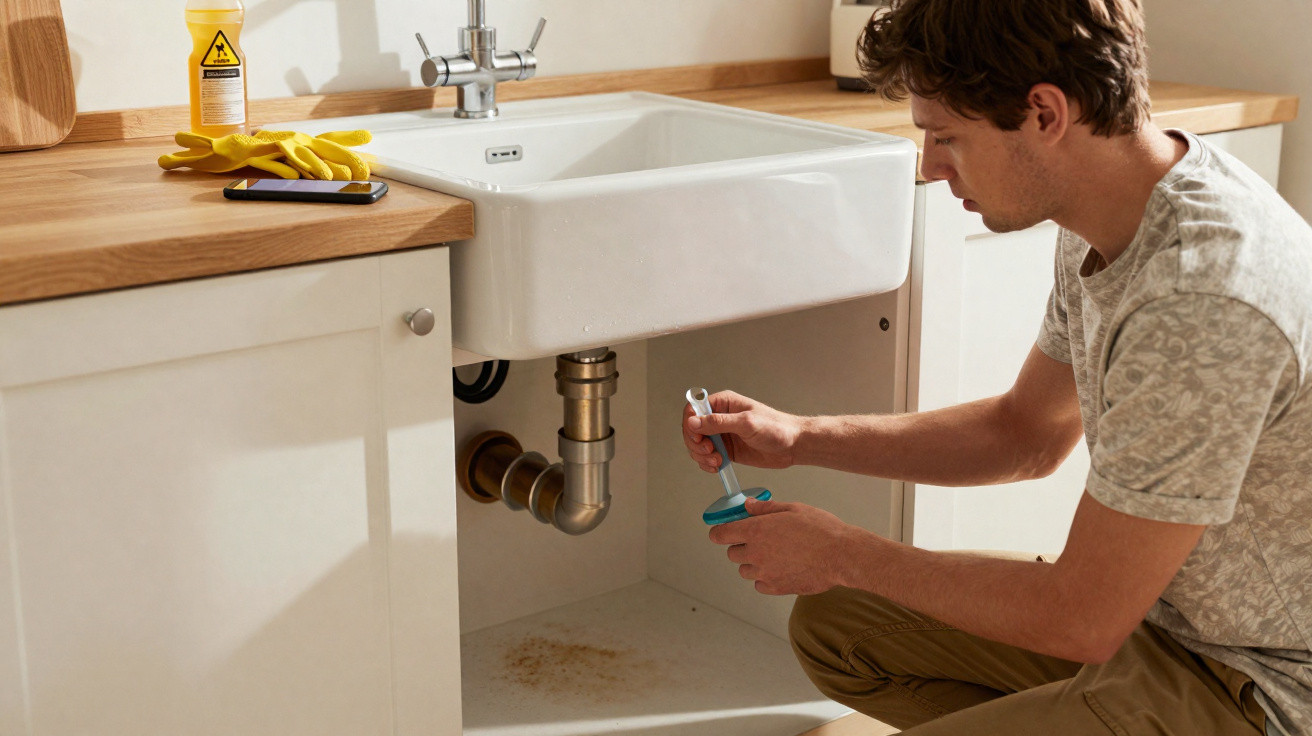
The plumber had scarcely shut the door before the noise returned: that slow glugging from the kitchen sink, as though the house were struggling to swallow. Fifteen minutes earlier, the water had finally spiralled away satisfyingly after one heroic dose of “ultra-power drain opener.” Victory: a photo of the empty sink, a story posted, then back to normal life.
Except the washing-up is now piled in the bath, the washing machine has stalled halfway through its cycle, and you are discreetly searching: “Why does my drain keep blocking again?” The bottle said “works once, works fast.” It did not explain where the blockage would end up afterwards.
There is something advertising rarely tells you: blockages do not vanish. They move.
When “problem solved” really means “problem moved”
Hover over a sluggish drain and it is almost possible to hear the product claims muttering from beneath the sink: “Dissolves everything”, “instant relief”, “one and done”. The appeal is obvious. Your shower has become a paddling pool, you are running late, and that bottle of chemical force looks like a superhero. One generous pour, an ominous fizz, and the water at last disappears.
That sense of relief is genuine. As the water level falls, so does the stress.
Yet, very often, that is only where the story begins.
Speak to plumbers and the same scenario comes up repeatedly. A householder calls about a recurring “mysterious” blockage. Under the bathroom sink are three partly used bottles of drain cleaner. The plumber runs a camera through the pipe and finds a thick, grey, sticky band-not beneath the shower or sink, but much farther along the line. It resembles a fatberg gradually forced through the house’s plumbing.
One London plumber I spoke to said 7 out of 10 serious blockages he clears have clear traces of recent “once and for all” products. Homeowners are not careless or lazy. They have simply been sold the wrong idea: that a lifetime of habits can be blasted away with one aggressive flush.
The mechanism is brutally straightforward. Powerful liquids and foams bore through the softer section of a blockage close to the fixture. Hair, soap residue and grease are partly dissolved, loosened and pushed onwards. The water suddenly has a narrow passage through which to drain, making it appear that the clog has gone.
Further down the pipe, however, where the fall is shallower or the pipe becomes narrower, that loosened waste slows and settles. It sticks to the pipe walls in layer after layer. Over time, it becomes something more like candle wax mixed with concrete dust. The “quick solution” has merely shifted the problem to a place your own tools are unlikely to reach.
Drain fixes: from the sink to the main line
To deal with a drain problem properly, think like water: begin nearby, then work further along. The first task is almost unglamorous-open things up. Remove the trap beneath the sink. Lift out the shower hair catcher. Before pouring in anything, pull out whatever you can physically remove. It is messy, certainly, but also reliably effective.
Then use gentle equipment that draws blockages back towards you rather than forcing them farther away. An ordinary plunger, a hand-operated drain snake or even a wet-and-dry vacuum with the right attachment can remove a surprising amount without sending the debris on a trip downstream.
After the nearby pipework has been properly cleared, deeper cleaning can be useful. Rather than relying on corrosive chemicals, use hot-water flushes, enzymatic cleaners that gradually break down organic build-up, or professional jetting for persistent issues. These approaches do more than make a hole through the blockage; over time, they clean the inside of the pipe like arteries.
If several drains start behaving oddly at the same time-gurgling toilets, slow baths and a smelly kitchen sink-the problem is seldom simply “under the sink”. It is likely in the main line. In that situation, calling a professional before adding more products is not an indulgence; it can protect the plumbing system from long-term damage.
There is also the point nobody enjoys hearing: everyday routines create tomorrow’s blockage. Pasta water carrying a film of oil, coffee grounds, wipes marketed as “flushable”, and bundles of hair coated in conditioner all travel through pipes that were never intended to handle this mixture.
“Most of my expensive emergency calls,” one veteran plumber told me, “started with a product that said ‘works instantly’. People trust the label, not the pipe.”
- Drain cleaners that “work once” often only create a temporary channel.
- Removing debris physically is more effective long term than pushing it with chemicals.
- Frequent chemical use may damage older pipes and corrode fittings.
- Slow drains that keep returning commonly indicate a deeper, shared blockage.
- Getting professional help early costs less than replacing a damaged main line.
Living with drains rather than fighting them
A subtle change takes place when you stop looking for miracles in a bottle and begin treating your plumbing as a living system. You respond to the first quiet gurgle rather than waiting for flooding. A sink strainer becomes not a punishment, but a small act of self-respect. After cooking with grease, you send a kettle of hot water down the kitchen drain as a routine rather than through guilt.
To be honest, nobody manages this every day.
Still, a handful of small, repeatable actions is better than any “nuclear option” claiming to erase years of habits in ten minutes.
At the heart of this is a shift in mindset. We are accustomed to technology that updates overnight, apps that disappear with a tap, and problems resolved by a subscription. Pipes are different. They retain a record. Every shortcut and every “one-time fix” leaves something behind on their walls. The real solution isn’t a stronger product, it’s a gentler, more consistent relationship with the unseen parts of your home.
The next time your drain slows, you may still reach for the under-sink saviour. But pause first and ask another question: am I solving the problem here, or moving it somewhere I cannot see?
| Key point | Detail | Value for the reader |
|---|---|---|
| Quick fixes push clogs | Powerful drain cleaners often shift debris deeper into pipes rather than removing it | Helps prevent “mystery” repeat blockages and costly call-outs |
| Start with physical removal | Clean traps, fit strainers, plunge or use a drain snake before using chemicals | Limits long-term damage and produces more lasting results |
| Watch for system-wide signs | Several slow drains, gurgling and odours can indicate main-line problems | Shows when to call a professional instead of adding more product |
FAQ:
- Question 1 Do chemical drain cleaners really damage pipes? They can. On older metal pipes or pipework that is already weakened, repeated use of powerful cleaners may speed up corrosion, soften seals and reduce the lifespan of your plumbing.
- Question 2 Is baking soda and vinegar a safe alternative? It is generally safer, although it is more about maintenance than magic. It may help loosen minor build-up and deodorise, but it will not remove a serious blockage sitting metres down the line.
- Question 3 How often should I clean my drains preventively? For busy kitchens and bathrooms with lots of hair, a light monthly clean using strainers, hot water and mild methods is usually sufficient to prevent major problems.
- Question 4 When do I absolutely need to call a plumber? If several fixtures drain slowly at once, you hear loud gurgling, notice a sewage smell or see water backing up where it should not, the issue is likely with the main line rather than a local clog.
- Question 5 Are “flushable” wipes really safe for drains? Most plumbers say no. They break down far more slowly than toilet paper, snag on rough areas in the line and contribute to stubborn downstream blockages that can develop unnoticed.






Comments
No comments yet. Be the first to comment!
Leave a Comment