
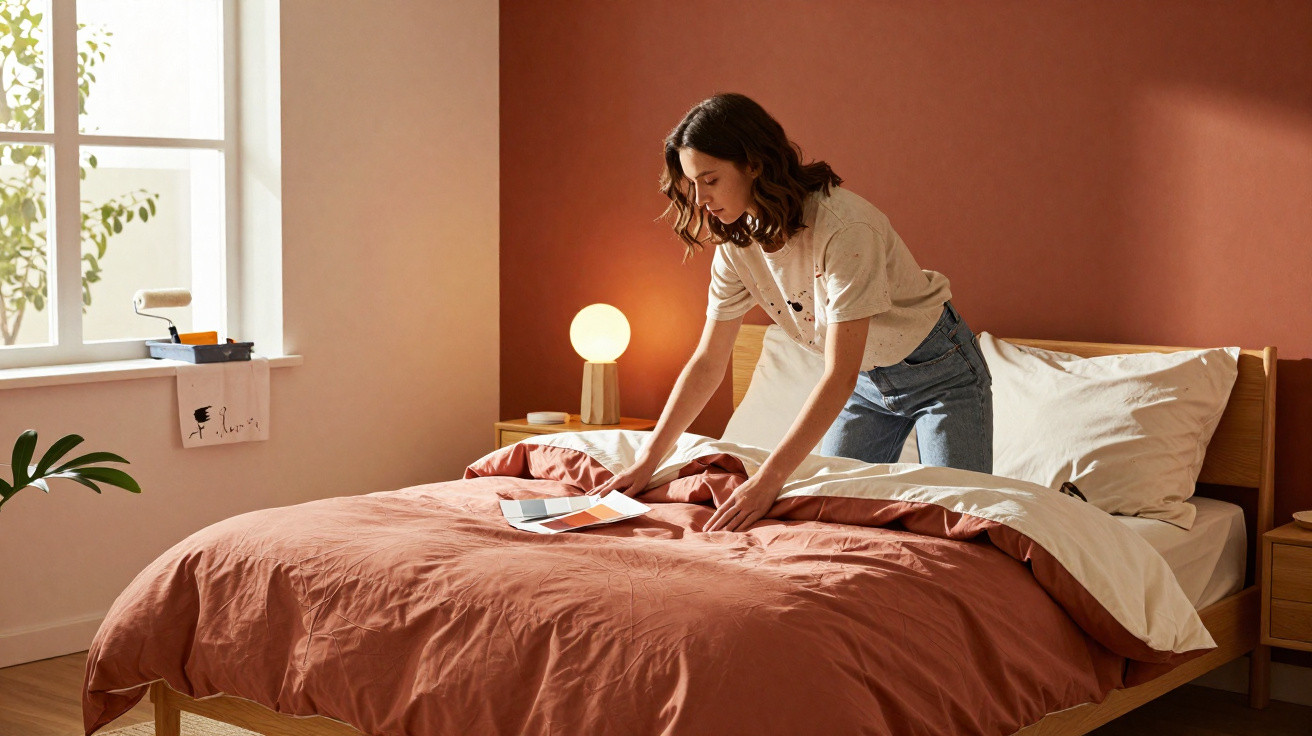
After a long day, you step into your bedroom and immediately feel… flat. The familiar beige walls are still there, the ageing comforter appears more exhausted than you are, and the unforgiving ceiling light gives the room a hospital-like feel. Most of us know that moment: you are in the room meant to be your retreat, yet it resembles a neglected storage space instead. Your bedroom ought to lift you up in the morning and make you feel at home every evening, rather than sap the little energy you have left. Fortunately, changing the space does not require a full refurbishment or a trust fund. Often, the most dramatic results begin with the smallest adjustments.
Why These Three Elements Pack Such a Visual Punch
Bedding occupies around 40% of the visual space in a bedroom, but it is often treated as a minor detail. Consider it: the bed is quite literally the room’s centrepiece and usually the first feature you notice when you enter. If that focal point feels considered and fresh, the rest of the room tends to come together around it.
Last month, Sarah, a teacher from Portland, replaced her faded floral bedding with sharp white linen and navy cushions. “I couldn’t believe how different the room felt,” she told me. “My husband walked in and asked if I’d painted the walls – but I hadn’t touched anything else.” Her experience is far from unusual. Our brains register broad areas of colour and texture before smaller details, forming an immediate overall impression.
Lighting has an even deeper psychological effect, influencing both your mood and the quality of your sleep. A single ceiling bulb that throws hard shadows around the room effectively signals to your brain that the area is practical rather than restful. An accent wall, on the other hand, adds dimension and depth without dominating the room. Together, these three features form a visual triangle, with each one strengthening the effect of the others.
The Smart Shopper’s Strategy for Maximum Impact
Begin by planning the lighting, as it will shape the other decisions you make. Rather than buying costly fittings, use a few warm-toned LED bulbs in lamps you already own, then add a plug-in wall sconce from a value retailer. Arrange lights at several levels: by the bed, halfway up the wall and perhaps with battery-operated stick-on lights behind the headboard.
In truth, you do not need thread counts over 300 or designer branding to make bedding feel luxurious. Give priority to colour and texture, not the price label. A £25 duvet cover in a shade that suits the room will have more impact than a £200 cover in a colour that does not. There is no need to match every item exactly, either; that is how a room starts to resemble a hotel catalogue rather than a home.
“The secret to affordable decorating isn’t finding cheap versions of expensive things – it’s understanding which elements actually create the visual impact you want,” says interior stylist Maria Chen.
- Select an accent wall according to the amount of natural light it receives.
- Combine light sources at different levels rather than depending on one powerful fitting.
- Choose bedding colours that work with the furniture you already have.
- Try paint shades using small sample pots before making a final choice.
When Small Changes Feel Like Home Makeover Magic
The strength of this method is the way these features create a ripple effect across the room. Against a deep green accent wall, an old chest of drawers can suddenly seem stylishly vintage. The mismatched scatter cushions you had planned to replace may even suit the new palette perfectly. At times, the answer is not buying more possessions; it is creating a background that lets the things you already own stand out.
| Key point | Detail | Value for the reader |
|---|---|---|
| Strategic lighting placement | Several sources at different heights build atmosphere | Changes the room’s mood without electrical work |
| Bedding as focal point | Covers 40% of visual space in most bedrooms | Delivers maximum impact with minimal investment |
| Accent wall psychology | Adds depth and directs attention deliberately | Helps rooms seem larger and more purposeful |
FAQ:
- Which wall should I choose as my accent wall? Choose the wall behind the headboard or the first wall visible when you enter the room. Steer clear of walls with windows or numerous breaks in them.
- What’s the best colour temperature for bedroom lighting? Use warm white LED bulbs between 2700K-3000K. They encourage relaxation and, unlike cooler blue light, will not disrupt your sleep cycle.
- How do I choose bedding colours that won’t look dated quickly? Use neutral shades as the foundation, then bring character in through cushions and throws. Timeless pairings such as white and navy or grey and blush remain appealing.
- Can I paint just one wall if I’m renting? Review your tenancy agreement first, although many landlords permit accent walls. Removable wallpaper or large wall decals can be good alternatives.
- What’s the total budget range for this makeover? Depending on what supplies you already have and how you shop, you can achieve this for $75-150. Charity shops and discount retailers are especially useful here.



Comments
No comments yet. Be the first to comment!
Leave a Comment