
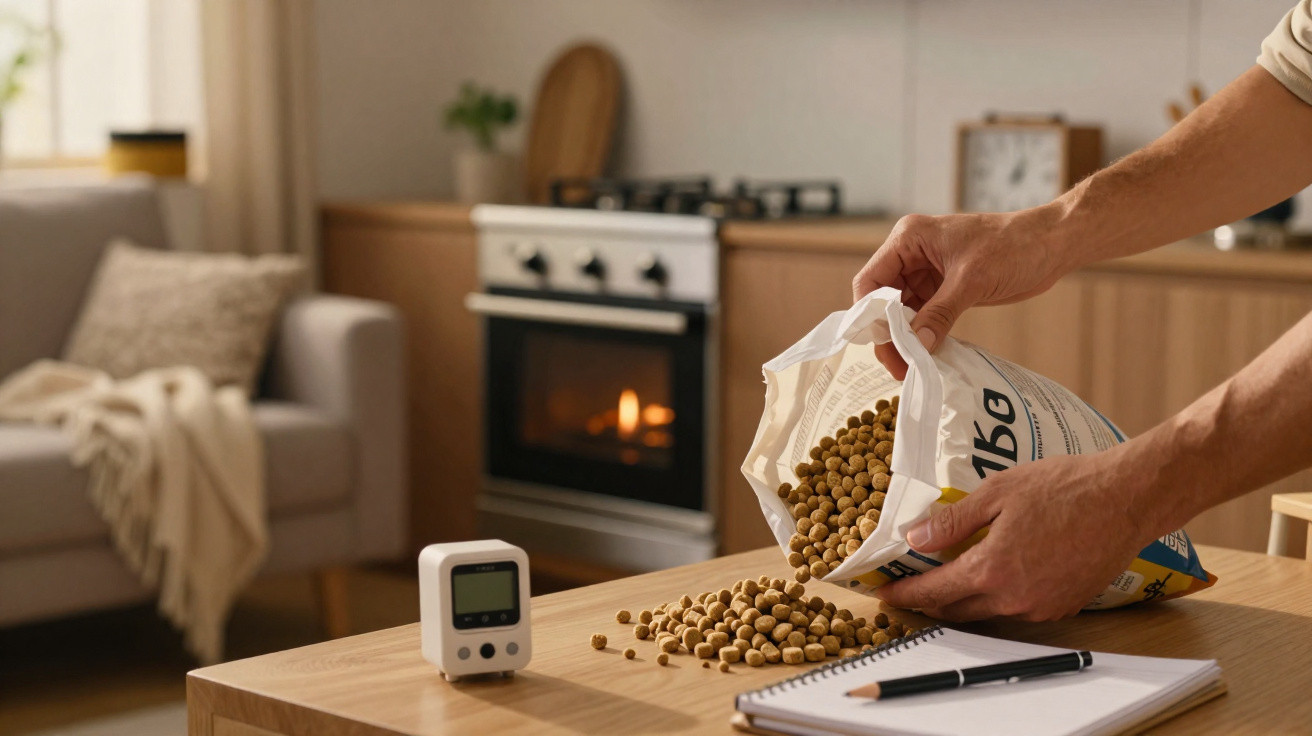
One simple question keeps resurfacing.
How long will a single 15 kg (about 33 lb) bag of pellets actually heat your home, and what factors make that time shorter or longer? It is rarely down to chance: a small set of practical settings and everyday habits largely determine the result.
What a 15 kg bag of pellets really represents
Before we talk about hours of warmth, it is useful to convert a bag of pellets into energy. With most decent wood pellets, you can expect about 4.6 to 5 kWh per kilogram. That means a 15 kg bag holds approximately:
- 70 to 75 kWh of theoretical energy
- Enough energy, in theory, to run a 1 kW appliance continuously for roughly three days
A modern pellet stove usually turns 85–95% of that stored energy into usable heat, if it’s clean and properly set up.
So the bag’s content is only one part of the equation. The key questions are how quickly your stove consumes that energy, and how much heat your home needs to stay comfortable.
Stove power and settings: where your hours disappear
High power: comfort first, pellets second
When you run a pellet stove close to its maximum output, it is much like driving a car hard on a motorway: fuel disappears quickly. Many common living-room stoves in Europe and North America top out at around 8–10 kW.
At that output, figures from real use tend to match up well:
- 8–10 kW continuous output
- Pellet burn rate of about 1.5–2 kg per hour
- One 15 kg bag used up in roughly 8–10 hours of uninterrupted, full-power heating
This approach is ideal for icy evenings when you arrive to a cold house and want the temperature to rise fast. As an everyday routine, however, it is a costly way to operate if you are trying to keep spending in check.
Eco mode and low power: stretching the bag
At the other end of the scale, many stoves provide eco, modulation or low-power options that bring output down to around 2–3 kW. The flame is calmer, fan noise reduces, and the same 15 kg bag goes much further.
Typical ranges are:
- 2–3 kW output
- Consumption of around 0.4–0.7 kg per hour
- One 15 kg bag lasting 25–40 hours, depending on the specific stove and settings
Run a 15 kg bag at low output all weekend, or burn the same bag in a single cold evening at full blast: both can happen with the same stove.
In many homes, real use sits between these extremes across a normal week: low power for steady background warmth, with short higher-power periods during colder spells or when the house is fully occupied.
How your home changes the equation
Insulation: your hidden “second stove”
The exact same stove can feel like two completely different appliances depending on the building it is heating. In a well-insulated home, the structure behaves like a large thermal store, holding onto the heat you generate. In a draughty property, much of that heat escapes almost immediately.
A rough rule of thumb often used by installers is about 1 kW of pellet stove output per 10 m² of reasonably insulated space. That leads to broad estimates such as:
| Home type | Area | Outside climate | Typical required power |
|---|---|---|---|
| New or well‑insulated home | 100 m² | Moderate winter | 4–6 kW |
| Older, poorly insulated home | 100 m² | Cold region | 8–10 kW or more |
This is why two neighbours can see dramatically different runtimes from the same 15 kg bag: one may have upgraded windows and insulated the loft, while the other has not.
Climate and layout: not just a technical detail
Building layout also plays a big role. A compact two-storey house generally warms up sooner and retains heat better than a large open-plan space with high ceilings. Open stairwells, extensive glazing, and adjacent unheated rooms all tend to increase consumption.
Your local weather matters too. A coastal town where winter nights sit just above freezing places far less demand on a stove than an inland area where sub-zero temperatures persist for weeks.
If your house drops several degrees as soon as the stove switches off, the building probably drives your pellet use more than the stove itself.
Real-life examples: what a 15 kg bag can do
Scenario 1: insulated home, eco mode
Imagine a well-insulated 90–100 m² home in an area with moderate winters. The stove is used mainly in eco mode at about 2 kW, maintaining 19–20°C in the mornings and evenings.
- Hourly use: around 0.5 kg
- Daily runtime: 6 hours morning + 6 hours evening = 12 hours
- Daily consumption: about 6 kg
- One 15 kg bag: around 30 hours of operation, or roughly 2.5 days of normal use
Scenario 2: draughty home, high power
Now take an older 100 m² house with poor insulation in a colder inland region. To hold 20°C while outdoor temperatures remain below freezing, the stove runs close to 8 kW for much of the time.
- Hourly use: about 2 kg
- Daily runtime: 10 hours on cold days
- Daily consumption: around 20 kg
- One 15 kg bag: emptied in less than 8 hours of continuous heating
Both homes are using a 15 kg bag. In the first, it is effectively a two-to-three-day supply. In the second, it may barely cover an afternoon and evening in mid-winter.
From a single bag to a whole heating season
For most households, the bigger concern is not one bag, but how many will be needed across the heating season-typically from October to March. The spread is wide, but some patterns are consistent.
- Well‑insulated, medium‑sized home (around 100 m²): 1.5 to 2 tonnes of pellets per season, or roughly 100–130 bags of 15 kg.
- Older or poorly insulated home of the same size in a cold region: 3 tonnes or more, easily over 200 bags.
A basic insulation upgrade can save the equivalent of a full pallet of pellets per winter, year after year.
For this reason, many suppliers now suggest monitoring consumption bag by bag over a full season. That record becomes a dependable benchmark when comparing prices, or when weighing up insulation work versus upgrading to a more efficient stove.
How to stretch each 15 kg bag further
Maintenance: small, boring tasks with big effects
A pellet stove that is not looked after will burn less cleanly, draw less effectively and waste fuel. Regular upkeep helps you stay closer to the stated 85–95% efficiency.
- Empty the ash pan and clean the burn pot regularly.
- Inspect the glass and seals; soot marks can indicate incomplete combustion.
- Arrange annual servicing of the flue and internal components by a qualified technician.
Restricted air intakes, dirty fans and clogged heat exchangers can force the stove to consume more pellets to achieve the same room temperature, even if the display still reports the same kW setting.
Smart settings and habits
Even without changing hardware, a few behaviour changes can add extra hours to each bag:
- Aim for stable, moderate heat instead of repeated switches between off and full power.
- Use scheduling features or a thermostat so heat is delivered mainly when the home is occupied.
- Reduce the set temperature by 1°C; in many homes, this alone cuts pellet consumption by 5–10%.
- Where possible, shut internal doors so the stove is heating a smaller volume.
A thermostat or connected controller often pays for itself in one or two seasons simply by reducing “overheating” periods.
Pellet quality: not all 15 kg bags are equal
Two bags that weigh the same and cost the same can behave quite differently in your stove. Moisture content, density and ash levels all influence how long the bag lasts in practice.
- Moisture below roughly 10% supports a hotter, steadier flame.
- Low ash output means less cleaning and more consistent airflow.
- Uniform pellet length reduces feeding issues that can disrupt combustion.
Certified pellets often cost slightly more per bag, but can provide more usable kWh per kilogram and cause fewer maintenance headaches. Over a full season, that can balance out the higher purchase price-particularly in colder areas.
Going further: how to calculate your own “hours per bag”
If you prefer to work with your own data, a simple weekend trial can give a realistic figure:
- Begin with a full 15 kg bag at a known start time and write down the stove settings.
- Keep the same power or temperature setting, and note the time the stove stops when the bag is empty.
- Log outdoor temperature and whether internal doors/rooms were open or closed.
This straightforward test produces a real-world “hours per bag” result for one set of conditions. Repeat it on a milder day-or after changing insulation or door habits-and you can quickly see where the biggest savings are.
Another way to think about pellets is as one part of a wider energy mix. Some households pair a pellet stove with electric radiators, a small heat pump, or passive solar gain from south-facing windows. By shifting some heating demand to milder daylight hours or sunny periods, they reserve pellets for the coldest times-extending each 15 kg bag without sacrificing comfort.

Comments
No comments yet. Be the first to comment!
Leave a Comment