
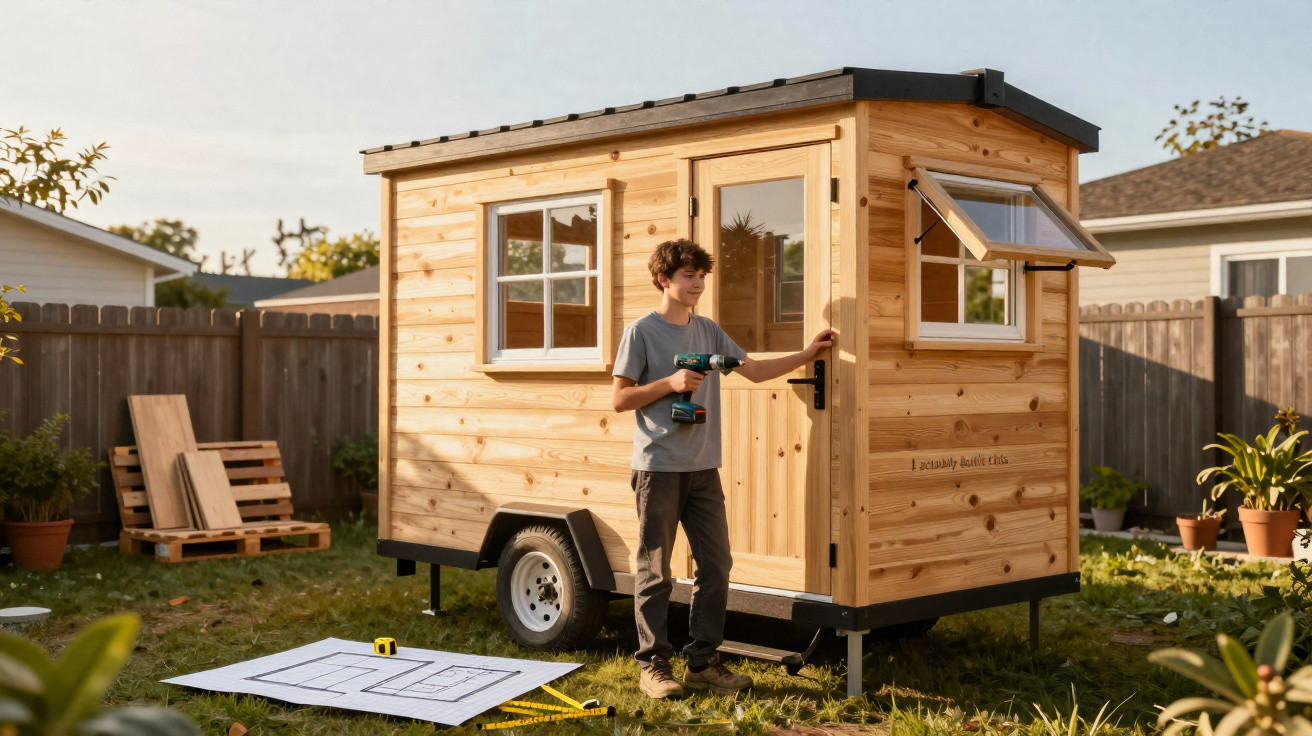
The house is no bigger than a garden shed, standing on a gravel patch behind a weathered family home. Nothing about it is obvious from the road, yet inside a teenager has created a full-sized version of a childhood ambition. The cedar door gives a soft creak as it opens, revealing a low loft bed beneath which a 13-year-old beams as though he has just received the keys to his first car. The difference is that nobody gave him the keys: he made the entire place himself, using his own hands, for roughly $1,500.
Extension leads run from the main house, while a mason jar collects drips from a makeshift sink. Fresh plywood still gives off its scent. The feeling is instant when you step into the compact interior: this is not merely a DIY build, but a statement.
A tiny house posing an enormous question.
The day a teenager stopped waiting for “someday”
Like many stories of this sort, it began with boredom and YouTube. While other children moved between games and TikTok, this 13-year-old from the Midwest disappeared into videos of tiny-house tours and homesteading channels. He watched people demonstrate ingenious lofts, folding tables and composting toilets. Eventually, his interest became a firm, quiet resolve: he wanted his own. Not two decades from now, but immediately.
His parents assumed it was a passing phase, the sort that ends with the first splinter or the first maths test. Yet he continued drawing floor plans in the margins of his homework. At barely 1.55 metres tall, peering at a tape measure, he was already learning to work within real-world limits.
He began with the resources available to him: a part-time lawn-mowing job and an old trailer chassis a neighbour agreed to sell cheaply. The chassis cost $200. He had put aside $300 by mowing lawns, walking dogs and raking leaves. Everything else was gathered gradually over several months: construction-site timber offcuts with permission, reclaimed windows from a house renovation, and leftover insulation offered free online.
One Saturday, a local carpenter walked past and saw him struggling with a warped board. He stayed for two hours, showing him how to square a wall. On another weekend, his uncle arrived with a second-hand door and a nail gun, “on permanent loan.” Slowly, the scattered materials started to resemble a house.
It is easy to romanticise a project like this from the outside. The reality, however, was no Pinterest fairy tale. The work was hot, repetitive and sometimes isolating. He spent afternoons redoing jobs he had got wrong the previous day. He cut beams incorrectly, underestimated expenses and argued with his parents about safety and planning rules.
But another process was taking place beneath the surface. In building a 6 m² house on wheels, he was creating something less visible too: a feeling of control over his own future. As adults debate housing crises and interest rates, this child with a drill and an ambition was quietly trying out another narrative. Instead of “I can’t afford a home”, the question became “What can I build with what I have?”
How can a 13-year-old really build a $1,500 tiny house?
His first meaningful move was not picking up a hammer, but writing a list. It was not an elaborate spreadsheet, simply a lined notebook divided into three columns: “Must have”, “Nice to have”, “Crazy ideas”. A bed, insulation and basic wiring went into the first category. A smart skylight sat somewhere between the second and third.
Next came the budget. He set a $1,500 limit, aware that this was already a demanding target for a child’s savings. Each weekend, he went back over the costs of screws, metal roofing and used windows. He phoned hardware shops to ask about damaged goods and returned stock. The secret was not just buying cheap, but shrinking the dream until it fit his wallet without killing the joy.
One fact adults seldom acknowledge is that the most intimidating part is beginning before you know enough. He managed that uncertainty through small, practical tests. Before constructing the full frame, he assembled a small wall section on the driveway to understand studs and plates. Before fitting a window, he watched the same tutorial three times and then trial-fitted it in a scrap opening.
He made errors that will sound familiar to anyone who has attempted a major project, whether young or old. He purchased the wrong screws because the packet “looked right.” He failed to include paint in his calculations. He nearly left out the underfloor insulation to cut costs, before spending one cold night inside and reconsidering. We have all had that moment when we discover that cutting corners simply reduces comfort later on.
His greatest good fortune was not financial. It was having adults who would support him without taking charge. His mum spoke to the local authority about where the trailer could legally be placed. A neighbour who was an electrician checked his basic 12-volt system before anything was connected. The arrangement was straightforward: he carried out the work, while they checked it was safe.
One afternoon, with sawdust drifting through the sunlight, his grandfather watched him trying to raise a wall section by himself. Following a long pause, the older man said, “You’re building more than a room here, you know.”
“You might forget the price,” his grandfather told him, “but you’ll never forget the day you sleep in something you built yourself.”
The finishing touches then turned it from a box into somewhere that felt like home:
- A slim shelf extending along the wall for books and a speaker
- A wall-mounted drop-down desk for homework and drawing
- A basic ladder made from leftover 2×4s up to the loft bed
- A gentle, warm run of LED lights carefully fixed along the ceiling
- A small rug his grandmother insisted on buying “because bare plywood is too sad”
What this $1,500 tiny house truly changes
At night, with the door shut and the outside world held at a distance, the small room feels different. Its walls are a little uneven, and the trim above one window does not line up perfectly. You spot the flaws, then realise that he does not make excuses for them.
Instead, he indicates what each one taught him: the crooked board that revealed the value of clamps, and the piece of trim cut too short that made him learn to repair joints. His voice carries a quiet pride. It is a form of teenage confidence based not on likes or followers, but on screws driven straight and level.
For the adults observing, the tiny house raises uncomfortable questions. Why does a 13-year-old feel compelled to make a space of his own at all? Why does a child’s $1,500 plywood cabin somehow seem more tangible than the distant dream of buying a “real” house one day?
In truth, hardly anyone does this every day. Most families are too busy, exhausted or overstretched to devote a year of weekends to a child’s building ambition. Still, the story connects because it speaks to something many people quietly want: less debt, greater autonomy and a place, however modest, that is unmistakably theirs.
By the end, the financial element feels almost incidental. Certainly, $1,500 is remarkably low beside any housing-market headline. Certainly, he reduced the costs by salvaging materials, reusing what he could and accepting every offered offcut. Yet the real “value” is that this child now understands deeply that large challenges can be broken down into boards and screws.
The lesson for readers is not necessarily “go build a house at 13.” It may instead be this: what would happen if you reduced your next major ambition to the smallest version you could genuinely begin this month? One raised garden bed rather than an entire homestead. A weekend shed rather than a complete cabin. A sketched floor plan rather than a mortgage application. Size is not the issue. Starting is.
| Key point | Detail | Value for the reader |
|---|---|---|
| Start smaller than you think | He built a 6 m² house on a used trailer with salvaged materials | Demonstrates that ambitious projects become achievable when you drastically reduce the scope |
| Use community as a resource | Neighbours, relatives and local professionals provided advice, checks and leftover materials | Encourages readers to seek support and use local networks rather than doing everything alone |
| Focus on learning, not perfection | Visible flaws became “lessons on the wall” instead of failures | Helps readers feel more able to start projects without waiting until they feel completely prepared |
FAQ:
- Can you really build a tiny house for $1,500? Yes, but only if it remains exceptionally small, you can use a trailer or foundation you already have access to, and you rely heavily on reclaimed or donated materials. When you do the work yourself, labour is unpaid, which changes the calculation considerably.
- Is it legal for a teenager to build and live in a tiny house? Building is generally permitted as a DIY project with parental supervision, but living in it long term depends on local planning rules, safety regulations and where it is parked. Many families use one as a garden studio or sleepover space rather than an official home.
- How long did a project like this take? For a 13-year-old working at weekends and during school holidays, it may take several months to a year. Work tends to happen in bursts: the frame might be completed in a few days, followed by slower stages such as insulation, wiring and interior finishing.
- What skills does a child need to start something similar? They need basic tool safety, patience when following tutorials and a readiness to redo work that is not right. Adult supervision for electrical work and structural safety is non-negotiable, even when the teenager leads the build.
- Is a tiny house like this comfortable to stay in? Comfort relies on insulation, ventilation and how intelligently the space is arranged. Even a very small, basic cabin can feel cosy with a good mattress, natural light and considered storage rather than clutter.
Comments
No comments yet. Be the first to comment!
Leave a Comment