
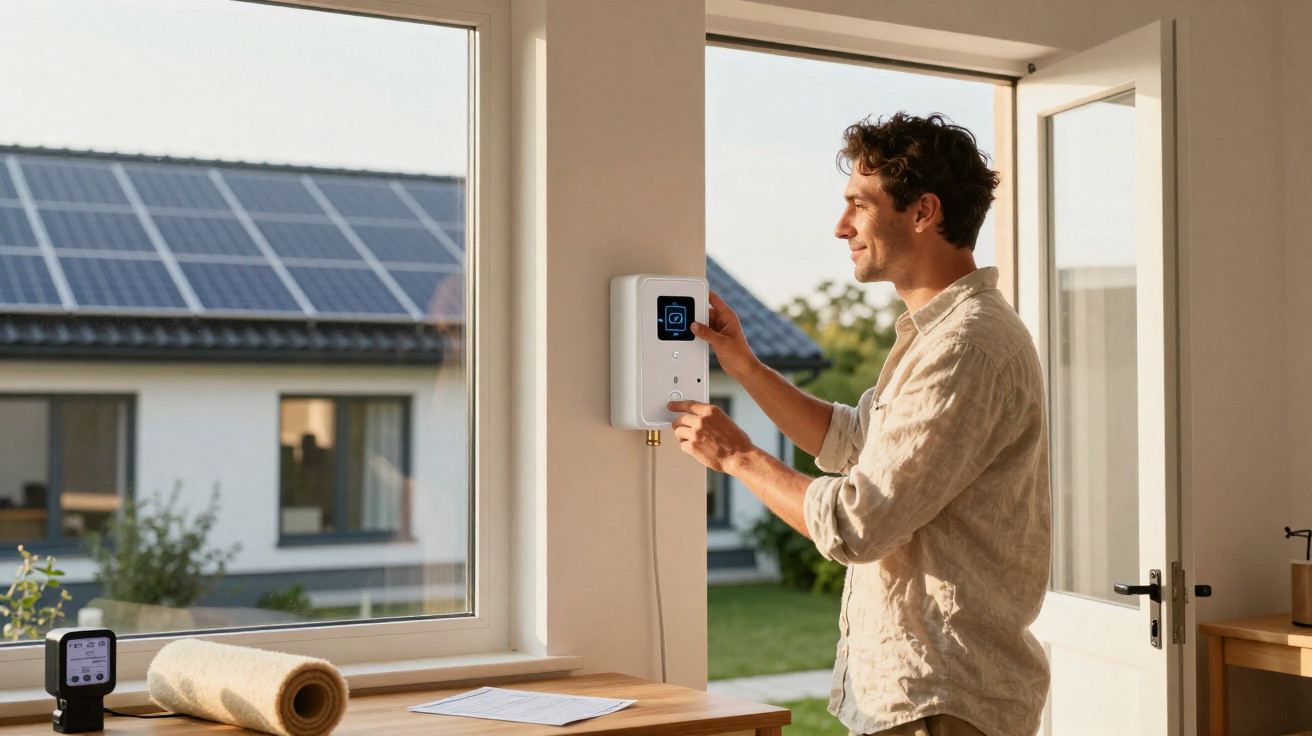
Across Europe and North America, households are seeking ways to stay warm without damaging either their finances or the climate. A major German scientific study has closely assessed the leading heating systems available, examining their long-term costs and environmental effects.
How scientists compared 13 heating systems fairly
The researchers simulated a standard two-storey home and assessed 13 heating technologies using identical conditions. Their aim was to establish not only which systems create less pollution, but also which provide genuine financial value once every less obvious expense is counted.
For this, they used two robust methods together: life-cycle assessment and net present value.
- Life-cycle assessment (LCA) tracks environmental effects from manufacturing through to disposal.
- Net present value (NPV) calculates future spending and savings, converting them into present-day values.
Rather than simply asking, “how much does it cost to run per year?”, this method takes a much broader view. Each heating system is considered as a long-term investment instead of a single purchase.
The study factored in installation price, energy use, maintenance, CO₂ emissions, resource consumption and even future energy price changes.
The team also accounted for the evolving electricity mix, on the basis that grids will become cleaner over time. This is especially important for electricity-driven technologies, including heat pumps.
The clear winner: air-to-water heat pump plus solar panels
After evaluating the figures, one arrangement came out in front: an air-to-water heat pump combined with roof-mounted solar photovoltaics.
This pairing cut environmental impact by around 17% compared with a modern gas boiler, while trimming total costs by about 6% over the system’s life.
An air-to-water heat pump works by extracting warmth from outdoor air and raising its temperature to heat radiators or underfloor heating. Although it uses electricity, it can provide several units of heat for every unit of power it consumes.
Solar panels make a substantial difference to this arrangement. They allow some of the heat pump’s electricity demand to be met directly from the roof rather than the grid, reducing both energy bills and the home’s carbon footprint.
Why this combination works so well
The researchers identified several benefits behind its strong result:
- High efficiency: current heat pumps can provide three to four times as much heat energy as the electricity they use.
- Self-produced electricity: solar panels cover part of electricity demand, particularly during spring and autumn.
- Future-proofing: as electricity grids incorporate more renewable generation, the heat pump’s indirect emissions continue to decline.
- Stable running costs: there is less vulnerability to gas price surges, which have been severe in recent years.
The researchers said that improving self-consumption management, such as by using smart controls or small batteries, could improve the result further. The greater the share of solar electricity used on site, the quicker the return on investment.
A surprise runner-up: wood gasification boiler
The heat pump and solar combination was closely followed by a more unexpected option: the wood gasification boiler. This modern, highly efficient wood boiler is built to burn logs cleanly at high temperatures.
Compared with a gas boiler, the wood gasification system cut environmental impact by roughly 42%, though overall costs were around 20% higher.
Its favourable environmental outcome is linked to sustainably sourced timber being treated as a renewable fuel. Where woodland is properly managed, replacement trees absorb an amount of CO₂ broadly similar to that released when the logs are burned.
This solution is not practical for every household. It requires somewhere to store fuel, frequent loading and dependable access to wood. However, in rural locations where local firewood is readily available, it can be a credible replacement for fossil gas or oil.
Systems that look green, but disappoint in practice
Several technologies presented as “eco” options performed less well in the German assessment. Two more elaborate systems ranked at the bottom of the eco-efficiency table:
- Pellet boiler combined with solar thermal panels
- Heat pump with ice storage (ice accumulator)
Both options involved expensive installation and maintenance, numerous components and complex control systems. Their environmental gains were insufficient to balance out their higher lifetime costs.
Complexity itself became a handicap: more equipment, higher upfront costs and more things that can fail.
That does not mean these are “bad” technologies in every circumstance. It does, however, demonstrate that additional technical sophistication does not necessarily lead to stronger long-term results.
The gas boiler problem: cheap today, costly tomorrow
Gas boilers are still widely used in many countries because they are familiar and comparatively inexpensive to fit. When fuel prices remain steady, their running costs can appear appealing too. However, the study gave them a stark overall assessment.
Across all the options tested, gas boilers produced the highest greenhouse gas emissions, even when combined with solar thermal panels.
The boiler equipment is not particularly costly, yet fuel expenditure accumulates over its lifespan. Future carbon charges and tougher climate policies may also increase the true cost of gas heating in the years to come.
| System | Environmental impact vs gas boiler | Lifetime cost vs gas boiler |
|---|---|---|
| Air-to-water heat pump + solar PV | About 17% lower | About 6% lower |
| Wood gasification boiler | About 42% lower | About 20% higher |
| Pellet boiler + solar thermal | Weaker performance | High |
| Standard gas boiler | Reference (highest) | Reference |
What this means if you are planning to change your heating
Selecting a heating system now resembles choosing a pension plan more than purchasing an appliance. It determines costs and emissions for fifteen to twenty years. The German research offers several useful pointers for households making that choice.
- Think over decades rather than seasons: a marginally higher initial outlay may be recovered through lower bills.
- Assess the full package: manufacturing, operation, servicing and eventual replacement all matter.
- Examine your roof’s potential: being able to fit solar panels strengthens the argument for a heat pump.
- Take account of the local energy mix: electric systems gain an advantage where electricity is rapidly becoming cleaner.
Households in colder areas often question whether heat pumps can perform during severe winter weather. The study covered a Central European climate, which is far from mild, yet the air-to-water heat pump with PV still led overall. In exceptionally harsh areas, a hybrid system combining a heat pump with a backup boiler can meet peak demand while continuing to reduce emissions and costs.
Key terms worth understanding
The research rests on two technical concepts that are increasingly appearing in consumer guidance.
- Life-cycle assessment: considers the entire chain, from raw-material extraction and manufacture to transport, everyday operation and end-of-life disposal. This avoids judging a system only by emissions from its flue or electricity socket.
- Net present value: combines all future costs and savings, discounting them to their value today. A system may cost more initially but still come out ahead if its annual bills remain sufficiently low for long enough.
Practical scenarios and mixed strategies
For a typical three-bedroom home with reasonable insulation and a suitable roof, an air-to-water heat pump with solar PV is likely to lower annual heating costs after installation, particularly in places with expensive gas. The payback period becomes shorter in countries offering grants or tax credits.
In a village with constrained grid capacity but convenient access to sustainably managed woodland, a wood gasification boiler may be more appropriate. In that situation, a smaller environmental footprint is paired with local fuel security, even where the spreadsheet costs exceed those of gas.
Some homes may use a combination of technologies: a modest heat pump as the main source of heating, supported by a small gas or wood boiler during extreme cold spells. Although this hybrid arrangement was not the study’s best-performing option, it can address comfort concerns while reducing dependence on fossil gas.
The research highlights one final issue: the choice that appears “greenest” on paper will not always offer the strongest real-world balance. Over the long term, systems that are straightforward, efficient and intelligently matched with on-site renewables often produce the most persuasive outcomes.






Comments
No comments yet. Be the first to comment!
Leave a Comment