
With the electricity bill climbing month after month, an almost unnoticed part of the home can end up costing far more than many people expect.
Tucked away at the back of the utility room, along a hallway, or hidden in an airing cupboard, the electric water heater runs quietly around the clock. It delivers hot showers on demand, yet it is also one of the biggest drivers of household power use. A small control device claims it can change that-without forcing anyone to put up with a cold wash.
Why the electric water heater adds so much to your bill
An electric water heater works like a large heated, insulated bottle: it keeps dozens of litres of water hot and ready whenever you need it. To do that, it switches on and off repeatedly throughout the day-even when nobody is using the shower or a hot tap.
That continual reheating cycle is what makes it one of the home’s highest energy users, alongside air conditioning and the fridge. In many households it accounts for a significant slice of the electricity bill, particularly for families of 3 or 4 who tend to take long daily showers.
"The issue isn’t only heating the water: it’s keeping the tank hot 24 hours a day, even through long periods when it isn’t being used."
Most heaters offer three basic operating modes:
- Forced on: the unit can heat at any time, drawing power whenever it wants.
- Automatic (with day/night contact): heating is concentrated into time periods set by the supplier, when the tariff is cheaper.
- Off: the heater stops heating altogether, which is only practical for longer absences.
In reality, many people leave the heater on forced mode out of convenience or simply because they do not realise the cost-and that is where the day-to-day waste starts.
What this “small box” does to cut consumption
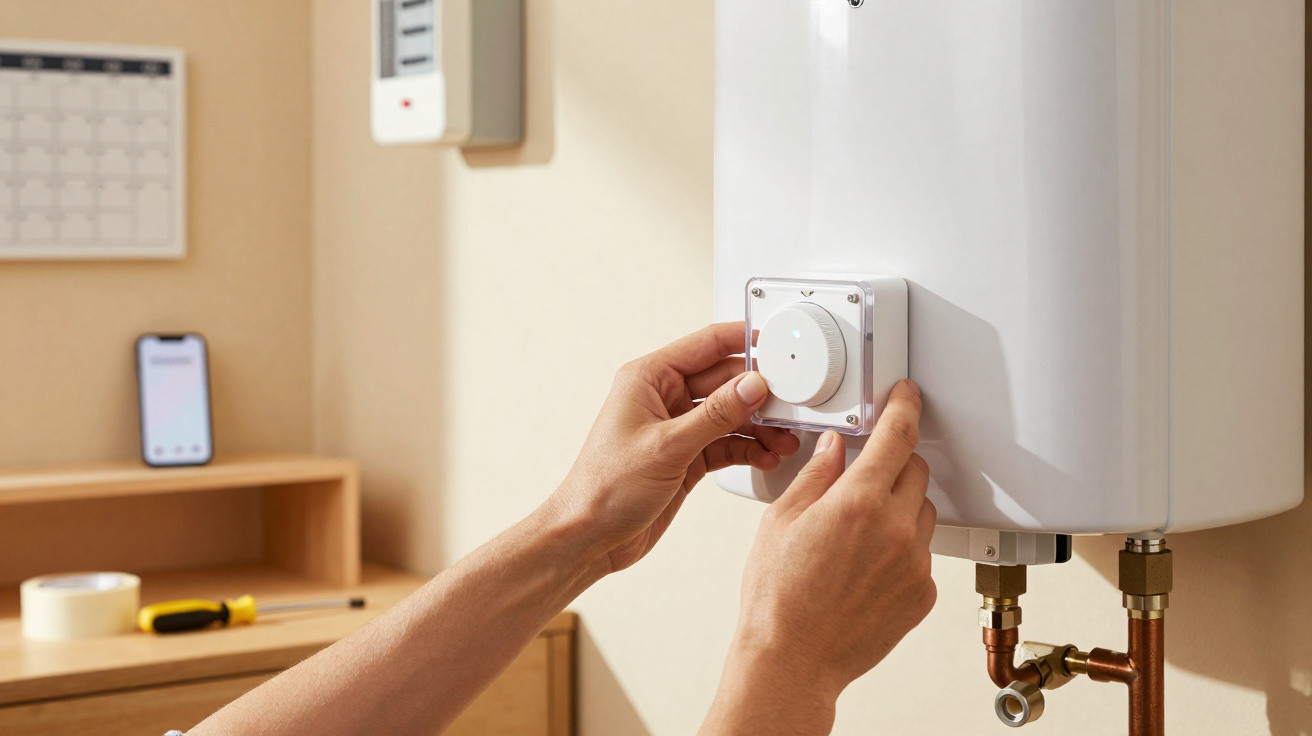
This small device is essentially a timer dedicated to the electric water heater. It is installed on the heater’s electrical circuit and takes control of when the heater is allowed-or not allowed-to draw power.
"Instead of keeping the heater permanently ready, the timer creates heating windows that match the household’s real usage."
In practice, it works like a smart clock: you set the times when the heater is permitted to run and warm the cylinder, and the times when it is completely disconnected from the supply. The result is that the unit heats in concentrated blocks, then relies on thermal inertia to hold temperature for many hours.
How it keeps the same temperature with less energy
The trick is basic physics. The tank is thermally insulated, so heat escapes slowly. If the heater is powered, for instance, twice a day for carefully chosen periods, the water can reach the same comfortable temperature without the appliance constantly cycling on and off.
A classic example is a schedule that heats during the small hours and again in late afternoon. Through the morning and later in the evening, the cylinder often remains hot enough for comfortable showers. For whoever turns on the shower, it feels the same-but the total heating hours drop considerably.
Practical benefits of using a timer
By aligning heating with your day-to-day routine, this “little box” can deliver several tangible advantages:
- Fewer operating hours, cutting power that would otherwise be wasted when nobody is home.
- Better use of cheaper tariffs, where your contract includes peak and off-peak pricing.
- Less on/off cycling of the internal thermostat, which can help extend the heater’s service life.
- A lower electricity bill, without sacrificing shower comfort.
In homes where everyone leaves early and returns in the evening, the benefit is often bigger: the heater can sit fully inactive for most of the day with no real impact on daily life.
Installation: what to check before you buy
Before fitting any device, it is worth checking how the heater is connected to your home’s electrics.
- Plugged into a socket: higher-power heaters should not be run from ordinary sockets. In these cases, plug-in timers can be risky because the current draw is high.
- Hard-wired to the consumer unit: this is the most suitable arrangement. The timer is installed on the same circuit, alongside the dedicated circuit breaker for the heater.
If you are not confident with electrical work, use a qualified electrician. Even models marketed as “simple” involve handling high-load wiring.
Available models and key points to watch
You can find everything from mechanical versions, with a rotating dial and time pins, to digital and connected models that can be adjusted via an app.
- Check the rated load (typically 2,000 to 3,000 watts for domestic electric water heaters).
- Pay attention to how easy it is to programme: the more intuitive it is, the more likely you are to keep the schedule matched to your routine.
- Consider connected versions if your timetable changes often, as they allow remote tweaks.
How to set the best heating times
The biggest mistake is copying someone else’s schedule. Every household uses hot water differently. The better approach is to observe your own pattern for a few days:
- Usual shower times in the morning and evening.
- Parts of the day when hot taps are used most.
- Weekdays when the home is empty versus busier days.
From there, a simple starting schedule might look like this:
| Household routine | Suggested heating window |
|---|---|
| Showers early and at night | On 04:00–06:00 and 17:00–19:00 |
| Showers only at night | On 16:00–19:00 |
| Home empty during the week | Short windows around shower times; off the rest of the time |
Over time, small tweaks will show how far you can shorten heating periods without losing comfort.
Other ways to cut consumption without lowering the temperature
A timer is only one piece of the puzzle. Small choices in the heater settings and in everyday hot-water use can amplify the results.
- Set the temperature to around 55 °C to 60 °C. Below that can encourage bacterial growth; much higher increases energy use and the risk of scalding.
- Descale periodically. A heating element coated in limescale needs more energy to heat the same amount of water.
- Fit flow restrictors on showers and taps. Fewer litres per minute means less hot water used.
- Insulate hot-water pipes where they run through colder areas, such as garages and loft spaces.
- Swap to a water-efficient shower head, designed to keep the feeling of volume with a lower actual flow rate.
"When heating becomes more efficient and the volume of water used falls, the effect adds up: fewer kWh, less wear, and less maintenance."
How much you can actually save
Modelling by electricians and energy-efficiency firms suggests that, by shortening the heater’s active time and fine-tuning the temperature, consumption can drop by roughly 20% to 30% for this specific appliance, depending on the previous usage pattern.
On an electricity bill of R$ 300 where the heater accounts for one third of the total, simply reorganising the heating hours can mean saving many reais each month. Over a year, the savings often cover the cost of the timer and still leave a net benefit.
What to consider before changing your heating routine
Not every home will adapt in the same way. Larger families, with showers spread throughout the day, will need wider heating windows. Households with a baby or elderly residents may prefer a larger safety margin in the cylinder temperature.
Another factor is the risk of overdoing it. If you cut heating time too aggressively, the water may run cold by the end of the day-leading to frustration and a return to forced mode. The most reliable approach is usually gradual testing.
For anyone looking to take the next step, pairing a timer with solar photovoltaic generation can create an appealing cumulative effect. Water can be heated mainly during the panels’ peak output, turning surplus electricity into stored thermal comfort in the tank.

Comments
No comments yet. Be the first to comment!
Leave a Comment