
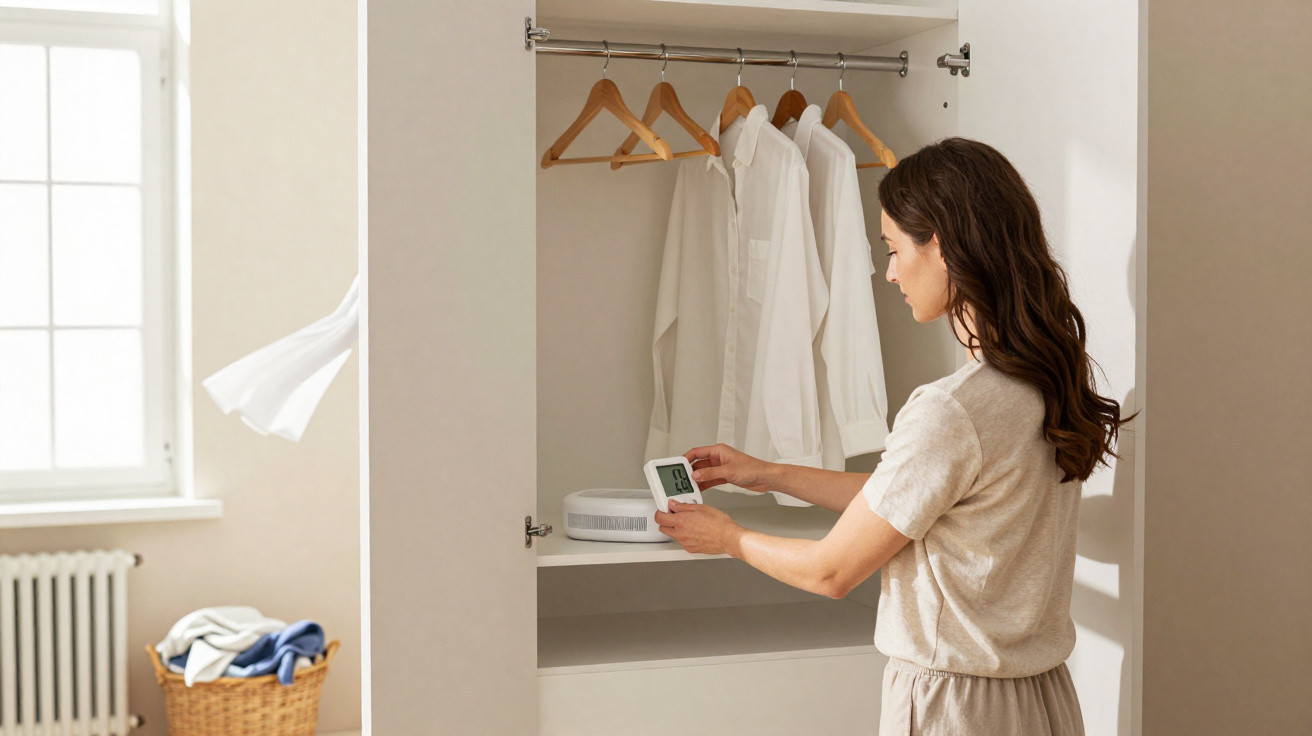
The smell comes first. Slightly musty, barely noticeable, somewhere between an old cellar and a damp towel. You open the wardrobe, pull out your favourite jumper – and there it is: the small grey-green mark on the sleeve. Tiny. Yet you know exactly what it means. Mould. In the wardrobe. On your things. In your everyday life.
We all know that moment when sudden disgust meets quiet frustration. How long has it been there? How many items are affected? And above all: why do you always notice it too late?
Mould in the wardrobe feels like a stealthy intruder. Invisible, silent and persistent. Once it is there, the damage has effectively already been done.
The real question is: can you stop it before it appears at all?
Where mould in the wardrobe really starts
If you photographed wardrobes shortly before mould appeared, they would look surprisingly unremarkable. Nothing dramatic. A little too full, a few coats packed too tightly together, perhaps a wardrobe door left ajar that does not quite close. A few towels that were still slightly damp, put away “just for a moment”.
And that is exactly where it happens. Not in some horror flat with wet walls, but in perfectly ordinary bedrooms and hallways. In homes that are heated, where people work, children play and cats sleep. Mould begins long before we can smell it.
Picture a flat viewing in a medium-sized town: three rooms, well maintained, in a good location. The landlady gives an apologetic smile as she shows the previous tenant’s wardrobe. At the back, in the corner against the outside wall, there are dark patches. The clothes had to be thrown away, she says quietly, almost ashamed. The former tenant worked a lot and was rarely at home: “You simply don’t notice something like that.”
Studies show that humidity in many bedrooms rises significantly overnight. Breath, closed windows and thick duvets all release moisture into the air. Some of it ends up in the wardrobe. Not litres of it, but drop by drop. Day after day.
Mould needs three things: moisture, very little air movement and organic material. A wardrobe provides this trio almost perfectly. Tightly packed, rarely opened fully, filled with cotton, wool and leather. If humidity then remains above roughly 60 per cent, the invisible guest thrives.
The sobering truth is that mould in the wardrobe is less of a “cleaning problem” than a microclimate problem. It is not about whether you are tidy; it is about whether your wardrobe can breathe. Most wardrobes are small, stuffy islands in otherwise lovely homes.
The unobtrusive early-warning system: routines rather than panic measures
The most effective anti-mould step for your wardrobe does not start with a specialist cleaner, but with an utterly ordinary action: open the door and let air in. It sounds ridiculously simple, yet it works like a mini reset for the wardrobe climate. Open it fully once a day, leave it open for a few minutes and perhaps pull out a drawer as well.
The effect is even stronger when you pair it with a quick burst of ventilation in the room. Throw the window wide open, keep the wardrobe open and get the air circulating. It need not be an elaborate ritual; it is more like brushing your teeth for your textiles. It is this small, almost invisible moment in everyday life that determines whether moisture remains or disappears.
The classic mould invitation is laundry that is “almost dry”. A jumper that feels just faintly clammy, a bathroom towel you want to hang away quickly. Most people simply put it in the wardrobe: out of sight, out of mind.
Let’s be honest: nobody checks every sock for residual moisture before it goes into the wardrobe. Nor does anyone genuinely do it every day. This is where one simple rule helps: anything that feels even slightly damp gets its own temporary spot – a chair, an open coat rack or a clothes airer. Only once it is dry may it enter the dark world of the wardrobe.
A mould surveyor who regularly inspects homes put it as soberly as he did aptly:
“Wardrobes are like small rooms without windows. If you stuff them full and never air them, you create your own damp habitat – right beside the bed.”
Once you understand that, you naturally start thinking about air routes rather than merely compartments and piles.
A few straightforward adjustments make an enormous difference:
- Do not push the wardrobe directly against cold outside walls; leave a gap of a few centimetres.
- Do not cram in clothes to the limit; fewer items and more air are better.
- Keep an eye on room humidity during winter – a small hygrometer costs little but gives an early warning.
- Open doors fully on a regular basis, rather than just “a little”.
- Treat moisture absorbers or bags of rice/salt only as additions, never as the sole solution.
When mould prevention becomes a quiet luxury
There is a subtle luxury nobody posts on Instagram: opening a wardrobe and smelling nothing. No perfume, no fabric conditioner, no mustiness. Just textiles, air and everyday life. In truth, that “nothing” is a small masterpiece of routine, observation and a few clear choices.
Anyone who genuinely wants to prevent mould starts by seeing the wardrobe as a living part of the home, rather than dead storage space. That means decluttering now and then, thinning out rows, removing old boxes and getting rid of plastic bags. Every centimetre you free up gives air another centimetre of room.
There is an emotional question behind it, too: how much do I really want to keep, and at what cost? Many wardrobes are not damp because the home itself is poor, but because they are overfilled. Every available gap is occupied by something you “might perhaps need someday”.
When you begin to let things go, you indirectly protect your favourite pieces. A half-empty wardrobe is not only visually freeing; it is also an unfavourable place for mould to live. Less fabric, more movement and fewer concealed corners where a microclimate can build up. Strange as it may seem, minimalism protects not only your mind but your wardrobe as well.
In the end, every wardrobe tells a quiet story about how a home is lived in. Is it aired briefly each day, or only in extreme heat? Are coats hung up while damp, or allowed to dry properly first? Is there space for air, or only space for possessions?
Perhaps it is worth looking at your own wardrobe through a stranger’s eyes. Not as storage, but as a small climate experiment that you influence anew each day.
And the next time you open the wardrobe door, you might pause for a moment and ask yourself: does this space breathe – or is the air standing still?
| Key point | Detail | Benefit for the reader |
|---|---|---|
| Wardrobe climate rather than cleaning alone | Humidity, air circulation and how full it is are decisive | Understands why mould develops before it becomes visible |
| Daily micro-routines | Open the wardrobe fully on a regular basis and combine this with burst ventilation | Easy-to-follow habits requiring very little effort |
| Mindful treatment of clothing | Put away only genuinely dry textiles and avoid overstuffing | Protects favourite items and significantly reduces mould risk |
FAQ:
- How can I spot early signs that mould is developing in the wardrobe? The first indications include a slightly musty smell, clammy fabrics and small grey or greenish spots on the walls or wooden trim inside the wardrobe. Condensation on cold inner surfaces is also a warning sign.
- Does it help to use scented sachets or perfume in the wardrobe? Fragrance only masks smells; it does not change the climate. At worst, the wardrobe smells pleasant while mould has long been developing in the background. Smell must never be the only criterion.
- Are moisture absorbers a good solution? They can help where the room air is generally too humid, but they never replace ventilation and sensible use. If an absorber fills up quickly, it is more likely to indicate an underlying moisture problem.
- How often should I inspect the wardrobe thoroughly? A quick look at all corners, the back panel and the floor once a month is usually enough. Take particular care after prolonged rainy spells or during winter when heating is used heavily.
- Do I always have to throw away mouldy clothes? Light, surface-level marks can sometimes be removed with a hot wash and specialist anti-mould products. If the fabric is already damaged or the smell does not go away, disposal is usually the more honest option.





Comments
No comments yet. Be the first to comment!
Leave a Comment