
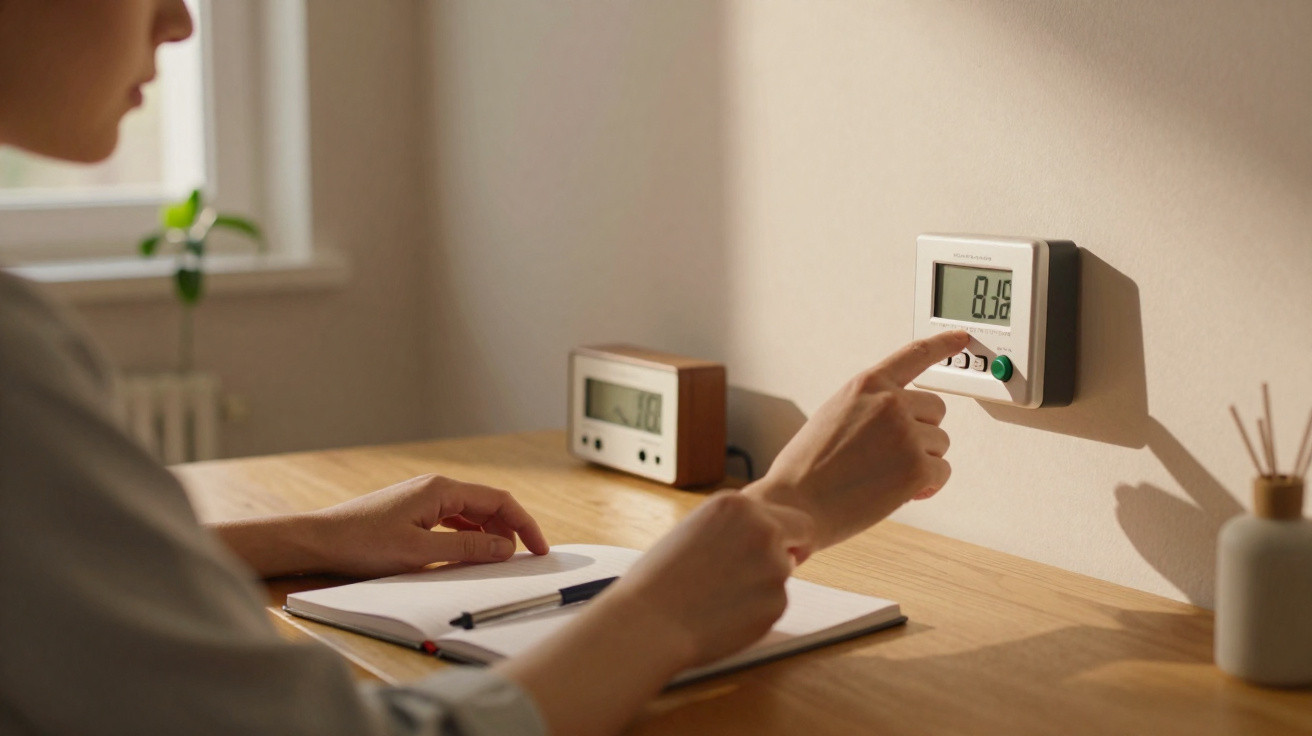
The thermostat on the wall insists it’s 21°C.
Your toes are convinced it’s 17°C. Somewhere between the glowing digits and the bite in the air, reality has slipped away. So you nudge the setting up a notch, then another, watching the display as if it’s bluffing across a poker table. The boiler fires, the vents murmur, and yet a low-level annoyance hangs around the room - like there’s a window open somewhere in your head.
You start to question everything: the weather, the insulation, your own judgement. Or is that small plastic box calmly feeding you a comfortable untruth? When the bill lands and the numbers look more like a phone number than an energy charge, uncertainty turns into suspicion.
What if the issue isn’t your heating at all - but the device that’s meant to control it?
Why your thermostat might be lying to you
Most of us treat a thermostat as if it’s a truth machine. You glance at the screen, accept the number, and move on - much like trusting the time on your phone. But a thermostat isn’t a neutral thermometer floating in the middle of the room. It sits inside a chaotic, shifting environment: draughts from doors, afternoon sun warming a wall, and heat stacking near the ceiling like an invisible tide.
That sensor doesn’t experience the room the way you do from the sofa or under the duvet. It only measures what’s happening right where it’s mounted - at that height, in that tiny microclimate surrounding it.
So when it reports 21°C, your living room may quietly be running on different rules.
In one UK survey, energy auditors found wall thermostats often read 1–3°C higher than the average room temperature. Consider what that means on a January evening: you believe it’s 21°C because the display swears it is, while the corner by the sofa may actually be closer to 18°C - which is why you’re bundled in a blanket and glaring at the heating controls.
I’ve spoken to homeowners who were adamant their home “never warmed up”. Then we checked their hallway thermostat and found it mounted directly above a radiator. That area hit 22°C quickly, so the boiler shut off early. The bedrooms at the far end of the house? Left at 17°C, as if they’d done something wrong.
Another familiar scenario: a thermostat installed on the wall opposite a large south-facing window. The sun warms the plaster just enough to fool the sensor. The system effectively says, “Job done,” while anyone in the shaded kitchen is still breathing tiny clouds.
Inside the casing, most thermostats rely on a small temperature sensor, commonly a thermistor. It responds to the air right around it, not to the whole home. And indoor air doesn’t blend evenly: warm air gathers high up, cold draughts creep along floors, and closed doors create little temperature “islands” the display never shows you.
Even newer smart thermostats are still heavily influenced by where their main sensor lives. Some attempt to correct with algorithms, and some pair with extra remote sensors in bedrooms or living spaces, but they’re still building an estimate rather than seeing the full picture. They’re only as honest as the data you feed them.
Then there’s simple manufacturing tolerance. A budget thermostat can be out by 1–2°C straight from the box - before it’s even had a chance to be skewed by your hallway radiator or your dog sleeping beneath it.
How to test your thermostat’s accuracy at home
The easiest way to catch a misleading thermostat is to introduce a second opinion. You don’t need lab equipment - just a dependable thermometer and a little patience. Choose a steady moment: heating on, doors shut, and no window left cracked open “just a bit”. Let the system run for at least 30–60 minutes so the temperature isn’t constantly rising and falling.
Put your reference thermometer close to the thermostat, at the same height above the floor. Avoid pressing it tight to the wall; leaving a small air gap is better. After five minutes, record both readings. Do it a few times. You’re not looking for perfection - you’re looking for consistency.
If the thermostat repeatedly differs by 1–2°C from your reference, you’ve likely found the problem.
On a cold evening in a semi-detached house, we tried this using an inexpensive digital room thermometer from a supermarket. The hallway thermostat confidently displayed 20°C. The handheld unit beside it sat at 17.9°C. The owner wasn’t imagining the chill - the wall unit was simply over-optimistic. We then carried the same thermometer into the living room where the family actually spent their time. It read 17.2°C, even though the boiler already believed everything was sorted.
On a different visit, an older homeowner was sure her “new” smart thermostat was faulty because she always felt too hot. We ran the same check. This time the hallway thermostat showed 18°C, while the reference thermometer read 20.5°C. Her smart device was under-reporting the heat, so the boiler kept running. Her living room felt like a mild greenhouse.
A couple of degrees may not sound like much on paper. Over a whole winter, though, it shows up in comfort, mood, and what you pay.
Comparing your thermostat to one thermometer is a solid start, but you can take it a step further without turning it into a project. Take readings in three places: next to the thermostat, in your main living area, and in the coldest room you actually use (often a bedroom). Measure them at the same time and note them down - on paper or in your phone.
You’ll quickly build a simple “temperature map” of your home. Is the thermostat positioned in the warmest spot? Then most of the house is likely cooler than the setpoint suggests. Is it in a chilly corridor by the front door? You may be overheating the rest of the property just to make that one location feel right.
Let’s be honest: nobody does this every day. But doing it once or twice each season can completely change how you interpret that little number on the wall.
Fine-tuning, fixes and when to move on
If you’ve confirmed a mismatch, the most straightforward response is to set your target with that bias in mind. If the thermostat shows 21°C when the room is really 19°C, you may end up setting 23°C to achieve a true 21°C. It’s a bit like holding the steering wheel slightly left because you know the car drifts right.
Plenty of modern thermostats allow you to adjust calibration in their settings. Look for options such as “temperature offset” or “calibration” in the menu or app. Shifting it by +1 or -1°C so the display matches your reference thermometer is a small change, but it brings the screen and reality back into alignment.
If the thermostat is badly placed, considering a move is entirely reasonable. Thermostats perform best in neutral, lived-in areas - meaning:
- out of direct sunlight
- not above a radiator
- not behind curtains
- not on an external wall
Ideally, it should be in a room you use for hours each day, roughly at chest height, where air can circulate gently around it.
Relocating a wired thermostat will usually require an electrician or heating engineer, but it doesn’t necessarily mean major building work. Sometimes shifting it only a few metres into the main living space changes how the entire system behaves. If you rent or don’t want to open walls, a wireless or smart thermostat paired with remote sensors can solve it more quietly: you place the sensor where you actually live, and the boiler responds to that instead.
On a human level, finding out your thermostat has been “lying” can feel strangely personal. You start second-guessing every shiver, every late-night extra blanket, every disagreement about why the bedroom feels like a fridge. Technically, though, it’s simply physics and positioning. Air layers. Sensors drift. Old mechanical thermostats using bimetallic strips can stick or lose accuracy with age. Even a modern smart unit can be nudged off by a nearby TV, lamp, or router gently warming the wall around it.
“The thermostat isn’t the temperature,” a heating engineer told me. “It’s just a narrative about the temperature. Your job is to check whether the story matches what your body is telling you.”
- Keep an inexpensive digital thermometer in a drawer. Once a season, take five readings, then put it away again.
- If people disagree about hot versus cold, trust their bodies first and the wall display second.
- If you’re unsure, prioritise stable comfort over chasing an exact number.
Living with a thermostat you can actually trust
Once you’ve looked behind the curtain, it’s difficult to see that glowing number in the same way. You start treating it less like a final judgement and more like a hint. 20°C on the wall but icy feet? You now understand your hallway may be enjoying a cosy little microclimate while the rest of the house trails behind.
The real change comes when you combine the measurements with how you actually feel. You work out your own “true 20°C”: the setting that means warm hands at the keyboard, no visible breath in the hallway, and children playing on the floor without towing a blanket like a cape. For you, that might be 19°C on the display, or it might be 22°C. What matters is that you’ve tested the story - not simply obeyed it.
On a winter night, with wind rattling the windows and the thermostat blinking back calmly, you’ll have a quiet advantage. You’ll know whether it’s being slightly dramatic, a touch optimistic, or genuinely accurate. That’s a small bit of control in a season where so much can feel out of your hands - and it’s a useful conversation for anyone who has ever stood in a supposedly “warm” home and wondered why their nose is still cold.
| Key point | Detail | Why it matters to you |
|---|---|---|
| Thermostats can be wrong by 1–3°C | Sunlight, radiators, cold walls and low-cost sensors can distort readings | Explains why a home feels too cold or too warm despite the set temperature |
| A simple test using an independent thermometer | Compare readings at the same height, and in several locations around the home | Helps you check whether the thermostat “lies” without specialist equipment |
| Adjust, calibrate or relocate the thermostat | Change the setpoint, use an offset, or move the device | Improves comfort and can reduce heating costs |
FAQ:
- How accurate should a home thermostat be? Most good-quality thermostats are usually within about ±0.5–1°C, but cheaper or ageing units can drift 2–3°C away from the true room temperature.
- Can I calibrate my existing thermostat myself? Many digital and smart thermostats include a “temperature offset” option in the menu or app, letting you add or subtract a degree based on your comparison checks.
- Is it worth replacing an old mechanical thermostat? If it’s decades old, difficult to read, or clearly inaccurate, moving to a modern digital or smart thermostat typically improves comfort and makes energy use steadier.
- Where is the best place to install a thermostat? On an internal wall, away from direct sun, draughts, radiators and electronics, in a room you use for hours each day, roughly at chest height.
- Why do I still feel cold even when the thermostat number looks fine? The thermostat may be in a warmer or more sheltered spot than you are, or your home may have draughts and cold surfaces that make you feel cooler than the air temperature alone suggests.





Comments
No comments yet. Be the first to comment!
Leave a Comment