
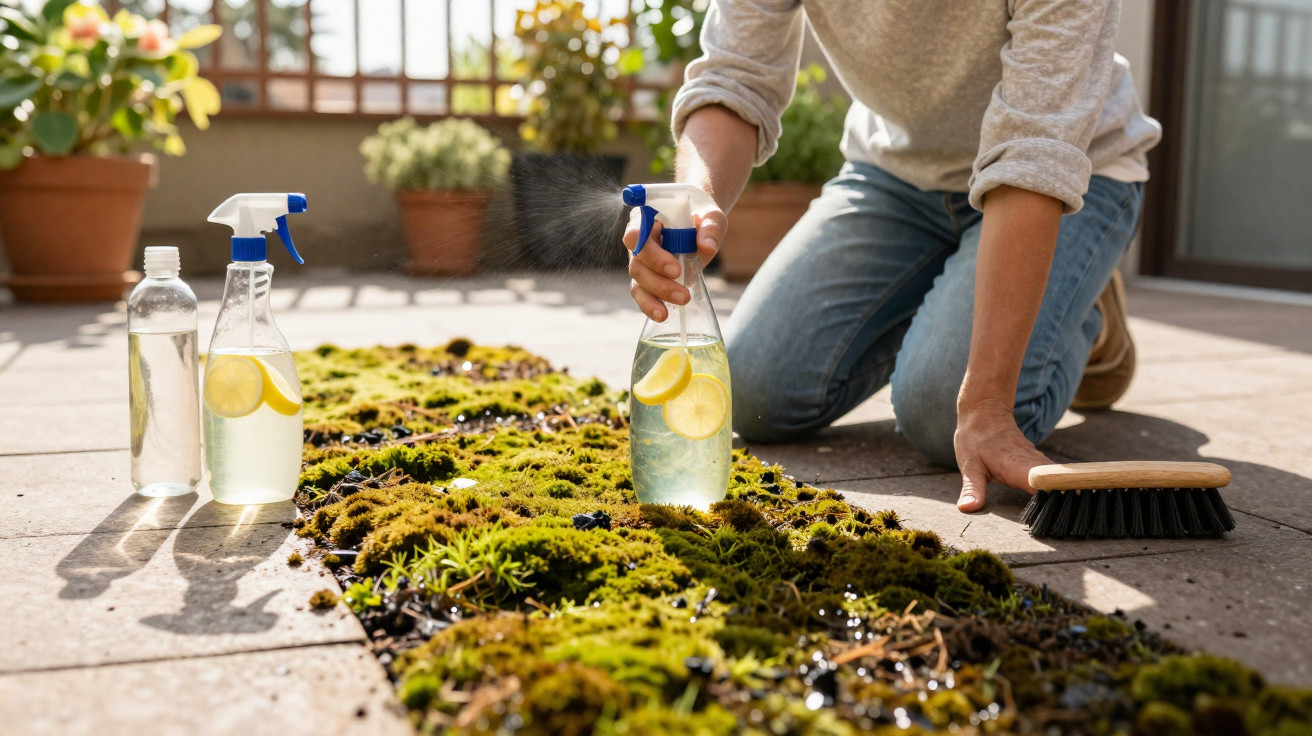
A quick reach into the kitchen cupboard can provide a surprisingly thorough answer.
Every year, many homeowners struggle with stubborn moss that spreads through every joint and leaves stone surfaces dangerously slippery. Costly specialist cleaners make big promises, yet they can often harm plants and the environment. In fact, one of the most effective options is usually already at home – and costs only a few pence.
Why moss quickly takes over patios and garden paths
Moss thrives in damp, shaded conditions. These are exactly the conditions found on many patios, paved paths, driveways and garden walls, particularly after a long, wet winter. Water collects in the joints, sunlight barely reaches them, and a green carpet soon develops.
Most people instinctively reach for a stiff brush or scrubbing brush. The surface may look clean for a short time, but the moss often returns within days. The explanation is straightforward: although the visible layer is removed, spores and root-like rhizoids remain in the smallest gaps. Unless these structures are targeted chemically, the moss can grow back quickly.
Chemical moss removers often work fast, but they frequently contain harsh substances. These may damage nearby greenery, flowerbeds or lawns. Anyone who has invested time in maintaining a healthy lawn and balanced garden environment will not want to take risks with strong chemical solutions.
“Moss is not defeated by sheer muscle power, but by using the right product in the right situation.”
Timing matters too. Cleaning while it is raining or immediately after a downpour wastes both effort and product. Water dilutes the mixture, washes it away from the surface and carries it into the ground. A dry day with light cloud cover is much more suitable: the liquid will not evaporate immediately, will not be rinsed away, and has time to work.
The kitchen combination that gets rid of moss
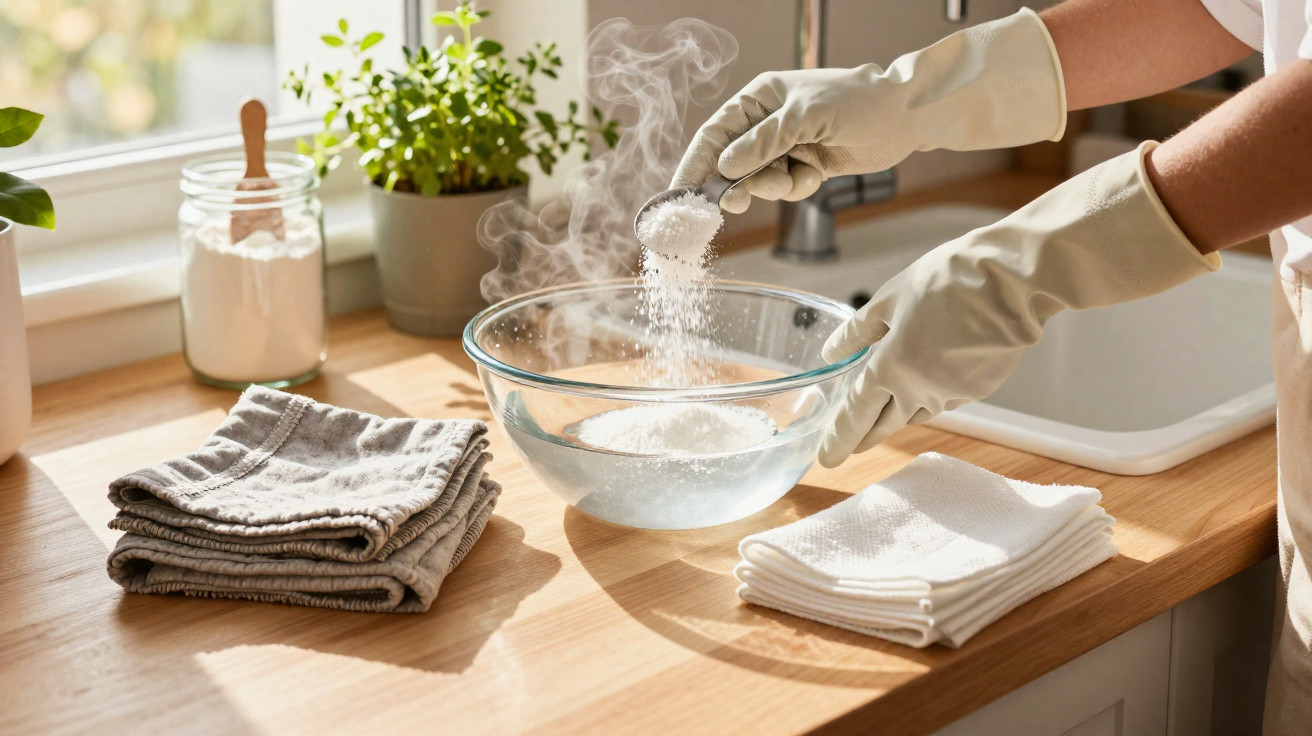
Two products found in almost every home can be remarkably effective when used together: ordinary white household vinegar and bicarbonate of soda. Dissolved in warm water, they create a mixture that not only loosens moss but may also help prevent it from returning quickly.
Vinegar contains acetic acid, which penetrates moss tissue and attacks it from within. Bicarbonate of soda is mildly alkaline and draws moisture from plant cells. Together, they affect moss in two vulnerable areas: the visible growth and the structures lodged in the joints.
A small squirt of washing-up liquid can boost the result further. It acts as a wetting agent, helping the liquid cling to the moss leaves and clumps instead of running straight off.
What you need for moss removal
- Household vinegar (white and unflavoured)
- Bicarbonate of soda
- Washing-up liquid (a small squirt is enough)
- Hot water
- A bucket or bowl
- A stiff brush or a yard broom with firm bristles
This equipment can be used for more than moss clumps on stone surfaces. Other unwanted plants growing in joints and between paving slabs can also be sensitive to it. For persistent weeds, however, targeted treatment for each type is generally more worthwhile than applying the same method everywhere.
Step by step: removing moss from outdoor surfaces
1. Prepare the surface thoroughly
Before applying any solution to the ground, clear away loose leaves, soil, small twigs and sand. Sweeping the patio properly first ensures that the mixture reaches the moss directly rather than disappearing into the dirt.
2. Mix the cleaning solution
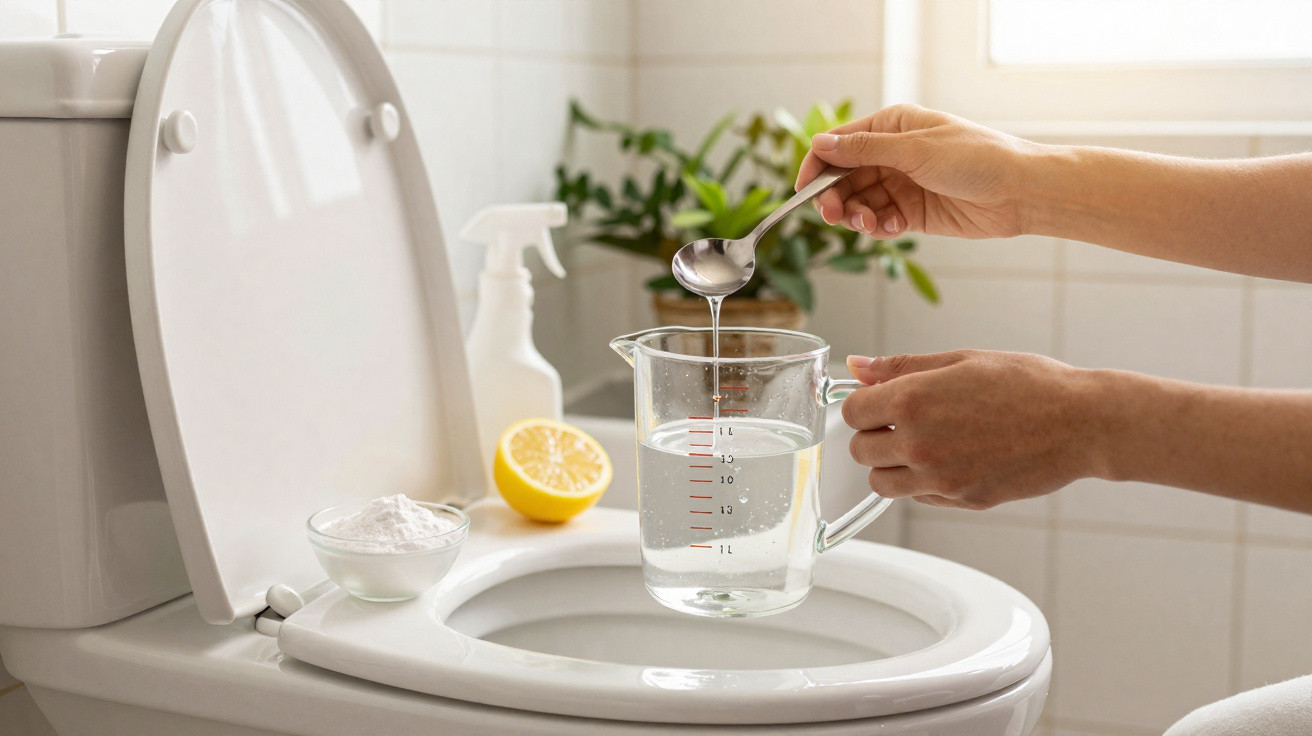
Fill the bucket with hot water, then add a generous amount of vinegar. Stir in two to three tablespoons of bicarbonate of soda until it has mostly dissolved. Finish with a small squirt of washing-up liquid. The mixture will fizz briefly, which is normal. Once the reaction has settled, it is ready to use.
| Ingredient | Purpose |
|---|---|
| Vinegar | Attacks the moss’s cell tissue |
| Bicarbonate of soda | Draws out moisture and makes regrowth more difficult |
| Washing-up liquid | Improves adhesion to the surface |
| Hot water | Enhances the effect and loosens dirt |
3. Apply the mixture and leave it to work
Pour the solution directly over all moss-covered areas or spread it using a watering can. Aim for as even a coating as possible. Then leave it alone. Allow at least 15 to 30 minutes for the acetic acid and bicarbonate of soda to reach the deeper layers.
Starting to scrub too early weakens the effect. A slightly longer waiting time is particularly worthwhile for thick moss clumps.
4. Finish with mechanical cleaning
After the waiting period, work across the surface using a stiff brush or yard broom in circular motions. In many cases, the moss will now lift away in flakes or whole mats. Any remaining material can be worked out of the joints with a little pressure.
Then rinse the entire area thoroughly with clean water. This removes dead plant matter, vinegar residue and bicarbonate of soda from the stones.
While rinsing, keep an eye on the surrounding area: avoid directing the water stream straight into flowerbeds, planters or vegetable patches wherever possible. Vinegar can harm sensitive plants, especially at higher concentrations.
Keeping moss away: how to keep patios cleaner for longer
A single clean rarely solves the problem forever. To get rid of moss for the long term, the site conditions need to change. Moisture is the most important factor. Wherever water continually sits or drains away slowly, moss has an easy time.
- Repair joints and stabilise loose paving stones
- Check the gradient so rainwater can run off
- Clean gutters and drains regularly
- Position planters so water cannot collect underneath them
Light is equally important. Overhanging branches and dense shrubs cast shade over patios and paths. Pruning them back moderately allows more sunlight to reach the paving. Dry, bright conditions make life much harder for moss.
Light preventative treatment can also be useful: apply a diluted vinegar-and-bicarbonate-of-soda mixture to particularly vulnerable spots every two to three months, before another green layer becomes visible. This gives spores less opportunity to establish themselves.
Important points for households to consider
Although household remedies can be helpful, nobody should simply reach for a watering can without thinking. Joints between natural stone, clay block paving and concrete can vary in their sensitivity. On very soft materials or polished surfaces, test the mixture first in an inconspicuous spot.
Some areas have strict rules on using vinegar and salt solutions on sealed surfaces, because residues may enter drains or groundwater. If there is any uncertainty, it is best to check the local position with the relevant authority beforehand.
There is another consideration: not every patch of green growth is automatically a problem. Moss can also be used deliberately as a design feature on old natural-stone walls or in damp corners of the garden. It is mainly a concern on slippery surfaces where people walk.
Everyday practical examples
On a balcony with concrete slabs, a small bucket of the mixture is usually enough for an initial test clean. Treating only the most affected corner is often sufficient to see the result. On driveways or wide paths, choose a dry day that is not too hot, so the liquid has enough time to work.
If there are children or pets in the household, it is best to wait until the surface has dried completely after treatment. By then, the vinegar and bicarbonate of soda will largely have evaporated or been rinsed away, and the paving can be used normally again.
Ultimately, anyone who keeps an eye on moss on patios and paths, sweeps regularly and occasionally follows up with the kitchen mixture can avoid expensive specialist products while significantly reducing the risk of slipping on slick surfaces.

Comments
В настоящее время к пробиотикам относятся следующие микроорганизмы:
Бифидобактерии (B https://пик-крым.рф/product/cadmium-iodatum/
bifidum, B https://пик-крым.рф/product/tuberculinum-rose/
infantis, B https://пик-крым.рф/product/oak-apple/
longum, B https://пик-крым.рф/product/cardiolpl/
breve, B https://пик-крым.рф/product/glycerolum/
adolescents);
Пищевые волокна (клетчатка);
Селен;
Все без исключения лекарства компании «Буарон», в том числе и монокомпонентные препараты, имеют регистрационное удостоверение лекарственного средства и соответствуют всем требованиям Министерства здравоохранения РФ, а само использование гомеопатических средств регулируется Приказом №335 от 29 https://пик-крым.рф/product-category/mono/b/ba/
11 https://пик-крым.рф/product/enterol-plus/
95 г https://пик-крым.рф/product/zincum-oxydatum/
«Об использовании метода гомеопатии в практическом здравоохранении» МЗ РФ https://пик-крым.рф/product/pilocarpinum/
Ксилобиоза;
Монокомпонентные препараты являются не только «исторической» основой бизнеса компании БУАРОН, заложенной еще в 30-х гг 20 века, но и приоритетным направлением для развития технологий и исследовательских программ сегодня https://пик-крым.рф/product/tarantula-cubensis/
Это целый ряд запатентованных процессов, которые из разряда «ноу-хау» БУАРОН перешли в категорию стандартов для всех остальных производителей https://пик-крым.рф/product/kalium-phosphoricum/
К пребиотикам относятся следующие органические соединения и компоненты пищи:
Непатогенные разновидности Escherichia Coli;
Leave a Comment