
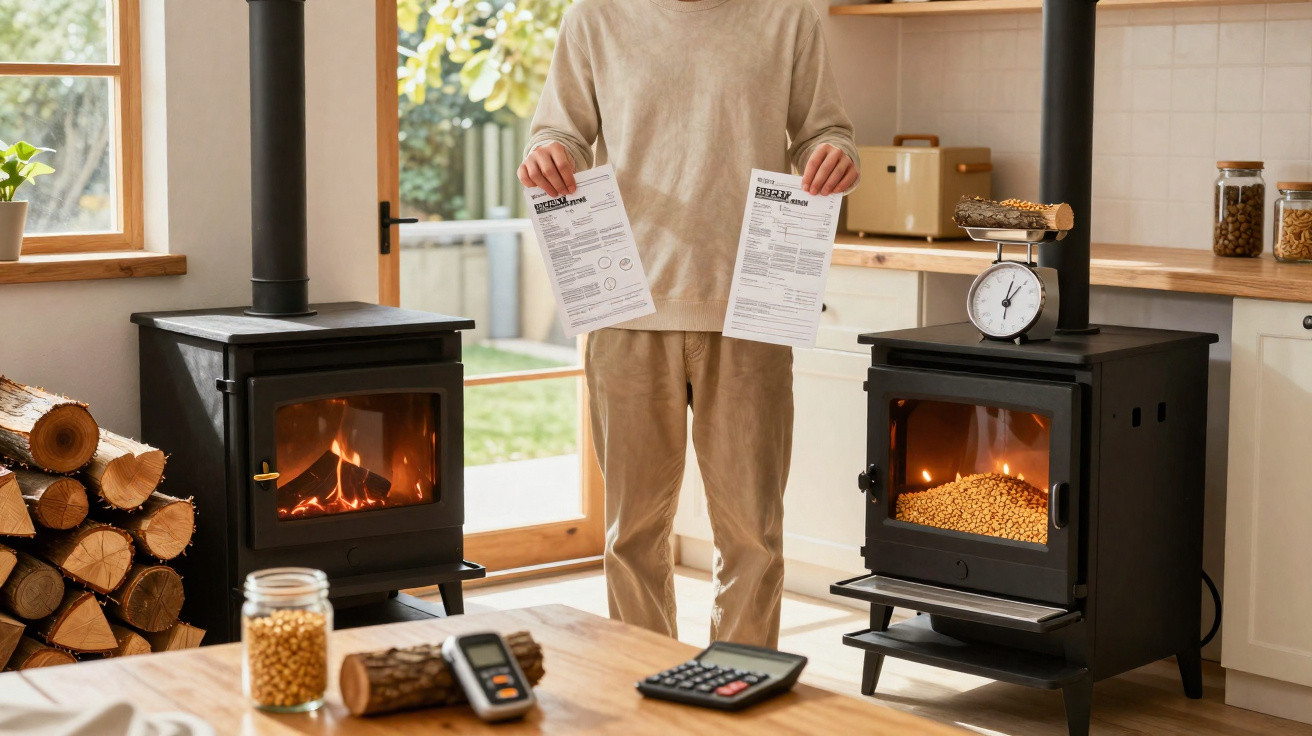
In the corner of his sitting room, an ageing cast-iron wood stove glowed a deep orange, the logs snapping and popping like a campfire. On his phone, a mate had just messaged photos of a sleek pellet stove, bragging about “fuel savings” and spotless glass. Same winter, same country-two very different flames… and two very different budgets.
From Europe to North America, the same question is being asked quietly at kitchen tables: do we stay with logs, or move over to pellets? Installer quotes don’t make it easier, online forums argue both ways, and every manufacturer claims to offer “the lowest cost”.
On some nights, the discussion becomes almost philosophical-tradition versus technology, independence versus convenience. Underneath it sits a harder question that nobody really enjoys confronting.
Which flame genuinely costs less, year after year?
Wood vs. pellets: what “economical” really means
In most households, the comparison begins with a single number: price per kilowatt-hour. Pellets can look a touch pricier on paper, but real life rarely follows a straight line. A modern pellet stove typically operates at 80–90% efficiency. Plenty of older wood stoves struggle to reach 60%, and some open fireplaces sink below 30%. That “cheap” log from the timber yard can quietly disappear up the chimney as smoke.
Affordability also includes what you don’t see at first glance: the time spent splitting, stacking and drying; the electricity a pellet stove requires; and the service visit that always seems to land on the coldest day of the year. Money saved on fuel can easily reappear elsewhere on your statement.
So the practical question is not “Which fuel costs less?” so much as “Which setup wastes the least energy, time and money in the life you actually live?” For some households, pellets are the obvious answer. For others, a well-stocked log pile still wins-by a long way.
Consider a small, rural house in Vermont: poorly insulated, but with easy access to woodland. The owners heat about 130 m². They purchase a mixed load of hardwood-around 4 cords per year-at 250 dollars per cord. That’s 1,000 dollars in fuel on paper. Their mid-range wood stove runs at 65% efficiency, which is respectable, yet plenty of heat is lost through a long, exposed flue.
In a nearby town, a retired couple in a better-insulated bungalow relies on a 9 kW pellet stove as their main heat source. They use roughly 3 tonnes of pellets each season, paying 280 dollars per tonne. That brings their annual spend to about 840 dollars. Their stove operates close to 88% efficiency, and the home holds a steadier temperature-avoiding overheating and wasted kilowatts.
Put side by side, the rural family spends more overall, despite having cheaper fuel per unit. The key difference is how much usable heat actually remains inside the building. This isn’t a one-off: energy agencies across Europe have published similar comparisons, showing modern pellet stoves often beating older wood stoves by 10–30% in real heat delivered for the same budget. When winter lasts six months, those percentages turn into a new coat, a dental bill, or a weekend away.
The reason for that gap is straightforward. Dry pellets at 6–8% moisture burn in a far more consistent way than assorted logs stored in a damp shed. Combustion is managed by an auger feed and sensors, rather than guesswork. A pellet stove can idle, modulate, and restart on a schedule. A log stove tends to live at the extremes: fierce heat for an hour, then a steady fall-off until someone adds more wood. That swing often means rooms pushed up to 24°C, windows cracked open in January, followed by a chilly wake-up at 3 a.m.
Those small daily losses accumulate. A thermostat-controlled pellet stove prevents many of them simply by being reliably steady. The trade-off is that pellets rely on a supply chain and electricity, while wood can be gathered, swapped, or cut yourself. In places with inexpensive local hardwood and frequent power cuts, the sums can tilt back towards logs-even if they burn less cleanly.
How to really compare costs at home (not in theory)
The most dependable way to judge what’s economical for you is to track two winters: one season using what you already have, and one with the alternative-or at least a “test month” under comparable temperatures. Note how much fuel you buy and how many heating days it covers. Keep it simple: a small notebook by the stove, one quick entry per bag of pellets or barrow of wood.
Next, convert that into cost per day of comfort. Not cost per kilowatt-hour, not per kilogram-per day when the house feels right. That’s where the surprises tend to appear. A pellet stove holding a consistent 20°C may use less total energy than a wood stove bouncing between 17 and 24°C. Same weather outside, different comfort level, different wastage.
Most people recognise the moment you return home and it feels like a fridge, even though the stove was roaring when you left. That’s the unseen cost of intermittent heat. A log stove without thermal storage will always peak and dip unless somebody is at home all day to feed it. Let’s be honest: almost nobody does that every day.
If you’re leaning towards a pellet stove, the biggest budgeting mistake is forgetting electricity and maintenance. A typical modern unit draws roughly 80–150 watts while running, with a brief spike at ignition. Across a full winter, that can add 40–100 dollars to your costs, depending on your tariff. It isn’t enormous, but it matters-particularly where electricity prices are rising.
Annual servicing is another predictable expense. Many manufacturers advise a professional sweep, a full clean, and a safety check every year or every two tonnes of pellets. That can cost 120–200 dollars or euros. With wood, chimney sweeping is still compulsory in many places and costs about the same, although some owners leave it too long and later pay in reduced performance-or worse, safety problems.
Fuel quality is where budgets can unravel fast. Low-cost, dusty pellets can burn quicker, create more ash, and block up the appliance. Wet logs from the edge of a yard can waste up to a third of their energy simply boiling off water before the room warms up. Each poor choice does more than cloud the glass-it siphons money from your future self, a few euros at a time, until the total for the season starts to sting.
“The cheapest stove is the one you live with comfortably for ten winters, not the one that looks cheapest in October,” explains a French installer who has been fitting both wood and pellet stoves for 20 years. “People forget to count their fatigue, their time, and their stress in the equation. Yet that’s what decides whether they keep using the system at all.”
To bring that down to everyday reality, it helps to write out what you value most. If you can’t stand noise, the gentle whirr of a pellet stove fan may irritate you, no matter how efficient it is. If you love the drama of big flames, a glass door filled with softly falling pellets might feel a bit “mechanical”. If you travel often during winter, pellet stoves are hard to beat thanks to timers and remote controls.
- Want autonomy during power cuts? A simple, non-electric wood stove is hard to beat.
- Live in a dense urban area with strict air rules? A certified pellet stove often passes where an old log burner doesn’t.
- Have access to free or almost free wood? A good modern wood stove plus proper seasoning can undercut pellets by a wide margin.
So, which really wins: wood or pellets?
When you ignore the marketing and look at euros or dollars per usable kilowatt-hour, modern pellet stoves come out ahead in many suburban and urban homes. High efficiency, steady indoor temperatures and low manual effort combine to reduce waste in quiet, hard-to-notice ways. Fuel prices may swing more than logs, but predictable day-to-day use often balances that out. Over ten winters, many household budgets end up appreciating that steady calm.
In rural settings-where wood is inexpensive, storage space is available and hands-on work is simply part of life-a well-chosen log stove remains a serious rival. Once you can buy or cut hardwood cheaply and season it for two years, the calculation can flip. The flame is less controlled and the routine is heavier, but the seasonal fuel cost can fall so far that even premium pellet systems struggle to match it-especially when electricity is costly or unreliable.
Between those poles sits a broad grey area where either option can be sensible. In that middle ground, “most economical” becomes a very personal judgement. Some people will happily pay a little extra each winter for the ritual of stacking logs and the scent of burning oak. Others prefer the opposite approach: spend more upfront on a pellet stove and enjoy pressing one button late at night on the way to bed.
What becomes clear, listening to installers and families, is that regret seldom comes from the fuel itself. It more often comes from expectations that don’t match reality: a pellet stove bought as a primary heater but undersized; a wood stove fitted into a badly insulated room; a household that underestimated the effort of moving three or four cords each year. The “wrong” choice is usually the one that doesn’t fit the rhythm of the home.
Perhaps the most straightforward way to see it is this: every flame has a cost-and a way of living attached to it. The most economical system is the one you can genuinely maintain, keep fuelled, and still enjoy for a decade or more, without resentment. The answer is hidden less in spreadsheets than in your habits, your climate, your fuel access, and the small details of your days.
One evening, years from now, you’ll come in from the dark, knock snow from your boots, and feel that first wave of warmth across your face. Wood or pellets, crackle or whisper. That’s the moment your decision will either feel right-or it won’t. It’s worth running the figures now, before the next bill arrives and makes the choice for you.
| Key point | Details | Why it matters to readers |
|---|---|---|
| Real seasonal fuel cost | A typical 8–10 kW pellet stove in a well‑insulated 100–120 m² home burns 2–3 tonnes of pellets per winter, often 500–900 €/$. A similar house on an older wood stove may use 3–5 cords of wood, from 600 to 1,500 €/$. Prices swing by region and supply. | Gives a realistic budget bracket instead of ideal lab numbers, helping you see which option fits your income and local fuel market. |
| Upfront investment and payback | Quality pellet stoves with installation often run 3,000–6,000 €/$. A basic but efficient wood stove can start around 1,500–3,000 €/$. Payback depends on what you replace (electric baseboards, oil, gas) and how many hours per year you actually heat. | Shows how long it may take before lower fuel bills offset the purchase, so you don’t expect “miracle savings” in the first winter. |
| Time and effort per week | Pellet users often spend 15–30 minutes a week loading bags and cleaning the burn pot. Wood users might handle 1–2 hours of stacking, carrying and lighting, more during cold snaps or if wood arrives unsplit. | Connects heating choice to your real schedule and energy level, not just your bank account, so the system doesn’t become a burden by February. |
FAQ
- Are pellet stoves always cheaper to run than wood stoves? Not always. In cities where pellets are widely available and seasoned hardwood is expensive, pellets often win in cost per usable kilowatt-hour. In forested areas with affordable, dry logs or your own woodlot, a good wood stove can be cheaper overall, especially if you’re willing to do the labour.
- How much electricity does a pellet stove really use? Most domestic pellet stoves draw 80–150 W while running and a short burst of a few hundred watts at ignition. Over a full winter, typical usage is roughly 100–250 kWh, which might add 20–70 €/$ to your power bill depending on your tariff and climate.
- Can I heat an entire house with just a pellet stove? Yes, in many compact or well‑insulated homes, a correctly sized central pellet stove can cover nearly all heating needs. In larger or older houses with closed rooms, it usually works best as a main source in the living area, backed up by radiators or another system for distant rooms.
- What’s the biggest hidden cost with a wood stove? For many people, it’s not the wood price itself but poor fuel quality and moisture. Burning logs that haven’t dried at least 18–24 months lowers efficiency, increases soot, and forces you to use far more volume than expected, quietly inflating your seasonal cost.
- Is it worth replacing an old wood stove with a modern model instead of switching to pellets? If you have cheap access to wood and like the ritual, upgrading to a modern, certified wood stove can lift efficiency by 20–30% compared with very old units. That alone can cut your logs consumption significantly without changing fuel type, and it keeps you independent of pellet supply and electricity.




Comments
No comments yet. Be the first to comment!
Leave a Comment