
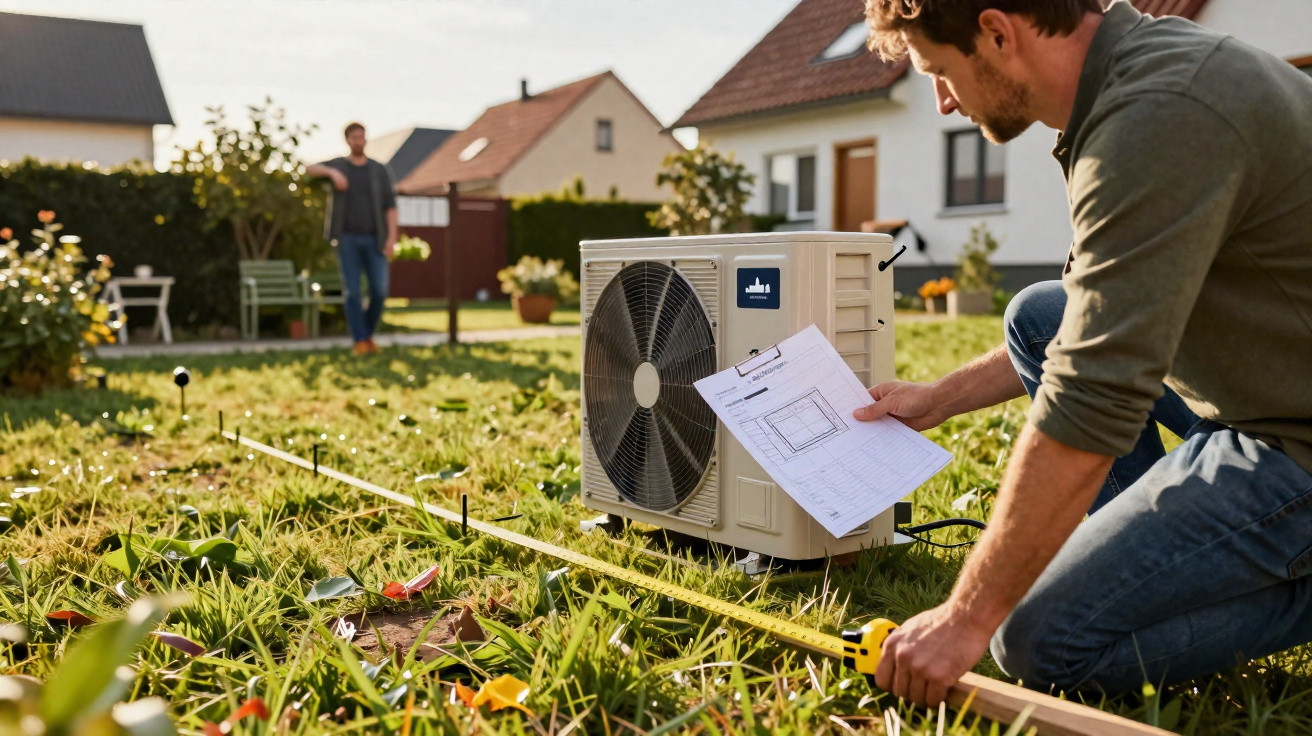
The heat pump boom is under way, and homeowners want to replace their heating systems as quickly as possible. But anyone who simply positions the outdoor unit “somewhere in the garden” risks an unpleasant surprise. Planning law, noise protection and neighbour-related rules have more far-reaching effects than many people expect – and an apparently harmless location can suddenly become an expensive issue.
Why the heat pump location is more than a minor detail
Many brochures make it look straightforward: a compact unit sits discreetly behind the house, screened by a little greenery, and that is that. In practice, it is more complicated. Although an air-to-water heat pump is considered “exempt from procedure” in many German federal states, meaning it can be fitted without a conventional planning application, this does not mean it may be placed anywhere in the garden.
“Exempt from procedure” only means that no standard planning application is required. Whether the installation is permitted at a particular location is decided separately.
This is precisely where many property owners are currently encountering unwelcome surprises. A real-world case from Stuttgart illustrates how quickly costs can mount when the authority examines the proposed installation site more closely.
Stuttgart case: a garden heat pump becomes a paperwork marathon
In Bad Cannstatt, a homeowner intended to replace an old heat pump. The new system was to go in the same garden position as its predecessor – on the owner's own land and unobtrusively behind the house. It appeared to be a routine replacement.
However, the responsible building authority requested extensive documentation: site plans, extracts from the land register and precise dimensions. What should have been a simple replacement turned into a small application process, creating extra work for both the planner and homeowner. According to the report, the documents cost around €1,600 – on top of the heat pump itself.
What may seem like an isolated local case is based on rules that apply nationwide: municipalities rely on the Land Use Ordinance and the relevant local development plans. The crucial issue lies there.
The building envelope: an invisible boundary in the garden
Every plot covered by a development plan has what is known as a building envelope, sometimes referred to in planning documents as the “buildable area of the plot”. Normal construction is only permitted within this zone. The house, extensions, garage and, in most cases, a heat pump can generally be accommodated there without difficulty.
If the heat pump stands within the building envelope, much of the process is straightforward. Outside it, the grey area begins – and so does the paperwork.
As soon as the outdoor unit is positioned freely in the garden, by a fence, at the rear edge of the plot or next to the patio, it will often fall outside this building envelope. The authority then treats the equipment not merely as domestic building services, but as a structure outside the designated building area of the plot. The result is more scrutiny, more documents and higher costs.
Typical problem areas for a garden heat pump
- at the rear end of the plot, close to the boundary
- free-standing in the middle of the lawn, far from the house
- close to a neighbour's patio
- directly beside the pavement or road
Many homeowners select such locations to keep noise away from their own living room or to avoid obstructing the façade. Yet, by doing so, they often unknowingly move outside the building envelope.
Noise protection: when a neighbour becomes the authority's listening ear
A second issue accompanies planning law: noise. Heat-pump outdoor units have become quieter, but they are not silent. Especially at night and on very cold days, the fan operates for longer and may be perceived as a nuisance.
The Technical Instructions on Noise Abatement (TA Lärm) set limits that vary by area type, such as a purely residential area or mixed-use area. Where locations are disputed, the local authority assesses whether noise levels at the plot boundary and neighbouring house remain within the permitted range.
If the heat pump is positioned close to the plot boundary, sometimes an irritated neighbour and a call to the council are enough to trigger an inspection.
Acoustic covers and quieter units can help, but they do not always solve the underlying problem of an unsuitable location. If the system later has to be moved or upgraded with more extensive noise-control measures, total costs rise considerably.
What homeowners should clarify before buying a heat pump
To avoid disputes with authorities and neighbours, it is worth doing some preparation before appointing an installer. The key steps at a glance are:
- Check the development plan: Where does the building envelope run? Are there specific requirements for ancillary buildings and technical equipment?
- Ask the planning authority: A brief telephone enquiry or an informal request about the intended location can clarify a great deal in advance.
- Involve the installer: Reputable specialist firms understand typical distances and noise limits, and can outline several options.
- Inform neighbours: Give them early notice, explain the location and noise level, and listen to concerns – this can prevent problems later.
- Allow contingency in the budget: Leave some flexibility for plans, reports or a minor change of location.
Good and poor heat pump locations compared
| Location option | Advantages | Potential problems |
|---|---|---|
| against the house wall within the building envelope | usually unproblematic under planning law, short pipe runs, straightforward connection | noise closer to the home's living spaces, more visually prominent |
| free-standing at the back of the garden | further from living spaces, often visually discreet | potentially outside the building envelope, additional documents required, conflicts with neighbours |
| close to the plot boundary | frees up space by the house, flexible pipe routing possible | noise on the neighbouring plot, strict distance rules, high potential for conflict |
| in the front garden facing the road | easy access, far from neighbours' gardens | visually conspicuous, may not be permitted depending on the municipality |
How authorities assess a proposed location
Building authorities do not base their decisions on personal preferences, but on clear criteria. Among the decisive factors are:
- Development plan: Does it contain provisions on ancillary installations or domestic building services?
- Area type: Densely built-up residential areas are assessed more strictly than less built-up zones.
- Distances: How far is the unit from boundaries and buildings?
- Noise forecast: Are manufacturer data and simple calculations sufficient, or does the authority require an expert report?
The further the desired location is from the house, the more likely the authority is to request detailed documentation. Simply saying “It has always been like that” is usually insufficient, particularly where the old heat pump was never formally assessed.
Technical pitfalls: pipe runs, frost and appearance
Technical factors matter alongside planning law. Long pipe runs between the outdoor unit and indoor unit result in greater heat losses and higher material costs. Pipes must be installed in a frost-proof manner and insulated properly; otherwise, many systems operate inefficiently.
Visual measures such as privacy screens or enclosures may look appealing at first glance, but they can restrict the air supply and increase noise levels. Anyone who hides the heat pump completely risks poorer performance figures and higher electricity costs.
Practical example: reducing the risk of a problematic location
Take a typical detached house in a densely built-up residential area. The occupants want to install the heat pump at the far end of the garden so that the patio remains quiet. However, the development plan shows that the building envelope ends only a short distance behind the edge of the house.
A sensible solution could be to place the unit on the side wall of the house, set slightly back within the building envelope. A sound-insulated outdoor unit and a planted privacy screen can reduce both the visual and acoustic impact. The location is compliant with planning requirements, pipe runs remain short, and the authority will often give approval more quickly.
Why a brief look at the documents can save a great deal of money
Anyone considering a heat pump should focus on more than performance, grant schemes and price. The installation site also determines whether the project proceeds smoothly and predictably, or whether a substantial additional item appears in the cost breakdown.
Half an hour spent reviewing the development plan, a phone call to the planning authority and a clear site proposal from the installer can prevent many pitfalls. That way, the heat pump remains what it is meant to be: a modern, efficient replacement for the old heating system – rather than an unexpected project in the garden and a drain on the budget.






Comments
No comments yet. Be the first to comment!
Leave a Comment