
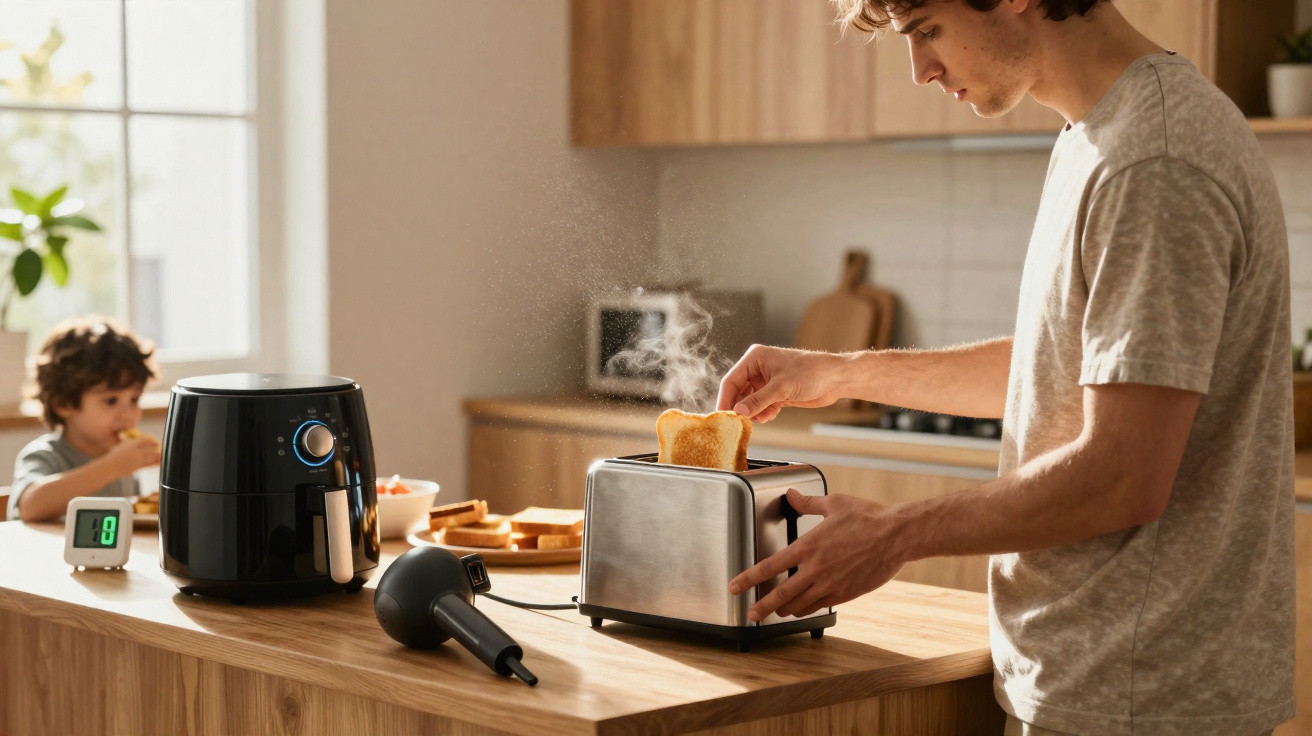
Small appliances shape everyday life, from the early kitchen rush to drying your hair late at night. Yet behind their familiar hum and warmth, scientists are identifying a haze of ultrafine particles that can enter the lungs directly, with children facing the greatest exposure.
When comfort appliances become micro-polluters
Indoor air may seem safer than urban smog or traffic fumes, but modern homes often combine heat-producing devices, electronics and limited ventilation. Researchers at Pusan National University in South Korea have highlighted the issue, finding that everyday appliances including toasters, air fryers and hair dryers may release billions of ultrafine particles each minute.
Under controlled laboratory conditions, a standard toaster operated empty, without any bread, released as many as 1.73 trillion particles per minute. It appeared innocuous on a worktop, but particle measurements showed it behaving more like a small industrial emission source.
These appliances generate clouds of particles under 100 nanometres wide – small enough to evade the body’s natural filters and reach deep into the lungs.
The researchers assessed familiar consumer products rather than specialist industrial equipment: ordinary toasters, popular air fryers and household hair dryers. Emissions differed greatly between models. Traditional hair dryers fitted with brushed DC motors produced 10 to 100 times more particles than brushless versions. Toasters and air fryers also generated pronounced peaks, particularly when used at higher temperatures.
Whereas outdoor pollution generally disperses into open air, these emissions can accumulate in enclosed kitchens, bedrooms and bathrooms. Users are often very close to the appliance, may breathe more deeply while cooking, cleaning or styling their hair, and frequently leave windows closed to retain warmth or save energy.
What are ultrafine particles?
Ultrafine particles (UFPs) are less than 100 nanometres in diameter. By comparison, a human hair is approximately 700 to 1,000 times thicker. Their tiny size is important because they can bypass nasal hairs and mucus, travel far into the bronchial tree, and settle in the alveoli, where gas exchange takes place.
- Rather than remaining only in the airways, many are able to pass through cell membranes.
- Some enter the bloodstream and can travel to organs including the heart and brain.
- There is no established clear “safe threshold” for long-term UFP exposure.
Their invisibility and lack of odour mean they are easily underestimated. With no smoke, smell or immediate irritation, exposure can go unnoticed.
Inside the appliances: the source of the particles
The Korean researchers went beyond particle counts. They dismantled the appliances, isolated individual components and examined the chemical make-up of the emissions. Heating coils and brushed electric motors repeatedly emerged as the principal sources.
Heating elements deteriorate as they are repeatedly exposed to high temperatures. During each operating cycle, minuscule fragments of material may break away. Brushed motors, which remain widespread in lower-cost hair dryers and small appliances, create microscopic debris when their brushes make contact with the commutator.
Chemical analysis revealed a cocktail of metals in the emitted particles: copper, iron, aluminium, silver and titanium, all at nanometre scale.
These metals come directly from coils, wiring, brushes and structural components. At nanoscale size, they have a large surface area for chemical reactions and may cause oxidative stress in cells. Laboratory tests in the study indicated cytotoxic and inflammatory effects, alongside possible links to DNA damage where exposure is repeated over long periods.
Appliance design choices that affect the air you breathe
One notable finding was the difference between products that appear very similar. Two hair dryers could be displayed side by side with near-identical packaging, while their particle emissions differ by a factor of 100.
| Appliance type | Key component | Relative UFP emissions (study findings) |
|---|---|---|
| Hair dryer with brushed motor | Brushed DC motor | High (10–100x more than brushless) |
| Hair dryer with brushless motor | Brushless motor | Much lower |
| Toaster (no bread) | Heating coils | Up to trillions of particles per minute |
| Air fryer | Heating element + fan motor | Very high at peak temperature |
This variation points to considerable scope for technical improvements. Brushless motors, already found in premium appliances and certain cordless tools, produce substantially fewer particles. Improved alloys, protective coatings and redesigned coils might similarly reduce emissions from heating elements. However, manufacturers seldom test for these emissions, much less disclose the results.
From kitchen air to the bloodstream: what health models indicate
To connect laboratory measurements with real-life exposure, the Pusan team used computational models of the human respiratory system. These simulations estimate where particles of varying sizes settle in the airways of children and adults.
According to the models, most ultrafine particles emitted by these appliances are deposited in the alveoli. A proportion may then cross into the bloodstream, from where they could reach the liver, heart or brain and trigger systemic inflammation.
Children inhale more air per kilogram of body weight, have narrower airways and breathe faster, so the same room concentration leads to a higher dose reaching their lungs.
For a child positioned near a toaster or hair dryer at face height, the modelled dose per kilogram of body weight was higher than for an adult in the same room. Health concerns associated with this type of chronic low-level exposure include:
- ongoing airway inflammation and declining lung function over time;
- worsening asthma and other respiratory conditions;
- greater cardiovascular strain resulting from systemic inflammation;
- possible disruption to immune responses.
Other nanotoxicology research suggests a similar pattern. Although an individual exposure may appear insignificant, daily use over many years could alter baseline inflammation and interact with pre-existing issues such as allergies, viral infections or heart disease.
Regulation is lagging behind the living room
Traffic and industrial outdoor pollution is heavily regulated in many countries. Authorities monitor PM2.5, PM10 and nitrogen oxides, issue warnings, and set emission limits. Within homes, standards generally focus on ventilation requirements or formaldehyde from construction materials. Ultrafine particles produced by appliances have largely escaped regulation.
The Pusan researchers contend that this omission is increasingly difficult to justify. People spend most of their time indoors, particularly children, older people and those working from home. Toasters and hair dryers operate close to the face rather than from faraway chimneys.
The study calls for emission limits for small appliances, laboratory testing protocols and health-focused labels that highlight low-emission designs.
Proposed policy measures include:
- standardised testing of UFP emissions in realistic operating conditions;
- maximum emission limits for each appliance category, comparable to energy-efficiency ratings;
- labelling systems showing “low ultrafine particle” performance to help shoppers choose products;
- public advice on ventilation during and after using high-heat appliances.
Such action would move part of the responsibility away from individual choices and towards product design. Engineers would have to consider particle emissions a key performance measure rather than an overlooked side effect.
What households can do now
Regulatory change takes time, while manufacturers do not typically redesign whole product ranges overnight. Until then, households can lower exposure through several practical measures without having to discard every appliance.
- Operate toasters and air fryers beneath a working cooker hood or close to an open window.
- Do not lean over a toaster slot or air fryer basket as it heats up.
- Dry hair in a well-ventilated space instead of a closed bathroom.
- When replacing appliances, choose models with brushless motors when that information is available.
- Clean appliance filters and vents regularly to prevent dust and particles from building up.
These actions will not eliminate emissions, but they can reduce local concentrations and shorten the time spent inhaling the most concentrated plume. This may make a meaningful day-to-day difference for people with asthma, COPD or cardiovascular disease.
Bigger picture: ultrafine exposure from several sources
The toaster is part of a broader indoor pollution pattern. Candles, incense, frying on gas hobs, 3D printers, laser printers and even certain vacuum cleaners can also produce ultrafine particles. Any one source may seem minor, but together they can create an unnoticed background haze in a tightly sealed modern home.
Health researchers increasingly refer to a lifetime “cumulative particle load”. Indoor emissions from consumer products add to ambient urban pollution, second-hand smoke where it is present, and workplace exposure. Lung tissue does not distinguish between the source of individual particles; the overall biological burden builds up.
One promising avenue for future research is real-time monitoring in the home. Affordable particle counters already reveal PM2.5 spikes when food is fried or candles are lit. Equipment capable of measuring the ultrafine range more accurately could make otherwise invisible emissions visible in graphs, encouraging regulators and manufacturers to respond more quickly.
For the moment, the Korean findings point to a straightforward change in perspective: the soft click of a toaster, the reassuring roar of a hair dryer and the buzz of an air fryer are not merely ordinary household sounds. They may also signal a stream of nanoscale debris moving through the room and towards the lungs of whoever is closest, especially the smallest people in the home.





Comments
No comments yet. Be the first to comment!
Leave a Comment