
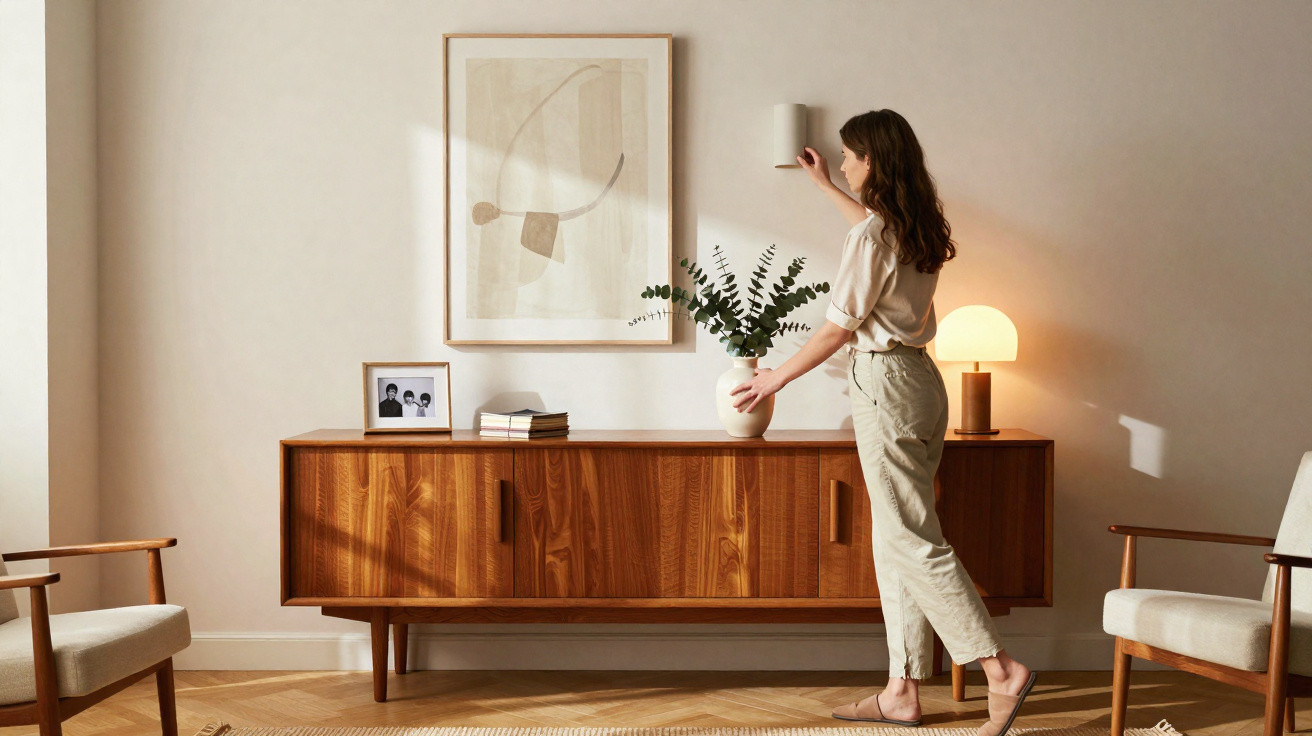
In this home, an old sideboard considered too dated has reclaimed a central place in the living room after an almost imperceptible transformation.
A family heirloom can quickly turn into a decorating dilemma: too ornate, too dark or too strongly associated with another era. Yet, simply presenting it differently can sometimes elevate it into a centrepiece. That is what an interior featured by a specialist home décor and interior design publication demonstrates: an inherited sideboard, overlooked for years, was brought back into the living room through two highly targeted adjustments.
An inherited sideboard considered “too dominant” in the living room
In the flat described by the website, the main issue was in the living room: a large antique sideboard passed down through the family. Although the piece held considerable sentimental value, its imposing style, heavy lines and dark finish clashed with the brighter, more contemporary decorative scheme planned for the rest of the room.
As a result, the sideboard had been reluctantly pushed aside. It was retained mainly for its practical storage capacity, rather than being genuinely embraced as part of the décor. The owners were torn between selling or giving it away, as they were attached to its history but admitted that they could no longer tolerate its visual presence every day.
The classic case of a piece of furniture you keep “because it is a family heirloom”, but never really make part of your home.
The interior designer’s challenge was therefore to retain the sideboard without completely repainting or stripping it of its character, while making it work within a more modern, pared-back living room.
Two minimal changes that transformed how the furniture was perceived
Instead of undertaking a full makeover, the professional focused on two straightforward levers: the sideboard’s immediate surroundings and a handful of subtle changes to its appearance.
1. Reworking the setting: wall, lighting and surrounding furniture
The first approach concerned the area around the sideboard. The wall behind it was already light, but it had not been used to its full potential. The interior designer turned it into a backdrop by concentrating on three elements:
- a neutral yet warmer wall shade, creating contrast with the wood without overwhelming it;
- more considered lighting, with a light source aimed at the top of the sideboard to emphasise its line rather than its bulk;
- clearer positioning within the room, avoiding the placement of other large pieces of furniture close by.
This work on the setting had an immediate effect: the sideboard no longer looked like an isolated block, but instead became an element integrated into a coherent whole.
2. Lightening the sideboard without denying its character
The second stage involved gentle alterations to the sideboard itself. Full sanding or an opaque coat of paint were considered too radical for a family heirloom, so the interior designer opted for targeted interventions instead:
- replacing the handles with a plainer, more graphic model that suited the living room décor;
- slightly lightening certain visible areas, especially the top, so that they reflected more light;
- simplifying the display above the furniture, using fewer objects and a few selected pieces - a lamp, picture frame and vase - to create a lighter visual rhythm.
Two modest interventions - the setting around the sideboard and a few targeted details - were enough to shift the piece from a constraint to a visual asset.
The sideboard remains true to its original style, but it no longer catches the eye in the same way. It now works with the rest of the living room rather than overpowering it.
How a fresh perspective can save a family heirloom
The example featured by the specialist décor publication reflects a growing trend: rather than buying new furniture, many people are seeking ways to reintroduce older pieces into contemporary interiors. This inherited sideboard shows that a successful transformation does not always require extensive work.
In practice, three principles frequently emerge when restoring a family heirloom:
- assess the furniture within its surroundings rather than in isolation, taking account of the wall, flooring, light and other furnishings;
- identify what is actually problematic: the colour, size, handle style, height or sheen;
- begin with reversible adjustments before altering the structure or the wood itself.
In the featured flat, rediscovering the sideboard also had a psychological impact: the owners no longer felt that they had to “put up with” a piece imposed by the family. They made it their own without rejecting its story.
What this means for a home in France
For readers in France, this type of approach can be readily adapted. Many homes, particularly family properties, contain imposing sideboards, dressers, chests of drawers or wardrobes inherited from parents or grandparents. Such pieces often date from periods when furniture was oversized in relation to today’s living spaces.
Rather than automatically taking them to an antiques dealer or the tip, several options similar to those outlined by the specialist publication can be considered:
- move the furniture to a more open wall, sometimes simply by rearranging the living room;
- reconsider the paint colour of the wall behind it: a gently contrasting tone can modernise the whole arrangement without touching the wood;
- refine the lighting: a wall light, table lamp or even a small track of adjustable spotlights can enhance the lines instead of drawing attention to the bulk;
- replace overly ornate or gold-coloured handles with more contemporary options, such as matt black, brushed brass or plain ceramic;
- reduce what sits on top of the furniture: a few carefully selected items are better than a row of ornaments.
Decorating professionals in France often recommend this gradual approach before moving on to more substantial changes, such as full repainting or replacing the legs. It allows homeowners to test how well the piece fits into the room without permanently breaking with its original appearance.
Practical ideas for transforming a sideboard without major work
To illustrate the scope for change, the table below summarises a number of easy measures that can be carried out at home:
| Perceived problem | Simple action | Expected effect |
|---|---|---|
| Furniture is too dark | Lighten the top or add a large pale table runner | Reduces the sense of bulk and catches the light |
| Style is seen as old-fashioned | Change the handles and simplify the objects placed on top | Updates the overall look without altering the wood |
| Furniture feels “overwhelming” | Position it alone against a wall, without a large adjacent item | Turns the sideboard into a statement piece rather than a visual obstruction |
| Visual clutter | Reduce the number of frames, vases and ornaments above it | Makes the outline clearer and lighter |
When should you consider a more extensive transformation?
There are, however, cases in which two small changes will not be enough. If the furniture obstructs movement, is genuinely out of scale for the room or is damaged to the point that its use is affected, more significant work may be required: cutting it down to reduce its depth, changing the legs to raise or visually lighten it, or applying opaque paint to unify badly damaged wood.
Some people also choose to give an antique sideboard a different purpose: using it as a TV unit, hallway storage, an open dresser or even an additional worktop in a kitchen. This reassignment can make an older style easier to accept by placing it in a different role.
A significant economic and environmental benefit
Behind the story of this restored sideboard highlighted by the décor publication lies an economic and environmental issue too. Keeping an existing piece of furniture, especially one that is well made, avoids the purchase of new furnishings that are often produced from less durable materials.
A light transformation of an antique sideboard generally requires only a few focused purchases: handles, wall paint, a lamp and perhaps a rug to redefine the area. The cost remains significantly lower than buying new furniture of equivalent quality, while preserving the sentimental value associated with a family inheritance.
For a French household, this approach therefore offers a double opportunity: to limit spending and reduce waste, while doing justice to an object steeped in history. The styling described in the source article shows that, sometimes, two well-chosen gestures are enough to turn a piece of furniture “you do not dare to own” into a genuine focal point in the living room.

Comments
No comments yet. Be the first to comment!
Leave a Comment