
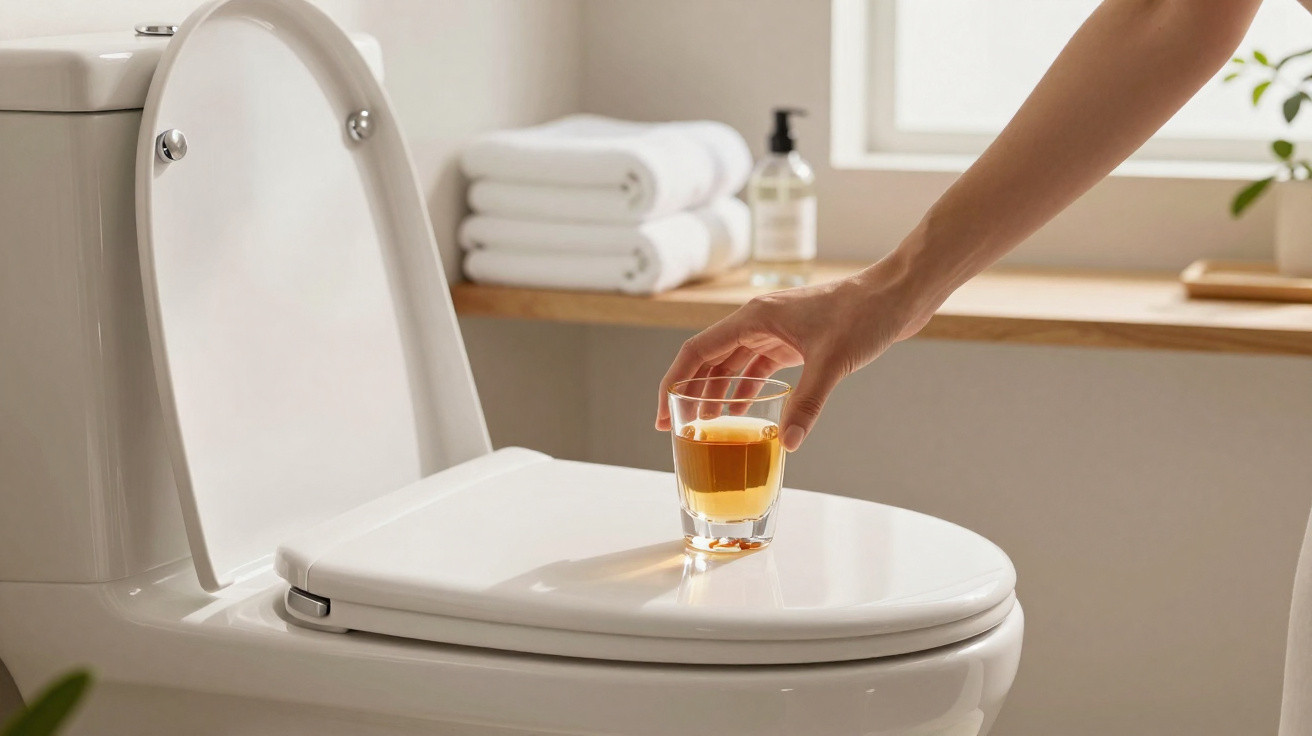
The woman in the TikTok clip never says a word. She puts an ordinary drinking glass on top of the toilet cistern, unscrews a small perfume bottle and sprays the inside with slow, almost overly deliberate care. She then pours water into the glass, leaves it there as though it were a candle, and exits the room.
Two hours afterwards, people in the comments insist they can “smell the screen”.
It is easy to imagine the effect: you push open the bathroom door and catch a soft, hotel-lobby-style fragrance, although the room appears exactly the same. There is no expensive diffuser or oversized floral display, only an unremarkable glass beside partly used hand soap.
It is the sort of simple idea that seems too inexpensive and effortless to work.
Could this be the starting point of that quietly luxurious bathroom scent?
The surprisingly effective glass-on-the-toilet trick
At face value, putting perfume in a glass seems like the kind of social-media stunt made solely to attract views. There is a clear cup, a few bursts of fragrance, tap water, and an edit that ends before the scent has any chance to prove itself.
Even so, it is hard not to picture yourself testing it before visitors come round.
The bathroom may be the smallest room in a home, but it can make an unforgivingly powerful first impression. One lingering smell of damp towels or residue from a toilet brush can instantly make the whole room feel less clean. A method that claims to deliver subtle luxury without any renovation is bound to appeal.
It also makes use of something many of us already have: a neglected perfume bottle that never quite suited our skin.
On social media, the scenario usually unfolds in much the same way. Someone says their bathroom smells “a bit… lived in,” however often they clean it.
Then comes the reel: a before shot, an uncomfortable expression, followed by a cut to a glass sitting on the cistern. Perfume is sprayed generously, water swirls around the glass, and a stray comment appears, perhaps saying “Omg my bathroom smells like a spa now.”
Below it are thousands of saves, with people tagging friends and writing: “We’re doing this before Saturday.”
One London woman said she put an inexpensive vanilla perfume in a glass and, for the first time, a visitor asked which “diffuser brand” she used. She simply laughed and moved the conversation on. Privately, she knew she had elevated a £4 body mist to the status of silent luxury.
In principle, the method does add up. Perfume is more than posh alcohol: it contains a concentrated blend of aromatic molecules formulated to evaporate gradually. Spraying it into a glass before diluting it with water creates a sort of budget fragrance bowl.
Changes in the bathroom’s temperature, together with the air movement caused by opening and shutting the door, help carry those scented particles around the room. The shape of the glass retains part of the fragrance cloud, then lets it escape slowly.
It will not rival a professional candle in a mansion-sized sitting room, but in a compact, tiled bathroom? It performs far better than you might expect.
The “suspicious” element is not that it works. It is that no one appeared to think of it ten years ago, when we were collecting reed diffusers and acting as though we genuinely liked potpourri.
How to use the perfume-in-a-glass trick without creating a chemical storm
The method itself could hardly be more straightforward.
Choose a clean glass or sturdy tumbler, preferably one you will not mind losing to a lingering perfume scent.
Spray the inside 5–10 times with a fragrance you enjoy smelling, even if you would not choose to wear it. Gentle florals, fresh citrus scents, cotton fragrances and “clean laundry” style perfumes often work well. Next, fill the glass halfway with cool water and position it on a stable, level surface away from direct splashes: the rear of the toilet, the edge of the sink or a high shelf.
After 20–30 minutes, the fragrance should begin to move through the room like the subtle scent of a hotel corridor.
This is the point at which plenty of people overdo it. Twenty sprays of a very sweet perfume in a small bathroom can feel less like a “luxury spa” and more like a “teenager’s first nightclub”. The aim is a light layer of scent, not a fog you can taste.
Start moderately, and add only a couple of extra sprays if you truly cannot smell anything after an hour.
We all know that moment when “just a bit more” turns into a headache and open windows in January.
There is also an obvious reality to remember: Let’s be honest, nobody really refreshes their bathroom fragrance every single day.
Choose an amount of effort that works with your real routine, rather than with the version of yourself who is always ready for visitors.
Creators who champion this idea often pair it with quieter, more traditional habits. One home stylist I spoke to said she does not regard it as magic, but as an enhancement for a room that is already properly maintained.
“I use the perfume glass like a finishing touch,” she explained. “Clean surfaces, dry towels, lid down, window cracked if I can. The glass is the last 5%. It’s the ‘oh wow, this smells nice’ moment people remember, even if they can’t spot where it’s coming from.”
Alongside the glass, she leaves a small checklist taped inside the cabinet:
- Open the window or run the fan for 10 minutes after showers
- Swap hand towels twice a week, more often with kids
- Keep a closed box for the toilet brush and extra rolls
- Use unscented or mild cleaners, then layer scent on top
- Refresh the glass trick before guests or once the smell fades
Suddenly, the sense of “luxury” feels less like a hidden hack and more like a small daily choreography.
The real luxury behind a scented bathroom
Once you notice it, the wider subject of bathroom fragrance reveals quite a lot about modern life. We are trying to recreate hotel atmosphere in homes that also serve as offices, gyms and storage spaces. We want a scent that communicates “calm, tidy, under control” even when washing is draped over the shower rail.
The glass trick partly succeeds because it is unobtrusive. It is not a branded diffuser calling attention to itself in the corner, nor is it a candle that requires you to remember to blow it out. It is a modest household object quietly doing something a little covert in the background.
That faint scent signals to guests that somebody has thought about the room. Somebody has paid attention to the details.
Perhaps that is why this small hack creates such an emotional response. It connects with a larger desire for our homes to feel gentler, more polished and slightly curated, without requiring the budget for a complete renovation.
A bathroom that smells costly, even when the tiles date from 1998, offers a small feeling of improvement. It is a private, low-key upgrade for those three minutes when you close the door between Zoom calls.
You could try different perfumes, or experiment with essential oils, until you find a signature scent of your own. Rather than the standard “ocean breeze” of supermarket sprays, it could become a fragrance your visitors begin to link specifically with your home.
What does it mean when a plain glass of scented water becomes part of your home’s identity? That is the question left in the air the next time you open the bathroom door and realise, without being entirely sure why, that you suddenly feel as though you have checked in somewhere else.
| Key point | Detail | Value for the reader |
|---|---|---|
| Simple setup | Glass + 5–10 sprays of perfume + water in a small bathroom | Easy, low-cost way to upgrade the room’s atmosphere |
| Right fragrance choice | Light, clean scents work better than heavy or overly sweet ones | Reduces risk of headaches and “cloying” smell |
| Part of a routine | Combine with airing out, clean towels, and discreet storage | Creates a consistent, quietly luxurious impression |
FAQ:
Question 1 Does the perfume-in-a-glass trick actually last more than a few hours? It generally remains noticeable for several hours in a small bathroom, depending on the strength of the perfume and how much air circulates. Warmer rooms and stronger fragrances usually last longer, although this is not a solution that lasts for several days.
Question 2 Can I use essential oils instead of perfume in the glass? Yes, a few drops of essential oil can be added to water, but the mixture will need stirring and refreshing more frequently. Some oils can also cling to glass, so it is best to reserve one cup for this purpose.
Question 3 Is it safe to have a scented glass near the toilet? It is generally fine provided the glass sits on a secure surface where it is unlikely to be knocked over. Avoid very low ledges when children or pets are present.
Question 4 Will this trick replace cleaning products or air fresheners? No, it will not conceal strong, ongoing odours or mould. Treat it as a final touch alongside routine cleaning and ventilation, not as a substitute for either.
Question 5 What if my guests are sensitive to fragrance? Select very mild, neutral scents and use fewer sprays, or do not use the trick at all when you know someone sensitive to fragrance will be visiting.

Comments
No comments yet. Be the first to comment!
Leave a Comment