
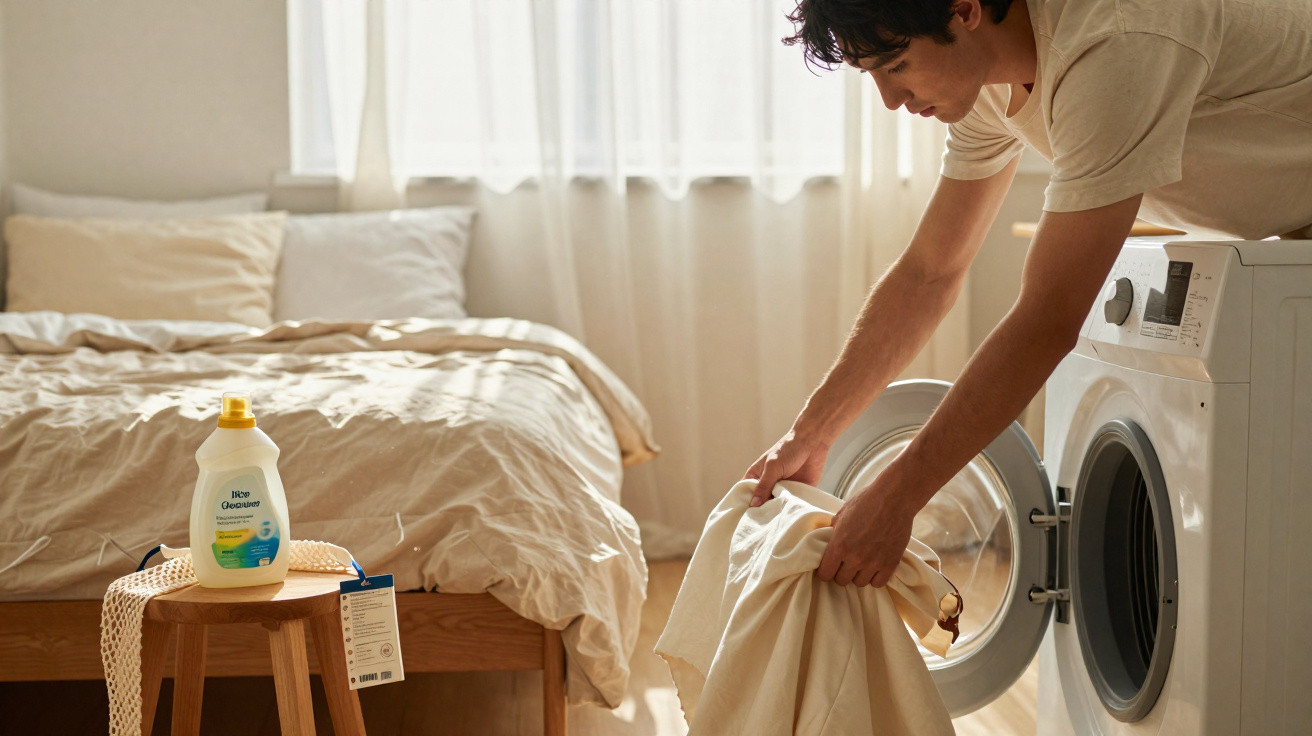
Fresh sheets lay in a crumpled pile, warm from the tumble dryer and scented with “Alpine Breeze” despite never having been near a mountain. As you pulled a fitted sheet over the mattress, you spotted a small worn area near one corner and stopped. Hadn’t you bought this set only last year?
We are often taught that clean bedding means a clean life: wash more and worry less. But that logic starts to unravel when costly linen begins to pill, fade and tear far sooner than expected.
Something inside that spinning drum may be slowly damaging the sheets you love most.
When “fresh sheets” becomes too much of a good thing
There is an odd satisfaction in stripping the bed and putting the sheets straight into the wash. The laundry basket fills up, the machine drum is loaded and detergent swirls through the water. It can feel as though you are doing the responsible thing, rinsing away stress along with the marks.
But every complete wash is a small storm for bedding to endure: hot water, a rotating metal drum, chemical surfactants and mechanical agitation. With each cycle, the fibres become a little rougher. Material that once felt silky can gradually become faintly abrasive. Bright white loses its crispness, while patterns begin to look worn. It is not immediate; it happens gradually.
On an unremarkable Tuesday much like the previous one, your “self-care” routine may be quietly reducing the lifespan of everything on your bed.
Ask hotel housekeepers what surprises them about domestic laundry habits, and many will give the same answer: people wash as if they are operating a fully booked hotel. One UK survey found that some people launder their bedding every two or three days “for hygiene”. That may sound admirable, but hotels allow for continual sheet replacement in their budgets. Your finances probably do not.
Consider Emma, who happily washed her new Egyptian cotton bedding twice weekly. Six months later, the pillowcases that had once been smooth were covered in tiny bobbles. The fitted-sheet corners had become so thin that they were nearly see-through. She blamed poor brand quality, left an angry review and purchased another set. She kept the same washing routine and got the same outcome.
This pattern plays out in thousands of bathrooms and laundry rooms. It is not because people are negligent, but because few of us challenge that habitual trip to the laundry basket.
Each wash cycle creates friction. Fibres scrape against one another, the drum, metal components, and zips on other garments. The outer surface of the yarn is damaged first, then breaks and gathers into pills. Hot water and strong detergents remove colour and weaken natural materials such as cotton and linen. Repeated dryer heat then bakes the fibres left behind until they lose their elasticity.
Imagine fabric as a rope formed from thousands of tiny hairs. Running your hand along it occasionally will leave it strong. Scrape and twist it constantly, however, and those fine hairs will begin to snap. Your sheet is that rope, and every “extra” wash is another hand dragged across it.
Washing smarter: caring for fabric without babying it
The understated way to preserve fabric quality is not to stop washing altogether. Instead, make each wash gentler and more purposeful. Begin with the essentials: cooler water, shorter programmes and a lower spin speed. Sheets do not require the same treatment as mud-covered gym kit.
Opt for liquid detergent, leave heavy “whitening boosters” out of routine loads and do not use too much product. That dense foam is not proof that items are cleaner; it is simply additional chemicals sticking to the fibres and gradually drying them out. Where possible, air-dry sheets on a washing line or drying rack, at least partly, then use the tumble dryer briefly to soften them.
By making one modest change at a time, your bedding can begin to age in years rather than wash cycles.
A straightforward schedule works well for many ordinary households: wash sheets every 7 to 10 days rather than every two or three. During hot, humid conditions, or if you perspire heavily, reduce that interval to once weekly. If you shower in the evening, wear pyjamas and keep pets out of the bed, you may leave them a little longer without reaching the “gross” stage.
Let’s be honest: nobody really does that every day. The internet’s immaculate routines rarely reflect how people genuinely live. Keep two or three bedding sets in rotation so that each has time to “rest” between use and washing. That break makes more difference than you may expect.
If somebody in the household is unwell, has allergies or has difficulty with dust mites, then washing more frequently during those periods makes sense. Treat those occasions as exceptions, rather than the usual standard for the whole year. Your fabric – and your energy bill – will quietly benefit.
There is another side to this beyond thread counts and fibre science: the discreet, personal comfort of bed. We have all experienced slipping into sheets washed only hours earlier, still carrying a faint scent of sunshine or lavender, and feeling a small, unexpected sense of relief.
As textile expert Marina Lopez told me:
“Bedding should feel like it’s getting better with age, not worse. If it looks exhausted after a few months, it’s not always bad quality. Often, it’s simply being over‑handled by water, heat and chemistry.”
To maintain that “better with age” sensation, these guidelines can help:
- Wash every 7–10 days in cool water on a gentle cycle.
- Use mild detergent at half the usual dose.
- Avoid fabric softeners for high-quality cotton and linen.
- Line-dry where possible; if necessary, tumble-dry on low heat.
- Rotate at least two sets, allowing each to rest between uses.
The quiet balance between hygiene, comfort and fabric life
Once you recognise that a washing machine can be both a friend and a possible enemy to fabric, it is difficult to forget. That does not require you to dread laundry day. It simply means paying attention to subtle signs: a corner starting to wear thin, slight roughness at the edge of a pillowcase, or a once-deep navy shade beginning to fade.
These signs of wear are not moral failings. They are the result of an ongoing relationship between your habits and your textiles. At times, you may choose to wash more regularly because your skin requires it or your child has allergies. At other times, you may notice that you are filling the machine from habit or anxiety rather than genuine necessity.
After considering this, some readers begin to view bedding much as they view their own skin. It is not something to scrub into submission, but something to understand and look after. Perhaps that is the real change: replacing automatic cleaning with conscious care.
| Key point | Detail | Benefit for the reader |
|---|---|---|
| Sensible frequency | Wash sheets every 7 to 10 days in most households | Limit wear without compromising hygiene |
| Gentle cycle and products | Use cold or lukewarm water, a delicate cycle, little detergent and no heavy fabric softener | Preserve the texture, colour and lifespan of bedding |
| Dry with care | Air-dry or use a low-heat setting, and rotate several bedding sets | Reduce shrinkage, fibre breakage and replacement costs |
FAQ
- How often should I really wash my sheets? For most healthy adults, every 7–10 days is suitable. In hot weather, if you sweat heavily or if pets sleep in the bed, washing once a week is a good routine.
- Does washing bedding in hot water make it wear out faster? Yes. Frequent hot washes can weaken fibres and fade colours. Keep hot water for particular circumstances, including illness, dust-mite treatment or heavy soiling.
- Are fabric softeners bad for my sheets? With high-quality cotton and linen, yes: regular fabric softener can coat fibres, reduce breathability and shorten their lifespan. Gentle detergent and thorough rinsing are generally sufficient.
- Is air-drying really better than using a dryer? Usually, yes. Air-drying is kinder to fibres and causes less strain. If you prefer tumble-dried softness, use a short, low-heat cycle after partially air-drying the sheets.
- What type of bedding lasts the longest with regular washing? Good-quality cotton percale or linen usually wears well when washed on gentle settings. Avoid very cheap microfibre blends if long-term comfort and breathability matter to you.




Comments
No comments yet. Be the first to comment!
Leave a Comment