
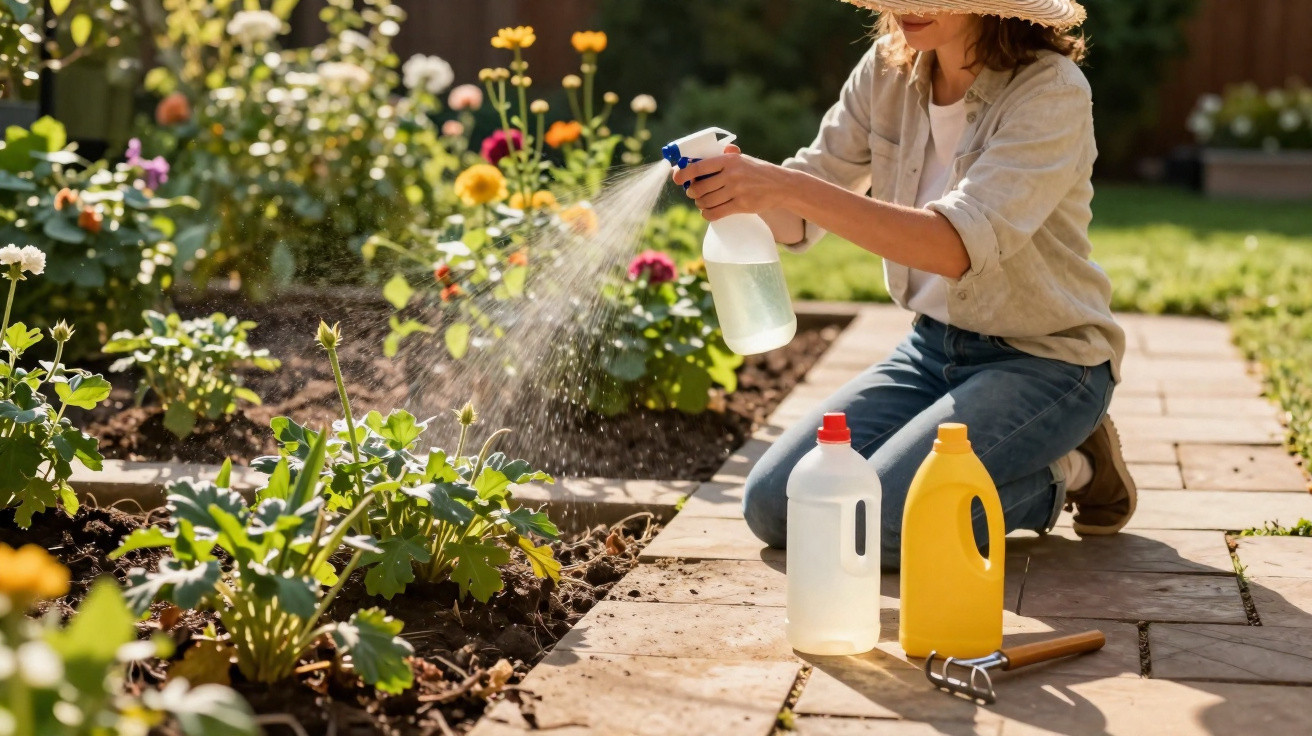
Many home gardeners have tested white vinegar as a natural remedy, only to watch the green intruders return. However, a more overlooked item from beneath the kitchen sink is gaining recognition for providing longer-lasting, low-maintenance weed control.
Why white vinegar disappoints against stubborn weeds
White vinegar has become well known as a “green” substitute for chemical weed killers. Its strong acidity rapidly scorches plant foliage. On a hot day, leaves may turn yellow, curl up and collapse within hours.
The real issue, however, lies below ground. Vinegar largely affects the parts of the weed that are visible. Its roots, shielded by the soil, frequently remain almost entirely unharmed.
Vinegar gives the illusion of a clean path, but the root system usually remains alive and ready to sprout again.
This explains why joints between paving and gravel paths can look weed-free briefly before the same plants reappear. Daisies, plantain, dandelions and clover are especially capable of returning from roots that have survived.
This above-ground effect can be useful for very small seedlings that have only just emerged. For mature weeds, or thick growth lodged between paving slabs, results are inconsistent and short-lived. Keeping hard surfaces tidy with vinegar alone would mean spraying every few weeks throughout the growing season.
That brings repeated labour, repeated expense and repeated pressure on the soil and surrounding plants. Frustrated by this pattern of regrowth, many gardeners have sought an enhancer that remains broadly “natural” but genuinely reduces the need for repeat applications.
The surprising role of washing-up liquid in homemade weed control
The unexpected answer is an ordinary bottle of washing-up liquid. Most washing-up liquids contain surfactants, which are also known as tensioactive agents. These compounds reduce water’s surface tension and interact with waxy or oily coatings.
Leaves also have a fine waxy coating, which helps them shed water and reduce moisture loss. Adding a small amount of washing-up liquid to a spray mixture disrupts this protective surface.
Washing-up liquid helps the spray cling to the leaf, spread evenly, and penetrate plant tissue instead of beading and rolling off.
On its own, a weak washing-up-liquid solution can gradually dehydrate the soft above-ground growth of very young weeds. The leaves become less able to retain moisture and may start to shrivel after several sunny days.
Mixed with vinegar, its action is considerably quicker and more noticeable, particularly on weeds in cracks, between paving slabs or over gravel driveways. The washing-up liquid keeps the acidic solution in contact with foliage for longer, allowing severe dehydration to take effect.
A simple homemade recipe gardeners are adopting
A frequently used basic mixture contains:
- 1 tablespoon of washing-up liquid
- 1 litre of water
- Optional: 1 cup of white vinegar
Stir or shake the ingredients together before transferring them to a hand sprayer. Only unwanted patches of growth should be treated, preferably on a dry, sunny day with no rain expected for 24 hours.
Sunshine accelerates the drying process. Warm weather also enables the plant to take up the mixture more fully, producing a neater finish on patios and paths.
Adjusting the strength of the mix to your garden
Different garden conditions do not require identical strengths of treatment. Gardeners commonly alter ingredient proportions according to the weeds’ age and where they are growing.
Gentle mix for light growth in joints
For small, young weeds beginning to emerge between patio slabs or beside a path, a gentler formula will often suffice:
- 1 litre of water
- 1 tablespoon of eco-labelled washing-up liquid
This mixture is intended for newly emerging weeds with very shallow roots. It places less stress on the soil and nearby area, and may be used a few times early in the season.
Stronger mix for established weeds on hard surfaces
Where weeds are bigger and more firmly rooted, some gardeners use a stronger blend:
- 1 litre of white vinegar
- 2 teaspoons of washing-up liquid
This formula acts rapidly on leaves and is suited to driveways, path edges and dense, low-growing mats of vegetation. It should be used solely on mineral surfaces, away from the roots of ornamental plants.
The “no-return” option with added salt
A harsher version is also used in spots where no future growth is wanted, including gaps beneath gates or around fence posts:
- 1 litre of white vinegar
- 40 g of table salt
- 10 ml of washing-up liquid
Salt-based mixes can sterilise the top layer of soil and harm soil life, so they should stay on purely mineral areas.
Salt builds up over time. It may be carried by run-off, affecting nearby plant roots, earthworms and microbes. Consequently, many horticultural advisers suggest using salty mixtures only very rarely, and never in beds, on lawns or close to trees.
How and where to use washing-up-liquid weed sprays
Although the ingredients are household products, homemade sprays still require careful application.
| Best locations | Areas to avoid |
|---|---|
| Paving joints on patios | Vegetable beds and raised planters |
| Gravel driveways and paths | Lawns you want to keep green |
| Edges along concrete or brick | Near the base of shrubs or trees |
| Under gates or along fences on hard ground | Any area prone to water runoff into borders |
Sprays need to be applied accurately. Set the nozzle to a narrow stream or concentrated cone, directing it exclusively at the plants being targeted. Avoid windy conditions, as drifting spray may scorch nearby ornamental plants.
Frequent, heavy applications of washing-up liquid to soil can alter its ability to take in and retain water. Surfactants change the way water travels through soil pores, occasionally causing crusting or areas that remain excessively wet or excessively dry.
Keeping treatments punctual and limited to hard surfaces reduces risks to soil structure and beneficial organisms.
Wearing gloves and eye protection is sensible as well. Vinegar and soap may irritate the skin and eyes, particularly while refilling a sprayer or if it leaks.
How this method compares to pulling, flaming and commercial herbicides
For many garden beds, hand weeding is still the cleanest option. It physically removes roots and creates no chemical residues. Its disadvantage is the time and effort involved, especially in tightly packed gravel or narrow crevices that are difficult for hands and tools to reach.
Thermal weeders, fuelled by gas or electricity, expose plants to intense heat. They are suitable for patios and driveways while avoiding the use of liquids. However, their price and energy requirements can deter users, and repeated treatments remain necessary during periods of vigorous growth.
Commercial “natural” herbicides often use the same core approach as vinegar-and-soap preparations: they rapidly dehydrate foliage. They are convenient to use, but cost more per square metre than a homemade mixture.
Synthetic weed killers that travel through the plant and reach its roots are unquestionably effective. Nevertheless, many gardeners now avoid them because of concerns about residues, pollinators and long-term soil health. This is one reason washing-up-liquid mixtures have become popular: they appear more familiar and manageable, despite still requiring cautious use.
Practical scenarios: where a soap-based spray fits into a wider strategy
Consider a small urban courtyard with ageing stone slabs covered in moss and opportunistic seedlings. Applying a strong vinegar–soap blend once at the beginning of spring may clear most of the growth. Occasional use of a gentler, mainly water-and-soap solution can then control fresh arrivals, while moss is removed with a hand brush rather than chemicals.
On a large country driveway, a gardener could treat only the slim strip between wheel tracks where weeds tend to gather instead of spraying the entire surface. Such a targeted method limits the amount of mixture reaching the ground and reduces refilling, while still maintaining a visually tidy entrance.
Key terms and ecological side effects worth knowing
Surfactant is the technical name for the active component in washing-up liquid that changes water’s behaviour. The term means “surface active agent”. These molecules have one end attracted to water and another attracted to oils and waxes, enabling them to clean dishes and break through the waxy coating of leaves.
Phytotoxicity is another expression gardeners may encounter on product labels or advice sheets. It simply refers to toxicity towards plants. At higher concentrations, vinegar, salt and many soaps are phytotoxic; this is what makes them useful in weed control, but also dangerous near plants that are valued.
Repeated low-level contact with these products can affect soil organisms, including fungi, bacteria and earthworms. A small number of spot treatments on paving is unlikely to destroy an ecosystem, but making vinegar-and-soap sprays a weekly response to every green patch around a property may progressively reduce soil quality.
Using this approach alongside mulching, ground-cover plants and thoughtful paving design generally delivers better results over time. Thick mulch in beds and broad planting along fence lines leave fewer spaces for weeds to establish. This creates fewer cracks requiring treatment and ultimately means fewer litres of homemade mixture leaving the kitchen and being applied to the ground.




Comments
No comments yet. Be the first to comment!
Leave a Comment