
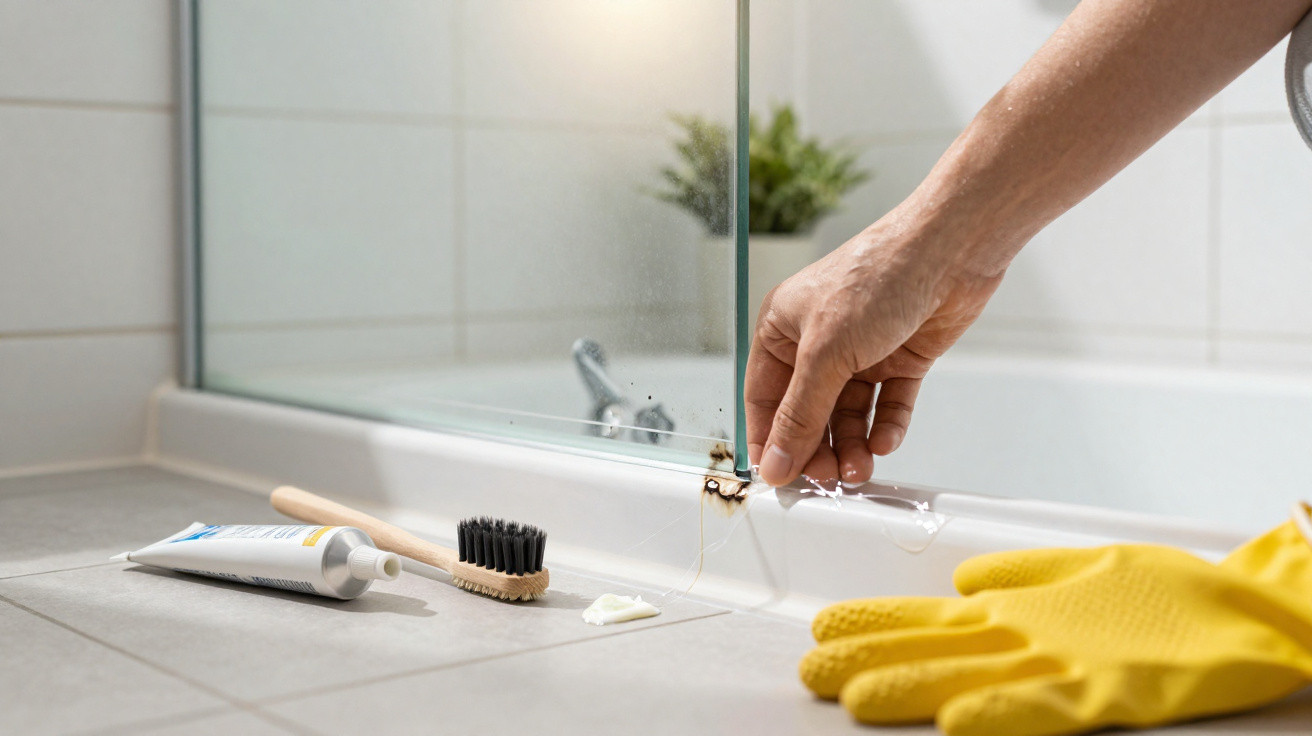
That narrow black strip along the bath, where the silicone meets the tiles, had a habit of creeping into the corners like a teenager slipping home after curfew. I attacked it with worn-out toothbrushes and bargain sprays smelling of citrus and swimming pools, yet it returned every time. Visitors would say, “Lovely place,” while I heard, “So you live with mould then.” Anyone who has crouched on chilly tiles, grumbling at a dark mark that refuses to shift, will understand that low-level rage. My bathroom turned into a private stage for defeat, with the door quickly closed whenever friends came over. I was not chasing perfection. I simply wanted that line to disappear - and remain gone. The solution was neither another brush nor a miracle trick, but changing the product I used and what I did after applying it. Curious yet?
The day I stopped pretending the black line was “just shadow”
It was after a wet Tuesday, one of those days when washing never fully dries and the mirror steams up without anyone even using the shower. I noticed mould spreading into a neat corner that I had re-sealed the previous year, and felt a small pang of embarrassment. We have all looked at some grimy part of our home and thought, “That’s who I am now.” Mould on sealant feels oddly personal, like a visible little failure sitting at ankle level. I had tried vinegar, bicarb and, during one overly hopeful moment, toothpaste. None of it lasted.
A plumber - the sort who repairs things with a shrug and a straightforward comment - looked at the sealant and said, “Wrong product. You need it to stay put.” He did not mean it metaphorically. He meant gravity. Sprays run away. Thin bleach pours into the bath, leaving the mould entirely untroubled. When the active ingredient cannot remain on the stain long enough to work through it, all you are doing is perfuming the issue. So I chose to try something that would cling.
Meet the mould remover gel that finally clings
I am not loyal to brands; it is physics that impresses me. What made the difference was not a fresher fragrance or a “triple-action!” promise, but a new consistency: gel. Specifically, the sort of mould remover gel that stays on upright silicone like a cat hanging from a curtain. Most UK supermarkets and online retailers sell these products: search for “mould remover gel”, or choose a foam that says it clings to surfaces. They are generally chlorine-bleach based, from the same family as thick toilet bleach, but formulated with enough thickness to stay on the sealant.
The key product is a gel-based mould remover containing sodium hypochlorite. This oxidiser makes the black staining vanish by bleaching and breaking down the discolouration embedded in the silicone. Foam alternatives can also be effective, particularly in corners, as the bubbles help the cleaner stay in place. A quick spray does not achieve the same result. You need a product you can apply like cake icing, confident that it will not slide away overnight.
Why the gel matters
Mould in sealant is persistent because silicone is mildly porous and dark strands work their way into it like roots. A fast wipe may brighten the surface, but it leaves the colony beneath intact, ready to put up its tiny black flags again as soon as steam reappears. Gel gives the cleaner time. It holds the active ingredient where it needs to be, allowing it to penetrate those minute pores and oxidise what is hidden from view.
That may sound slightly grim and very chemical - because it is. Yet it also seems fair. Rather than expecting a five-second spray to complete a six-hour task, you allow the product to sit and work without watching the clock. Gradually and without fuss, the sealant releases its grey history.
The quiet science behind the miracle
It is worth looking briefly at what is happening. Chlorine cleaners do not physically scrub mould away; they break it apart at molecular level. Imagine a black marker streak on kitchen roll. Water might make it spread, while a proper oxidiser can dismantle the ink until nothing remains visible. Mould is a living stain, making it more troublesome, but the same idea applies. It needs both contact and time.
People often believe mould always returns because, much like everything else in life, most of us rush the job. A quick spray, a wipe, a sigh, and it is supposedly done. The bathroom then fills with steam, dampness settles, and the surviving mould enjoys the conditions. If it is killed right through the silicone, however, there is nothing left at that location to grow back from. That is about as “permanent” as cleaning can be, provided you do not continually offer it a swamp to celebrate in.
The method nobody told me (until a plumber did)
There is an approach that takes the gel from “pretty good” to “where have you been all my life.” It begins with a dry surface. Open the window, switch on the extractor fan and dry the sealant with a towel until it squeaks. Then leave the bathroom door open for half an hour. Is that fussy? Perhaps. But the gel needs to touch sealant, not a layer of water slipping between the two like a bad date.
Dry the sealant first; water weakens the chemistry and squanders your effort. Once dry, you can tape off the bath and tiles if you prefer a tidy finish. Apply a thick, generous line of gel over the mouldy area. You are not painting it on; you are covering it with a blanket. As it settles, you will notice that faint swimming-pool scent - a reminder of school changing rooms and overly chlorinated holiday pools - and know it is at work.
The cling-film trick
This is the part that feels like good cheating. Press strips of standard cling film over the gel. The aim is not to shut out the air, but to prevent the gel from drying out and ensure every millimetre remains closely pressed against the silicone. It also stops the product gradually drooping away, which it otherwise will because gravity is endlessly persistent. In corners, strips of cotton wool soaked in the cleaner work wonderfully, left to nestle against the bead.
Then leave it alone for at least six hours, or overnight if possible. I learned the hard way that the change takes place while it appears that nothing is happening. One morning, I came downstairs early, put my feet on the cold tiles, heard the soft rustle as I peeled back the plastic - and the line was white. Where an area remained a smoky grey, I repeated the full process for another night, much like applying a second coat of paint. This time, the final specks gave in.
The morning after: white again, and strangely emotional
There is a distinctly British satisfaction in sorting out a small but irritating problem: a kettle that no longer screams or a window that eventually closes without slamming. This felt similar. I rinsed off the gel, wiped the sealant using a damp cloth, then stood there longer than intended, watching condensation run along a properly clean edge. The room had a light disinfectant smell, the fan provided a reassuring hum, and I considered all the sprays I had wasted.
I genuinely laughed when the white line emerged again, as though the tiles had concealed a secret. Was that excessive? Possibly. But anyone who has lived with that black seam will understand. It is not merely unsightly; it makes every shower feel faintly less clean, as though the grime has an opinion. With the seal restored, the bath looked newer and I felt slightly more in command of my own home.
Keeping mould off silicone sealant without turning into a bathroom monk
Here is the honest part: nobody truly does this every day. We do not squeegee tiles after every shower or patrol the room with a towel like a lifeguard. Life is not a hotel. Still, there are simple ways to help the white stay white. Use an extractor fan that genuinely removes steam, leave the window slightly open after showering, and run a cloth along the sealant whenever you have two minutes. These are small routines, not an entirely new identity.
In a compact bathroom with poor ventilation, think of moisture as you would watering a houseplant: the goal is the right amount, not deprivation. Too much damp and mould has a party; enough airflow and it never quite establishes itself again. I used a cheap hygrometer for a week out of curiosity and discovered that my bathroom stayed damp for hours. That was when I put the fan on a short timer and, surprisingly, the mould did not return to that area. The gel had already dealt with the deeper problem. Preventing fresh growth turned out to be the easy bit.
When even this will not save the sealant
Sometimes silicone simply loses the battle. It becomes hard with age, soap residue works its way in, and mould reaches further than cleaning chemicals can penetrate. If the bead appears rough or pitted, cleaning alone may never make it look pristine. That does not mean you have failed; it is simply what materials do after years of hot baths and cold mornings. In those cases, cutting it out and re-sealing is the better option, and it is less alarming than it sounds.
If it still won’t turn white after 12 hours, the silicone is done - replace it. Remove it with a plastic scraper or a careful utility blade, clean the channel using white spirit, allow it to dry, then apply a fresh bead. Yes, it is a Sunday project. But fresh silicone resembles repainting a skirting board: somehow, the entire room feels renewed. From then on, use the gel trick at the first indication of trouble and the cycle need never begin again.
What “permanent” really means in a damp country
We live with the weather in the UK. Dampness finds its way in even when the forecast promises sunny intervals. With mould, “permanent” is not a spell but a two-part agreement: kill it deeply once, then make the conditions unfriendly afterwards. Gel makes the first part straightforward. The second means avoiding a bathroom that remains filled with wet mist for hours. Do that and the white will generally remain white, until the silicone naturally ages and you decide to replace it.
And a note for renters and people in shared homes: you are dealing with other people's routines as well as your own. You cannot control how everyone showers, but you can leave the fan running a little longer, open the window without making a fuss and keep a bottle of gel for your own reassurance. When your deposit is involved, those extra two minutes count.
The little checklist I keep in my head now
I do not put it on a fridge magnet, but the routine runs through my mind whenever I spot a faint grey bloom: dry first, apply the gel thickly, cover with plastic, leave it for a long time, then rinse. That is all. The steps are not a ritual; they simply respect time and texture. During a busy week, I set it up in the evening and remove it in the morning while the kettle chatters. There is something satisfying about finding you have been “cleaning” while asleep.
If you are considering non-bleach options, they may be gentler for grout and painted surfaces, but silicone is a different challenge. Vinegar can make the bathroom smell sour while achieving very little. Hydrogen peroxide gels are available and can work, although they are less widely sold here and are easier on the nose if the bleach odour bothers you. The principle remains identical: cling and contact. That is the entire trick in one sentence.
A small confession from a clean convert
I once assumed people who “knew tricks” were a separate species: organised, up early, and probably ironing their pillowcases. The gel showed me that this was not a character failing, only a missing tool. I still have weeks when everything unravels and the laundry glares at me from a chair. At least the bathroom no longer taunts me with a black line. It is remarkable how much lighter a shower feels when your eyes are not repeatedly drawn to a stain.
Now there is a brief moment each morning when light catches the white edge near the taps, and I feel rather absurdly proud. The solution was neither costly nor complicated. It was simply a matter of understanding what mould needs and giving it the opposite. My only regret is all those years spent scrubbing without thinking. If your bathroom has been quietly suggesting that you have lost the plot, try the gel, the cling film and the overnight wait. You may wake up to a small, perfect victory.




Comments
No comments yet. Be the first to comment!
Leave a Comment