
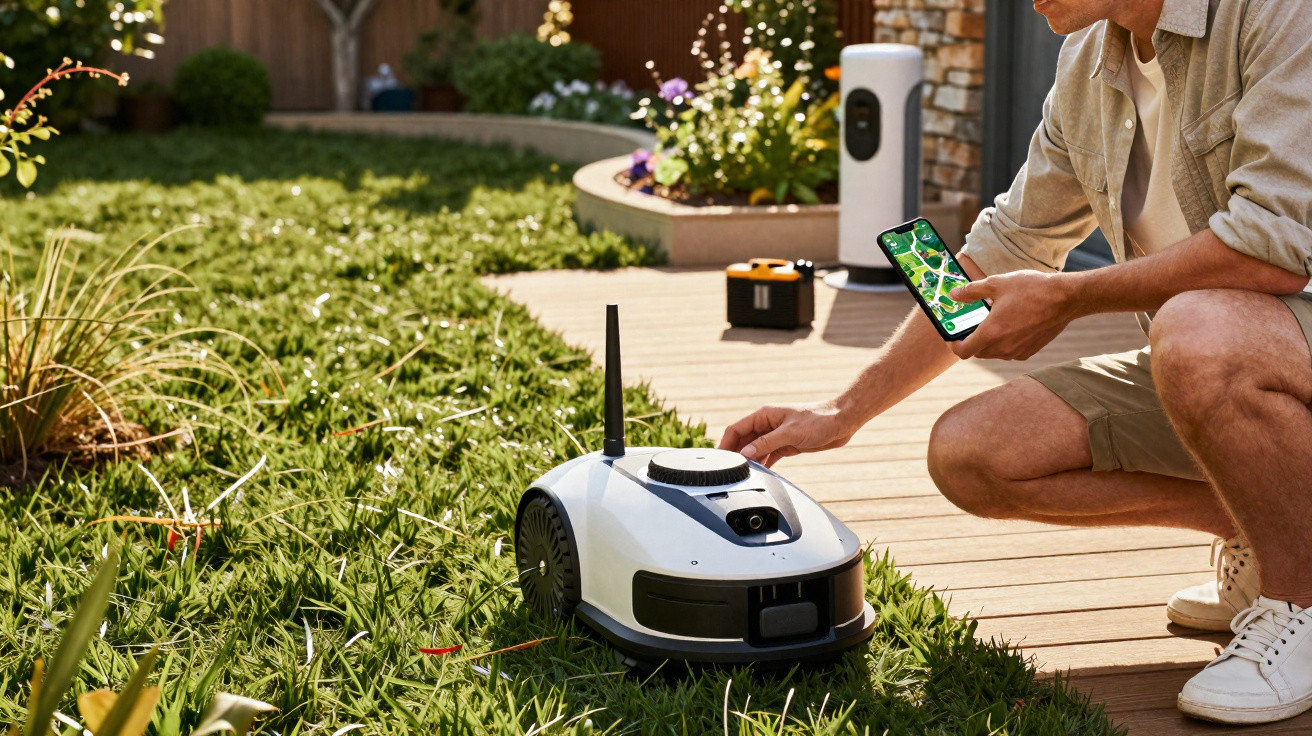
RTK, NetRTK, LiDAR, cameras, automatic mapping, drive wheels and cutting width: robotic lawn mowers come with no shortage of selling points. The challenge is knowing which ones matter for your garden. In this buying guide, the Presse-citron editorial team breaks down the key criteria for finding a robotic lawn mower suited to both your plot and your budget.
If you are looking for a robotic lawn mower, it can be hard to know where to begin when prices range from modest to five times as much and specification sheets are packed with acronyms. Navigation, mapping, traction, mowing performance and customisation options through dedicated apps are all factors worth considering before making a purchase.
Having thoroughly tested numerous models for our comparison of the best robotic lawn mowers, the Presse-citron team reviews the criteria that genuinely matter in this buying guide, helping you select a robotic lawn mower that suits your garden and your budget.
Installation and navigation: the first criterion to assess
For years, early industry leaders such as Husqvarna and Gardena imposed the same routine: laying out and burying a perimeter wire around the entire lawn to define the mowing area, often with a guide wire to help the robot find its way back to the charging station. Later, the first generation of wire-free robots replaced this setup with an RTK antenna installed in the garden, although it still needed to be connected to the charging station.
Today, the major promise of robotic lawn mowers is a completely wire-free experience, making both installation and day-to-day management as straightforward as possible. Although they no longer require a perimeter wire, current robots must address three challenges in return.
First, they need to locate themselves to within a few centimetres, detect and avoid obstacles, whether that is a permanent tree or a toy left in the grass. Their movements must also be coherent enough to mow the entire lawn without repeatedly covering the same patches.
Four main technologies coexist on the market to achieve this. The real complication is that they are not mutually exclusive. Each manufacturer effectively develops its own formula by combining them, then often gives it a proprietary name. The aim is to impress buyers while attempting to stand apart from competitors.
For example, Segway Navimow promotes its new EFLS system in 2026, combining tri-frequency network RTK, vSLAM and VIO. In plain terms, the brand is describing antenna-free satellite positioning supported by cameras that take over when the signal weakens. The same principle applies across manufacturers, from Mova and Dreame to Ecovacs and Roborock.
We will therefore help you decode these labels, so that you can separate meaningful technical differences from occasionally rather grandiose jargon.
The RTK antenna: traditional satellite precision
Let us begin with the oldest wire-free robot technology. Despite appearances, it has not disappeared from shop shelves altogether. Some models released in 2026 still require it, including the Roborock RockNeo Q105 that we tested.
In theory, the approach is simple. An antenna placed in the garden receives satellite signals, calculates positioning errors and sends corrections to the robot in real time. Accuracy consequently improves from one or two metres with standard GPS to only a few centimetres.
Its benefits are substantial. Navigation is highly reliable, and the technology is fully mature. Above all, satellite signals can be received in bright sunshine, at night and beneath overcast skies alike.
Unlike robots relying solely on cameras, a model fitted with an RTK antenna can mow at any time without becoming less reliable. Better still, this technical choice can allow manufacturers to offer competitive prices, sometimes below €1,000.
Its drawbacks are largely practical. The antenna needs an open position with a clear view of the sky, which rarely enhances the appearance of a garden. Signal quality also deteriorates when the robot works beneath large, densely leafed trees or alongside a building.
NetRTK: identical precision without installing anything
NetRTK, sometimes written NRTK or wire-free RTK, uses exactly the same satellite correction principle. There is one significant difference, however: no antenna is needed in your garden.
It works in two stages. Satellites initially provide the robot with a raw location accurate to within one or two metres. A network of fixed stations distributed across the country then calculates the current error and transmits it to the robot, allowing it to refine its position to centimetre accuracy. To receive this continuous correction stream, the robot must remain connected to the internet, either over Wi-Fi or through an integrated mobile connection, depending on the model.
The good news is that the trend is towards inclusion at no extra cost. Major manufacturers now provide NetRTK access, including data, free of charge, and some even removed the subscription fee they had previously charged in 2026. A few brands, Husqvarna among them, still charge for it, so this is an important point to check on the model specification.
Do not confuse this free service with the 4G plan used for remote control, alerts and locating the robot if it is stolen. That separate service can become chargeable after an introductory period provided by the manufacturer. We will return to this in the section on apps. The key benefit of this technology is plainly its ease of installation: place the charging station, connect the robot and begin the first mapping process.
That said, it is not flawless. If your broadband router does not reach the far end of the garden and mobile coverage is unreliable in your area, precision can collapse. This is why Segway lets buyers check, by postcode before purchasing, whether its NetRTK network is dependable in their garden.
One final point to remember is that positioning still relies on satellites, with the same blind spots as a traditional RTK antenna. Whenever vegetation or building façades obstruct the sky, the robot can lose its bearings.
LiDAR: the most independent option, but not the cheapest
LiDAR takes an entirely different approach. Satellites are no longer involved. A laser continuously scans the robot's surroundings and recreates the garden in three dimensions. It maps trees, walls, flower beds, furniture and unexpected obstacles, allowing the robot to position itself according to what it actually sees around it in real time.
This independence makes all the difference in places that defeat satellite-based technologies: beneath a densely leafed tree, beside a low wall or in a narrow passage. Another advantage is that LiDAR is unaffected by light levels, so it does not lose accuracy when daylight fades.
A word of caution about specification sheets, though, as brands are happy to create confusion. Many models list both LiDAR and satellite positioning, but there is no contradiction: the two simply divide the work between them.
Satellite positioning roughly places the robot in the garden, while LiDAR refines its location and takes full control whenever the sky signal weakens. Other machines take this concept further and dispense with satellites altogether, such as the Dreame A3 we tested, whose 360° 3D LiDAR handles all navigation.
The obvious trade-off is financial. A robot with LiDAR is expensive to manufacture, and equipped models start at around €1,200. For a simple, open rectangular lawn, it is clearly a luxury. In a complex garden, however, it is the most reassuring investment available.
Cameras: the common denominator for every robotic lawn mower
Finally, cameras are now the most widespread component linking all wire-free robotic lawn mowers. The real question is not whether your prospective robot has cameras, but precisely what part they play.
On the most affordable models, cameras do everything on their own. The robot navigates solely through its visual system, assisted by artificial intelligence that interprets camera data to recognise the lawn, plot boundaries and obstacles. This stripped-back formula is what brings wire-free robots below €800, as demonstrated by the Mova ViAX 250.
The weakness of the “camera-only” approach is lighting. Without infrared illumination, vision becomes less accurate as conditions darken. On the affected models, night mowing is therefore impossible, as their vision loses precision when light levels fall.
Elsewhere, cameras act as supporting systems. When paired with an antenna or NetRTK positioning, they identify things that satellites entirely overlook, including a forgotten toy, a trailing garden hose or moved furniture. Combined with LiDAR, they add object recognition to the laser's 3D map. In every case, they make the rest of the technology suite more dependable.
The number of cameras generally ranges from one to three, while manufacturers readily highlight viewing angles of 150, 300 or even 360 degrees. A wide field of view is mainly useful for manoeuvring and narrow passages, but it says nothing about how well obstacles are detected.
Most importantly, whether they are labelled HD, HDR or AI-enhanced, cameras are not all equal. With the same number of viewing units, differences come down to recognition algorithms and the robot's processing power. These are not visible on specification sheets, and only real-world testing can distinguish them.
Mapping: the stage that determines mowing quality
This stage must be completed carefully if you want the robot to mow accurately from its very first runs. Mapping establishes where it should work, where its wheels must never go and how it can travel between separate areas.
Automatic mapping: the robot explores by itself
The newest method prioritises complete autonomy. Once the station is positioned at the lawn edge, the robot explores its new territory, identifies boundaries, flower beds and obstacles, then creates its map without any intervention. The Eufy E18 robotic lawn mower particularly impressed us in this respect. Its fully automatic mapping is among the most accomplished we have tested.
Although appealing on paper, this approach is mainly relevant for simple lawns with clearly square or rectangular shapes. Each robot's tutorial also recommends clearing the ground and starting with short grass before launching exploration, which shows that the machine prefers unambiguous conditions.
On a fragmented plot, one overgrown with tall grass or with unclear boundaries, the generated layout will often need some manual adjustments.
Manual mapping: a full-size remote-controlled car
For the vast majority of gardens, we still recommend manual mapping. Using a virtual joystick on your smartphone, you steer the robot along the edges to draw the lawn's outline, much like a life-sized remote-controlled car. It is fairly enjoyable, although it calls for some dexterity once the garden has numerous corners and tight spaces.
Most apps allow you to pause the route, while some let you increase the robot's speed if you are in a hurry or if the lawn consists only of long straight lines. In any event, advice from our tests is simple: take your time. A rushed route, particularly around boundaries, will affect every subsequent mowing session.
Improving your map: the real key to stress-free mowing
Drawing boundaries is only the first layer in reality. What matters most comes afterwards, in the detail you add to the map. Start with no-go areas, which should be created around flower beds, exposed roots, children's trampolines and vegetable patches: anything the blades must never approach.
Next come routes: virtual corridors telling the robot how to reach another section of lawn separated by a path or patio. Depending on the model, these settings are drawn directly on the app map. In other cases, you must guide the robot around the object to record it. Do not rush this stage, especially with camera-based robots without LiDAR. Navigation quality will depend heavily on your accuracy.
One map or several: the vital detail for fragmented gardens
The final consideration is multiple-map management. Do not confuse this with zones, which every robot can handle by dividing one map into several mowing spaces with individual settings.
Multiple maps address other circumstances, such as lawns split between the front and rear of the house, or divided into completely separate plots with no usable route for the robot. A small, flat, clear path is not an issue, as it can be designated on the map as a connecting corridor.
A few high steps, a locked gate or a gravel parking area, on the other hand, are enough to stop the machine permanently. This flexibility is usually reserved for premium models able to store two maps.
To use it, though, you will need to carry the robot by hand every time you change areas. Some models complicate matters further. Most can mow the neighbouring plot using their battery alone, so one station is enough.
Other models tie each map to a specific station. To operate on a separate plot, you must then invest in a second base, usually priced between €150 and €250.
Traction: an essential factor for gardens with slopes
In theory, every robot moves without complaint once charged. In practice, a damp bank, side slope, large root or hole can quickly disrupt even the best mechanism. Broadly speaking, traction falls into three distinct categories according to the number of powered wheels.
Before examining them in detail, here is a useful reference point. Slopes are expressed as percentages rather than degrees. When a robot claims to handle 30% slopes, it means it can climb ground rising by 30 cm for every metre travelled horizontally.
Two-wheel drive: the standard configuration
The overwhelming majority of robots use the same layout: two large powered rear wheels, often with pronounced tread for grip, plus one or two unpowered front wheels.
These much smaller wheels turn freely, like those on a shopping trolley, and simply follow the movement to guide the machine through corners. This arrangement works perfectly well on a flat or slightly uneven lawn.
Once the terrain becomes more challenging, this method of movement reveals its limitations. The unpowered wheels can get stuck in hollows, slide on soft ground and cause the robot to drift downhill on slopes.
Manufacturers generally quote a maximum incline of 40 to 45%, but remember that these figures are measured in ideal conditions: short, dry grass. In wet weather or after overnight rain, real capability is no longer the same.
These same two wheels also control U-turns. To pivot, the machine brakes one wheel while driving the other, producing an almost stationary rotation.
Three-wheel drive: a sound compromise for winding gardens
This recently introduced intermediate design tackles the weak point of the unpowered front wheel. That wheel becomes powered too, with noticeable benefits in three specific situations. First are climbs, where the extra traction reduces wheelspin. Next are uneven edges, where conventional models eventually rub against fences.
Lastly, there are U-turns, because that near-stationary rotation has a hidden cost. On slopes, it can shear the turf and leave unattractive marks. An additional driven wheel makes the manoeuvre cleaner and far less harsh on the lawn. This option costs slightly more than the standard layout, but it is worthwhile in a rolling garden full of edges and corners.
All-wheel drive: the lawn's 4×4
At the top end are all-wheel-drive models with four powered wheels, sometimes each driven by an independent motor, such as the Dreame A3 AWD Pro 5000. Power is constantly distributed across all four contact points, almost entirely eliminating wheelspin even on slippery ground.
These machines can tackle claimed slopes of up to 80%, or even a little more from certain manufacturers. Such figures are simply beyond the reach of the two previous categories.
This abundance of traction does have drawbacks. First is size: expect a weight of more than 20 kg, enough to mark waterlogged ground and make the machine awkward to lift. Then there is cost, as these models sit firmly at the premium end, often starting from €2,500.
Mowing: cutting width and edge management
Since wire-free robots emerged, mowing itself has paradoxically been pushed almost into the background. Yet it deserves close attention, especially because one principle changes everything compared with a petrol or electric lawn mower.
A wire-free robotic lawn mower does not collect what it cuts. It uses mulching, finely chopping grass into pieces a few millimetres long. The clippings remain on the ground as natural fertiliser.
Customisation is also worth checking before purchase. Some robots adjust cutting height directly in the app, whereas others still require you to use a physical dial hidden beneath the cover. This height generally ranges from 2 to 6 cm, although some models reach 9 cm.
The best-equipped machines go further, allowing different settings in each map zone for cutting height, mowing frequency and even stripe direction.
One disc or two discs with pivoting blades
Almost every robot uses the same mowing component underneath: a disc fitted with three to six small razor-sharp blades. They are not rigidly fixed, as each blade pivots freely on its screw. If it touches a hard object, it folds back rather than forcing its way through. This reduces breakages and accidents, but does not prevent the cutting edge from wearing down.
Manufacturers advise replacing blades every four to eight weeks during peak season, but you do not have to follow this timetable exactly. It depends on your ground and how often you use the machine. The clearest warning sign is grass that is torn rather than cleanly cut, with tips turning yellow within days. In all cases, the job takes a few minutes with an ordinary screwdriver, and replacement blades cost around €20 per set.
Disc diameters generally range from 20 to 25 cm. This width directly determines mowing time: the wider it is, the fewer passes the robot needs. It is a figure to watch closely if your lawn exceeds 500 m².
Models designed for large grounds double up with two cutting decks mounted side by side. This can increase cutting width to between 35 and 44 cm. Each pass then takes in almost twice as much grass, a decisive advantage beyond 1,000 m², where a single disc would require repeated trips to keep the lawn under control.
Edges: the Achilles' heel of almost every robotic lawn mower
First, it is important to understand why edges cause these robots such difficulty. For obvious safety reasons, the blades sit recessed beneath the chassis, never flush with the bodywork. The direct result is that the machine cannot cut where its wheels cannot travel.
Not all edges are equal in this regard. Along a path or patio level with the lawn, the issue is minor. The robot can run its wheels onto the surface, letting the blades reach almost to the grass edge. The missed strip is therefore limited to a few centimetres.
Against a wall, fence or planter, matters become more difficult. The robot cannot overhang the boundary, stopping before the blades get close, and the uncut strip can reach 10 or even 15 cm. If you want a finish worthy of an English garden, you will still need to get involved by taking the edge trimmer out of the shed.
Every robot attempts a solution for edge management
The most common answer is software-based: an edge-mowing option activated in the app. It makes the robot follow the perimeter one final time at the end of a session. On the hardware side, some models offset their disc towards one side of the chassis to gain a few extra centimetres.
In 2026, Ecovacs takes the concept much further with its GOAT A1600 LiDAR Pro. It is the first robot to feature a genuine edge trimmer on its side. There is no blade here, but rather a nylon line spinning at high speed.
It strikes the grass in precisely the same way as a gardener's strimmer. This design is ideal for closely following walls and stones without damaging itself. It does have the same downside as its handheld cousin, however: it is considerably noisier than conventional mowing.
The final option, and the cleverest as well as the least expensive, is manual steering offered by some apps. Here, you finish the job yourself. The robot becomes a remote-controlled mower, as it does during mapping, while you deal with corners and awkward spaces.
It may take some time depending on the size of your garden. This is more of a fallback than an ideal solution, but it has the merit of being available.
The app: your robotic lawn mower's remote control
Once the robot has been installed and mapped, its app becomes your main way of interacting with it. It is worth knowing from the outset that they are not all equal. Some offer only the bare essentials, while others improve the experience with a wide range of features.
The most common options
A basic set of features is now found on almost every new model. Scheduling stops the robot from unexpectedly buzzing into action, with settings adjustable by day, zone and even season. Choosing the direction of the stripes prevents grass from always being laid in the same direction, so it should be alternated between sessions.
Some apps even allow you to adjust obstacle avoidance, from a cautious machine that gives every potential hazard a wide berth to a bolder one willing to pass close to large flower beds.
Within every app, the robot also remains close at hand. Its position is shown in real time, and a button sends it back to its base whenever required. Work can be organised from the middle of the lawn through to the edge finishing mentioned above. The map is never fixed either: a flower bed planted in spring or an inflatable pool set up for summer can be added in seconds.
For security, a PIN code and lift alarm are fitted to most models, with the machine sounding as soon as someone lifts it from the ground. Many models also narrate their actions in a small voice, usually available in French, which can be useful for understanding why the robot is reluctant to start working.
Add notifications if it becomes stuck, mowing history and manufacturer updates, which can sometimes introduce genuinely useful features months after purchase.
Premium features
The most ambitious, and often most expensive, models add several more sophisticated extras. The most common is a rain sensor, which sends the robot back to shelter at the first drops. The cleverest models do not even wait for rain, consulting online weather forecasts to postpone their session.
Hedgehogs and cats also receive consideration, with small wildlife protection softening the machine's behaviour after dark. Other examples include low-branch detection, preventing the robot from becoming trapped beneath a shrub; mowing modes matched to seasonal growth; and voice control through Alexa or Google Home from a few brands.
None of these features is essential, but some directly suit real-life circumstances, such as a garden lined with low hedges or living in a particularly rainy region.
The 4G module and camera feed: remote monitoring
Two functions deserve separate clarification because they can be confusing. First is the 4G module, an integrated SIM card that keeps the robot connected beyond Wi-Fi range. It is used to control the machine remotely and receive notifications wherever you are. You can therefore start mowing from anywhere.
It also helps locate the robot if it is stolen, making it traceable from your smartphone. Watch the charges, though. This service is often free in the first year before becoming subscription-based. Expect to pay between €20 and €30 annually, depending on the brand.
The camera feed, meanwhile, turns the robot into a mobile sentry. From the app, you can see what its cameras see, allowing you to check whether a gate is shut or keep an eye on your garden while on holiday. Some models even offer a patrol mode, in which the robot makes rounds between mowing sessions and sends you a photograph whenever it encounters an unknown presence. A few also allow you to speak through the machine to deter unwelcome visitors.
Finally, there is one subtle point: not every robot with cameras provides a video feed. Navigation and surveillance are separate functions. If this feature appeals to you, check the robot's specification before buying.
After-sales support and spare parts: buyers' legitimate concern
These points still deter many buyers, and the concern is justified given how many brands new to Europe have appeared in just a few seasons. A few checks can nevertheless provide clarity before purchase. First, confirm that spare parts, including blades, wheels and batteries, are readily available to order.
This information is generally listed on the product page or the brand's online shop. A battery that can be changed with a few turns of a screwdriver, without using after-sales support, is a genuine advantage. It can extend the machine's life by several years.
You should then check whether the manufacturer has a repairer or after-sales support contact point in Europe. The best apps also assist in this area, with direct support contact, step-by-step maintenance tutorials and monitoring of consumable wear.
Battery life: a matter of size
As with a smartphone, the logic is mechanical: the larger the machine, the larger the battery it carries. A small 250 m² robot needs only a modest cell. By contrast, a 24 kg 4×4 houses a battery designed for several dozen ares. There is therefore little point comparing battery life in absolute terms; what matters is the area covered per charge.
Be wary of manufacturers' vague claims on this subject. A robot sold as suitable for 5,000 m² plainly does not cover that entire area in one go. In our tests, the best-equipped machines manage 800 to 900 m² per charge. Maintaining a very large plot will consequently take several days. Terrain also plays its part, as slopes consume far more energy than flat ground.
The good news is that this process needs no management from you. Like a robot vacuum, modern mowers return to charge by themselves when their battery approaches 15%. They then resume exactly where they stopped. Allow around two hours of charging for most models, while some smaller machines complete it in under an hour.
Choosing a robotic lawn mower is no small task
By the end of this guide, one point is clear: no robotic lawn mower is perfect in every situation, because each garden has its own rules. An overpowered machine offers no additional benefit on a small, level patch of grass, whereas an entry-level model will quickly struggle on a large, uneven property.
Area, slope, obstacles, how fragmented the plot is and network coverage should therefore carry far more weight in your choice than the flashiest specification sheet. To move from theory to practice, read our comparison of the best robotic lawn mowers, where we recommend a model we have tested for every type of lawn and every budget.





Comments
No comments yet. Be the first to comment!
Leave a Comment