
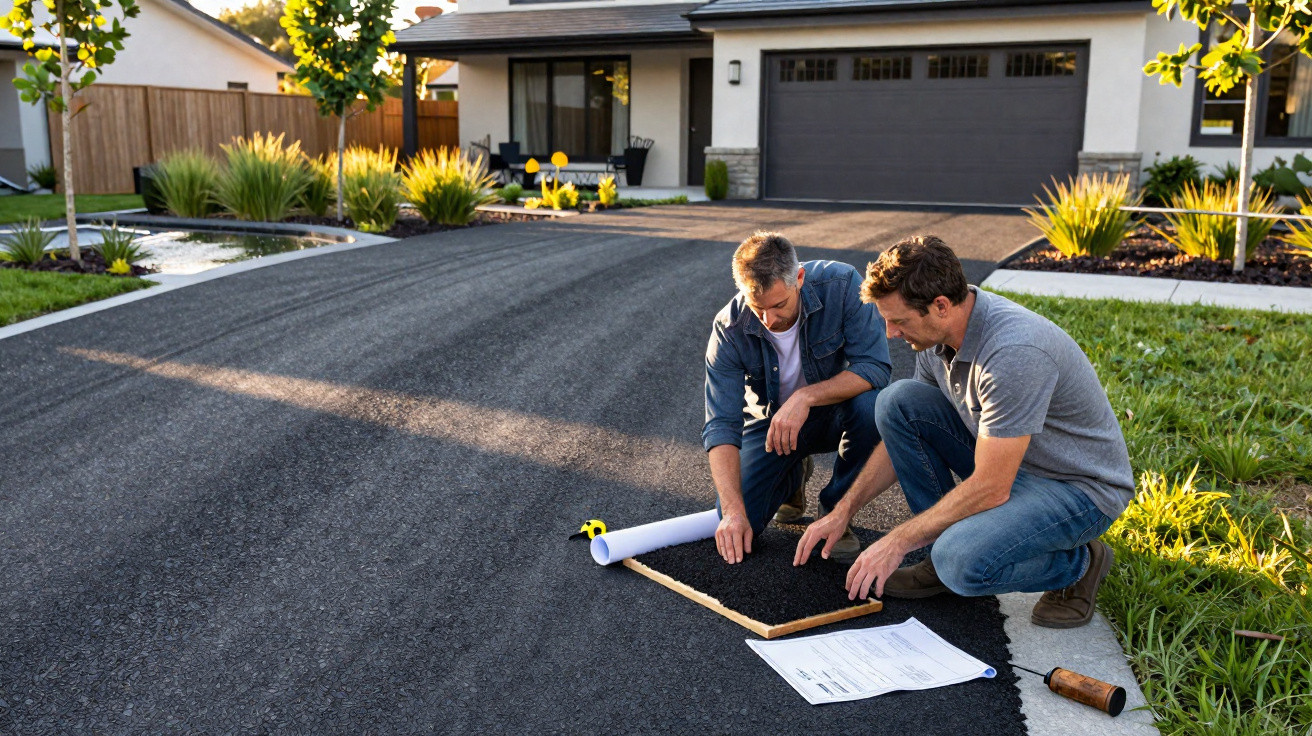
Today, anyone refurbishing a driveway is considering more than appearance and durability: the carbon footprint, heat stress and intense rainfall also matter. Rather than pouring another large concrete slab, a different surface is attracting attention: recycled asphalt, paired with permeable structures and, in some cases, binders made from plant-based materials.
Why traditional concrete driveways are becoming less appealing
For decades, concrete was the standard choice: smooth, hard and clearly defined. Yet after a few years, many driveways develop the same problems: hairline cracks, standing water and sunken areas. In summer, the surface becomes painfully hot underfoot, while in autumn every wet shoe carries dirt indoors.
The more significant issue, however, lies in the material itself. Cement, the key ingredient in concrete, is produced in kilns operating at extremely high temperatures. This process relies largely on burning fossil fuels. Globally, the cement industry accounts for a substantial share of greenhouse-gas emissions within construction and is regarded as one of the most climate-damaging building materials.
“A large, uninterrupted concrete surface in front of the house is increasingly at odds with buildings designed to be energy-efficient and climate-conscious.”
Concrete also lacks flexibility. If the ground moves because of freeze-thaw cycles or inadequate compaction, the slab cracks. Isolated repairs are highly visible and can be technically problematic. In many cases, the only option is extensive replacement – an expensive and resource-intensive solution.
The cost question: concrete versus asphalt surfacing
In many cost comparisons, concrete performs less favourably not only environmentally but financially too. An attractive concrete slab with decorative finishes, colour pigments or textured surfaces can quickly cost considerably more per square metre than a bituminous surface.
- Decorative concrete driveway: often €70–120 per m²
- Conventional asphalt or bitumen surface: around €30–70 per m² (including installation)
- Recycled asphalt in North American examples: approximately €6.9 per square foot, while concrete there can reach €18.5
As a broad guide to service life, a well-made concrete slab may last 30 to 40 years, while high-quality recycled asphalt can last around 15 to 30 years. Asphalt is easier to repair locally, however: damaged sections can be milled out and rebuilt without sacrificing the whole surface.
Recycled asphalt: turning road waste into driveway surfacing
The professional construction sector has long treated recycled asphalt as standard practice. When roads are refurbished, contractors mill off the old asphalt layer, crush the material and return it to the production cycle as RAP (Reclaimed Asphalt Pavement).
This material is particularly well suited to private driveways. Recycled asphalt is processed again with a binder before being laid as a fresh wearing course. The result is a hard-wearing, dark surface capable of supporting cars, delivery vans and pedestrians without difficulty.
“Recycled asphalt saves raw materials, energy and transport distances – while preventing old road surfacing from ending up in landfill.”
How recycled asphalt improves the carbon footprint
Several aspects make this surface more climate-friendly than newly produced concrete or entirely new asphalt:
- Fewer virgin raw materials: Part of the aggregate comes from old roads rather than newly quarried stone.
- Lower energy demand: Reprocessing existing material requires less energy than manufacturing every component from scratch.
- Shorter transport distances: Asphalt recycling facilities are often located close to major road construction projects.
- Less landfill waste: Old surfacing is returned to the material cycle instead of being sent to landfill.
For neighbourhood climate-action plans required in many places, this is an argument that appeals equally to local authorities and private property owners.
Thinking permeably: drainage surfaces instead of a concrete basin
Another reason concrete has fallen out of favour is its lack of permeability. Rainwater collects and runs across the surface, placing pressure on sewers and drainage systems. Many towns and councils are therefore tightening their rules to limit the sealing of land.
This is where so-called permeable drainage surfaces have an advantage. These are asphalt mixes designed with an intentionally open structure. Voids remain between the aggregate particles, allowing rainwater to infiltrate slowly rather than run off across the surface.
“Drainage asphalt works like a giant sponge: water soaks in instead of surging into the drain like a flash flood.”
These surfaces cost, on average, 15 to 25 per cent more than conventional asphalt, but they offer clear benefits during heavy rainfall. Allowing water to infiltrate reduces the risk of puddles, ice sheets in winter and overflowing channels.
Greener with plant-based binders
Manufacturers are also testing alternative binders. Rather than relying entirely on petroleum-based bitumen, some products contain a proportion of binders derived from renewable raw materials, such as plant oils or resins.
Combined with 30 to 35 per cent recycled aggregate, this creates a surface that significantly reduces petroleum use. For homeowners seeking a consistently sustainable approach, this is a compelling advantage.
How owners should plan a recycled asphalt driveway properly
Anyone replacing a concrete slab should not treat the project as a simple “fresh coat”. A durable driveway depends on the full construction, from the sub-base and load-bearing layer through to the finished surface.
| Planning stage | What to consider? |
|---|---|
| Ground survey | Establish load-bearing capacity, frost depth and drainage direction |
| Gradient | Direct water away from the house; a 2–3% slope is ideal |
| Sub-base | Provide a sufficiently deep, well-compacted crushed-stone layer |
| Surface choice | Ask about recycled content, drainage capacity and binder type |
| Contractor selection | Check references and experience with RAP and drainage surfaces |
When comparing quotations, it is worth examining three points that are often hidden in the small print:
- Proportion of recycled materials: What percentage of the surface genuinely consists of reused components?
- Layer thickness: A wearing course that is too thin may save money initially but can show damage sooner.
- Drainage capacity: Will the surface be constructed to allow infiltration, or will it remain sealed?
Why experienced specialist contractors matter
Recycled asphalt and permeable mixes are less forgiving of workmanship errors than a makeshift gravel track. Installation temperature, compaction and transitions to kerbs all need to be correct. Some platforms report that a large proportion of the specialist contractors they place can already demonstrate targeted experience with these materials.
For property owners, this provides a straightforward way to assess contractors: those who can clearly explain the mix, laying thickness and drainage during the initial discussion understand the job. Those who respond evasively are more likely to represent a risk than a solution.
Who benefits from switching – and what are the limits?
Not every driveway requires the most technically demanding surface. Someone who only occasionally drives a small car over the area has different requirements from an owner with a van or motorhome. The following provides a rough guide:
- Typical detached-house driveway: Recycled asphalt with a moderate layer thickness is usually sufficient.
- Several parking spaces / heavier loading: A more substantial construction, potentially with an additional load-bearing layer.
- Sloping sites: Precise drainage design and strong edge restraint are necessary.
- Pedestrian paths only: Paving or grass-reinforcement grids may also be suitable alternatives.
Limitations become apparent on extremely soft ground or where groundwater presents problems. In these cases, an engineer or experienced groundworks contractor can determine whether additional measures such as ground improvement, drainage systems or retaining structures are sensible.
Practical advice on maintenance, appearance and combinations
Recycled asphalt generally looks darker and more utilitarian than decorative exposed concrete or paving with a natural-stone character. Owners wishing to enhance its appearance can use kerbs, edging or planting strips. Combining recycled vehicle tracks with planted areas between them creates a more homely impression.
Maintenance is straightforward: remove oil and petrol stains as quickly as possible, sweep away leaves in autumn, and after several years assess whether a new thin wearing course would be worthwhile. This can substantially extend the driveway’s lifespan without renewing the entire construction.
Heat exposure is another frequently underestimated factor. Dark surfaces absorb more solar energy, cool down more slowly overnight and warm the microclimate around the house. Those who find this problematic can use lighter gravel edges, trees or pergolas to reduce radiant heat.
It is also worth checking local planning rules. Some councils offer wastewater-charge benefits where surfaces can be shown not to be fully sealed. Permeable or combined surfaces may therefore prove financially worthwhile over the long term.




Comments
No comments yet. Be the first to comment!
Leave a Comment