
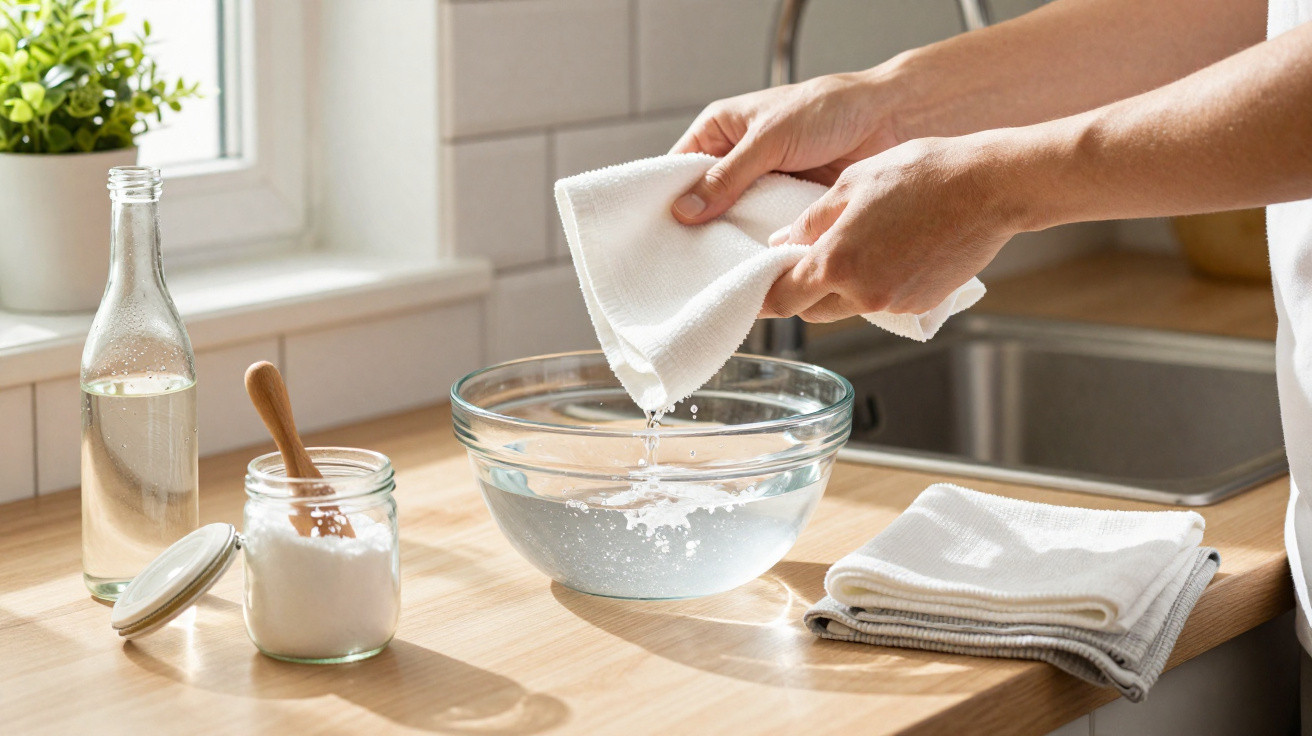
Months old, already grey and somehow musty: many tea towels are thrown away far too soon – even though a simple trick is all it takes.
Anyone who cooks regularly will know the issue: tea towels that were once bright white quickly become grey, stained and stiff. The usual response is to buy new ones or reach for harsh chemicals. Yet a straightforward blend of household staples can restore their original whiteness surprisingly well – with no chlorine cleaner required.
Why tea towels quickly turn grey and unattractive
Tea towels are true workhorses in the kitchen. They absorb grease, sauces, tea and coffee residues, red wine, and anything else that gets spilled during cooking. That is exactly why they lose their brightness so rapidly.
- Fats and oils become embedded deep within the fibres.
- Colourants from coffee, tea, tomato sauce or red wine permanently stain the fabric.
- Wash temperatures that are too low remove grease and bacteria only incompletely.
- Too much detergent leaves residues that settle over the fibres like a film.
- Hard, limescale-rich water makes the material rigid and robs white fabrics of their brightness.
Over time, this creates the familiar grey film. The towel feels stiff and smells slightly rancid or like a deep-fat fryer – even immediately after washing.
The real enemy is not dirt alone, but the combination of grease, detergent residue and limescale that becomes deeply lodged in the fabric.
Why chlorine cleaner often causes more harm than good
Out of habit, many people use chlorine cleaner to get rid of the grey cast. At first, its effects can seem impressive: stains fade quickly and the towel appears brighter. However, that comes at a considerable cost.
Chlorine-based cleaners can:
- make cotton and linen fibres brittle
- cause a yellowish tinge over time
- damage prints, patterns and decorative borders
- irritate the skin and respiratory system
- release toxic gases if mixed incorrectly with acids
One point is particularly risky: anyone combining chlorine cleaner with vinegar or other acidic products risks harmful fumes. For an everyday item that constantly comes into contact with hands and crockery, this is hardly an appealing option.
The gentle alternative: bicarbonate and vinegar together
The unexpected star in the battle against grey kitchen laundry is a familiar powder: bicarbonate of soda. Combined with ordinary clear household vinegar, it creates a mixture that works deep within the fabric without damaging it.
How bicarbonate works on fabric
Bicarbonate of soda is mildly alkaline, helping to loosen grease and neutralise odours. Once distributed through the material, it releases dried-on food residues and pigments that discolour tea towels. Unlike many harsh cleaning products, it does not attack the fibres; instead, it works quietly in the background as a gentle “loosener”.
At the same time, it helps prevent unpleasant smells from lingering in the fabric. Familiar cooking odours, old grease and musty notes become noticeably less apparent.
Why vinegar is the ideal partner
Household vinegar has a different role: it dissolves limescale deposits and old detergent residues. This removes the invisible coating that makes fibres feel hard and look dull. It also neutralises bacteria and germs, which readily multiply in damp towels.
In warm water, vinegar reacts with bicarbonate to create a fizzing soak that releases grease, limescale and dark marks from the fabric – a thorough “reset” for tired tea towels.
Step by step: the “back-to-white” soak for tea towels
This household trick needs only a few simple ingredients that many people already have in the cupboard.
Basic recipe for the cleaning soak
| Ingredient | Amount |
|---|---|
| Bicarbonate of soda | 3 tablespoons (approx. 30–40 g) |
| Clear household vinegar | 250 ml |
| Water | 2–3 litres, hot but not boiling |
| Tea towels | Cotton or linen, pale or white |
How to use it
- Place the dirty tea towels in a sufficiently large bowl or bucket.
- Sprinkle the bicarbonate of soda evenly over the textiles.
- Slowly pour the vinegar over them – the resulting foam is intentional.
- Add hot water until every towel is completely submerged.
- Leave to soak for at least 6 hours, preferably overnight.
- Then wash the towels in the machine as usual – without chlorine cleaner and without overfilling it.
- Finally, allow them to dry in the air, ideally in sunlight.
Even after one treatment, the fabric feels noticeably softer and fresher, and looks visibly brighter. Heavy discolouration often does not disappear completely the first time, but it is significantly reduced.
When nothing else works: the bicarbonate “emergency” simmer
For towels already considered hopeless cases – rock-hard, dark grey and marked by very old stains – a short simmer can help.
Heat 2–3 litres of water in a pan, add 1–2 tablespoons of bicarbonate of soda, then gently simmer the towels for 15–20 minutes. Rinse them thoroughly afterwards and give them a full machine wash. This method is particularly suitable for sturdy cotton, not delicate fabrics or printed items.
How to keep whites brighter for longer after the treatment
To prevent tea towels from becoming dull and grey again after only a few weeks, a different day-to-day routine helps.
- Change towels regularly – ideally every day or every other day.
- Never leave wet towels scrunched up for long; hang them up instead.
- Wash heavily soiled towels, such as those covered in cooking grease, separately.
- Use detergent sparingly and adjust the amount to the water hardness.
- Where possible, wash pale towels at 60 °C.
Adding a bicarbonate and vinegar soak from time to time also helps to prevent stubborn deposits. This keeps the fabric softer and brighter for considerably longer.
What causes grey film, limescale and stiff fabric
The proverbial grey film is rarely caused by dirt alone. In many areas, tap water is hard and rich in limescale. With every wash, tiny crystals settle into the fibres. Together with excessive detergent, they create a coating that lets through water and light less effectively, making white fabric look dull.
Bicarbonate and vinegar work precisely at this point: bicarbonate loosens grease and dirt, while vinegar dissolves limescale. Once this film is removed, the original colour shows through more clearly. The material becomes supple and absorbent again, taking up water more effectively when drying dishes.
How the trick can be used on other textiles too
This mixture is not limited to tea towels. Many households also use it for:
- white cotton towels
- dishcloths and flannels
- pale fabric napkins
- cotton aprons
Care is needed with delicate materials: wool, silk, or items with metallic threads, sewn-on appliqués or special coatings should not go into this soak. For these, it is better to use mild specialist detergents and follow the care instructions.
Anyone wanting to avoid harsh bleach has a simple tool in bicarbonate and vinegar: little effort, manageable costs and considerably fewer chemicals in everyday life – with tea towels that no longer look embarrassingly grey when visitors look into the kitchen.



Comments
No comments yet. Be the first to comment!
Leave a Comment