
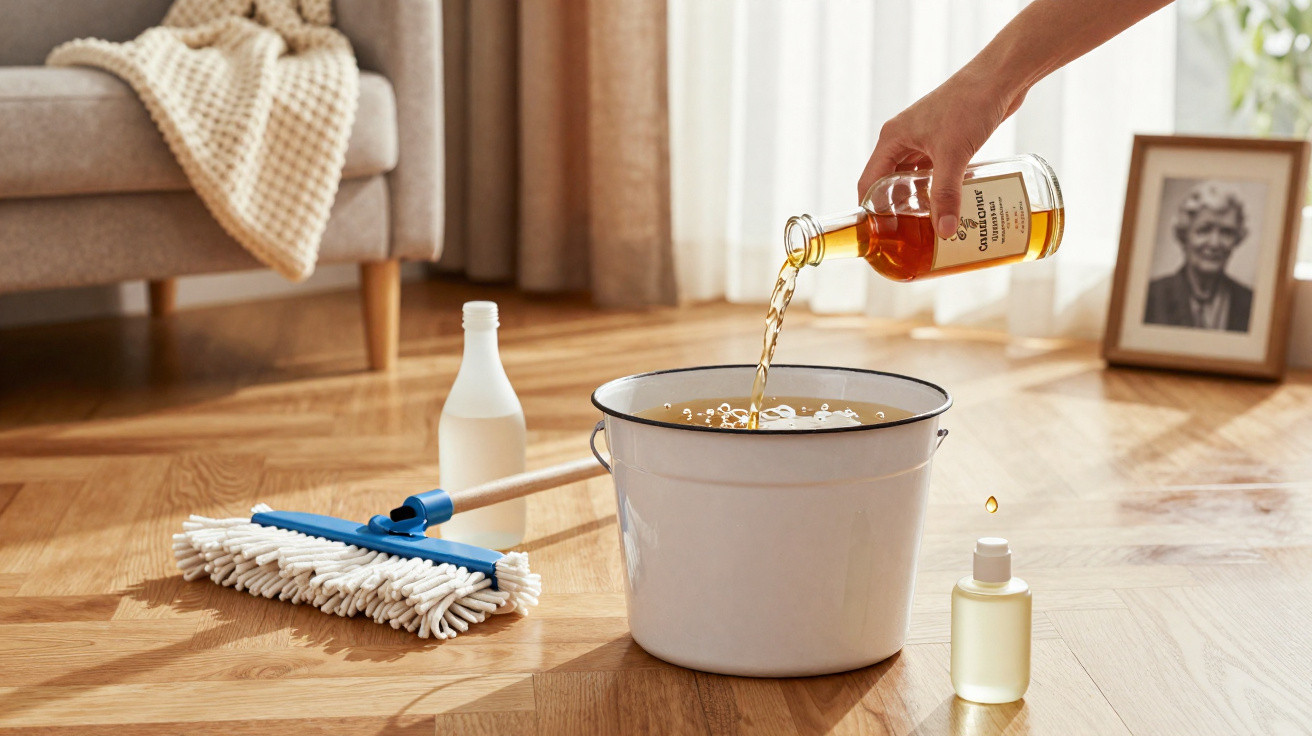
The bucket was made of metal, dented in three spots and older than everybody gathered in the room.
It gave a quiet clink as Grandmother tipped hot water from the kettle into it. She then picked up three unassuming ingredients, so simple they almost seemed questionable. There was no costly spray or plastic bottle claiming “ultra gloss” in 24 hours - only a battered spoon, a handwritten jar and a small bottle carrying a light citrus-and-soap scent.
The boards beneath us had endured generations of feet, sharp-wheeled toys and at least two dogs with absolutely no regard for mops. But as she guided the cloth in slow, familiar strokes, the lifeless wood appeared to stir. Streaks of light emerged, as though hidden lamps beneath the boards were being turned on one by one. Without raising her eyes, she smiled and said, “You don’t need much when you know what works.”
What was most surprising was the speed at which the room was transformed.
The understated strength of an old recipe
Today, most people keep cupboards crammed with cleaning products that promise miracles in fluorescent lettering: one for tiles, another for wood, another for laminate and one simply for “shine”. Even so, the floor can look worn again within two days. Grandmother’s traditional mix takes the opposite approach: three or four ingredients, one bucket and a technique that takes less than a minute to describe.
Its simplicity is strangely disarming. In an age of microfibres and multi-surface formulas, it can almost feel incorrect. As the cloth slides across the floor and the boards dry in mark-free sections, you may find yourself asking, “That’s it?” The result is not the harsh, plastic-looking gleam shown in adverts. Instead, it is a gentle, well-loved lustre that makes the room feel both fresh and peaceful.
A small survey of professional cleaners in the UK a few years ago produced an unexpected finding: many still used homemade solutions on difficult floors, particularly old timber and tiles. This was not for appearance’s sake, but for jobs where pricey products had repeatedly let them down. One cleaner described her “nan’s water” as her secret weapon and, when asked what it contained, laughed. It was water, white vinegar, a few drops of washing-up liquid and a little oil for wooden floors.
The same theme appears repeatedly. Many supposed “trade secrets” are simply family recipes quietly passed down through kitchens and utility rooms. They were put to the test over decades of children spilling juice, pets bringing in mud, winter boots and summer sand. There were no advertising claims - just one measure of success: did the floor look better and remain that way?
In practical terms, these traditional recipes are less mysterious than they first appear. Vinegar removes mineral deposits and old layers of cleaning product. Gentle washing-up liquid lifts grease from cooking and everyday use. A modest quantity of oil conditions timber and creates that subdued, warm sheen. Hot water handles much of the work.
The crucial factor is proportion. Add too much vinegar and the room will smell of salad; use too much soap and a dull, tacky residue remains; use too much oil and the hallway becomes a skating rink. The grandmother mix that makes floors shine is not magical water, but a finely judged combination of tiny amounts, made so often that the hand eventually stops needing measuring spoons.
The precise grandmother mix for shining floors
This is the basic form of the traditional mix, found in many families with only slight differences. Fill an ordinary bucket with hot - but not boiling - water, around 4 to 5 litres. Pour in half a cup of white vinegar, followed by only a few drops of mild washing-up liquid, no more than a teaspoon. For wooden or laminate flooring, add a tablespoon of vegetable oil or olive oil and whisk it straight into the bucket.
Use the mop or a wooden spoon to stir until the water appears faintly cloudy. This shows that the ingredients have combined. Soak a clean mop or cloth, wring it out thoroughly and clean in small areas. Allow each section to air-dry before stepping on it. The sheen does not arrive immediately: it develops while the surface dries and the fine coating of oil settles evenly.
The method can look almost absurdly easy when written down. In practice, its effect lies in the small details. Do not overload the mop head or cloth, and replace the water once it becomes cloudy with dirt. For tiled or vinyl surfaces, leave out the oil and use only vinegar and soap. On genuine wood, keep the cloth fairly dry, treating the task more like damp polishing than wet mopping. The complete job often takes less time than a “deep clean” involving three shop-bought products, simply because there is no need to swap tools or bottles every five minutes.
This is also where many people go wrong. There is a temptation to add “a little more” of every ingredient, believing that more product means more shine. It is seldom the case. Excess vinegar may gradually dull some finishes and leave a lingering odour. Too much soap forms an unseen layer that collects dust. Too much oil creates footprints and streaks that can look nearly worse than the original grime.
Hurrying the drying period is another frequent error. People mop, then immediately pull chairs across the room or walk through in socks, leaving marks that make it seem as though the cleaning has failed. In fact, the mixture has done its work; it simply needed ten more undisturbed minutes. Let’s be honest: nobody really does this every day. In most households, this deeper shine treatment is needed perhaps once every week or two. At other times, a quick clean using hot water alone will deal with everyday dust and light dirt.
There is also concern about “ruining the floor” with vinegar or oil. For particularly delicate or high-end finishes, testing the mixture in an unobtrusive corner is sensible. However, many older floors are considerably more robust than they appear. They have already weathered bleach, aggressive detergents and years of being overlooked. When diluted and applied carefully, a mild mix is often a benefit rather than a danger.
“When I switched back to my grandmother’s floor mix, the funniest thing happened,” a reader from Manchester told me. “Guests started asking if we’d changed the flooring. We hadn’t. We’d just stopped suffocating it with products.”
That response helps explain why these recipes continue to appear across social media, TikTok cleaning clips and family WhatsApp chats. Old-school doesn’t mean outdated; it often means stress-tested. People are weary of spending a small fortune on bottles that promise too much and deliver too little.
A handful of straightforward limits will keep the method safe and effective over the long term:
- Choose white vinegar only; coloured vinegars may stain.
- Do not use strongly fragranced washing-up liquids, which can leave an overpowering smell.
- Omit oil completely on highly glossy, factory-coated laminate.
- On wooden floors, always wring the mop until it is merely damp.
- When treating any delicate finish for the first time, test a small concealed area.
On a peaceful Sunday morning, with the windows slightly ajar and light falling across the floor, observing these small rules can feel more like a ritual than a household task.
Why this small ritual remains relevant today
This old mixture represents more than gleaming planks or tiles. It reflects a whole idea of “enough”: enough product, enough effort and enough time, rather than excess or exhaustion. Cleaning is often squeezed into the final 20 minutes of the day, fitted around emails and dinner. A bucket, a brief recipe and a few measured passes across the floor can therefore feel unexpectedly grounding.
The practical savings can mount up quickly. Vinegar costs little, washing-up liquid is already at home and oil is in the kitchen. There is no need to buy a “wood shine booster”, a “tile reviver” and a “floor deodoriser”. This pared-back approach also suits the gradual shift towards using fewer chemicals at home: fewer plastic containers, fewer labels to decipher and fewer competing scents in the hallway.
There is an emotional element too. We have all experienced the moment when the house is finally tidy, the floor is clean and calm suddenly returns. A shiny floor is not merely visual: it changes how you move through the space and how you breathe in your own home. You notice light bouncing beneath the table. Instead of an artificial “ocean breeze”, there is a subtle clean smell. You may even recall the sound of a dented metal bucket in somebody else’s kitchen.
This is why people speak of these traditional mixes with such fondness. The point is not solely vinegar and soap, but the sense that certain solutions can genuinely endure across generations without being repackaged every year. It is the reassurance of a method that does not demand attention, yet performs quietly whenever it is given the opportunity.
Grandmother’s old floor mix will not repair a broken board or remove deep scratches, nor will it turn a rental property into a palace. What it can do is make what you already own look cared for again. There is less dullness, less stickiness and more glow: a small but determined glow that says this is a lived-in home, but one that is looked after.
Perhaps that is why this modest recipe keeps appearing in search results, comments beneath viral videos and chats between neighbours on stairwells. It shows that not everything requires an upgrade. Sometimes the best route ahead is a dented bucket, three ingredients and a method proven by someone who cleaned floors long before “gloss finish” became a marketing phrase.
| Key point | Detail | Benefit for the reader |
|---|---|---|
| Minimalist mix | Hot water, white vinegar, a few drops of washing-up liquid and a little oil for wood | An easy recipe to remember, using ingredients already found at home |
| Precise quantities | 1/2 cup of vinegar, 1 teaspoon of soap, 1 tablespoon of oil for 4–5 L of water | Prevents streaks, protects floors and delivers a lasting shine |
| Adaptable ritual | With or without oil depending on the floor type; test a small delicate area | Suitable for different floor coverings, with safe and tailored use |
FAQ:
- Can I use this mix on all types of floors? It performs well on most tiles, vinyl and many wooden floors, but leave out the oil on glossy laminate and always test a hidden area on delicate finishes.
- Will vinegar damage my wooden floor over time? At this low dilution, and when applied with a thoroughly wrung mop, it is generally safe for sealed wood; soaking the floor, rather than the vinegar itself, is the real danger.
- How often should I use the grandmother mix? Once a week is enough for most homes, with simple hot-water mopping between treatments for routine dust and light dirt.
- What if I hate the smell of vinegar? Add a few drops of essential oil, such as lemon or lavender, to the bucket, or open the windows during cleaning so the scent disappears more quickly.
- Why does my floor look streaky after using it? Streaking normally indicates too much soap or oil, or a mop that is overly wet; use less product next time and wring the mop out more thoroughly.

Comments
No comments yet. Be the first to comment!
Leave a Comment