
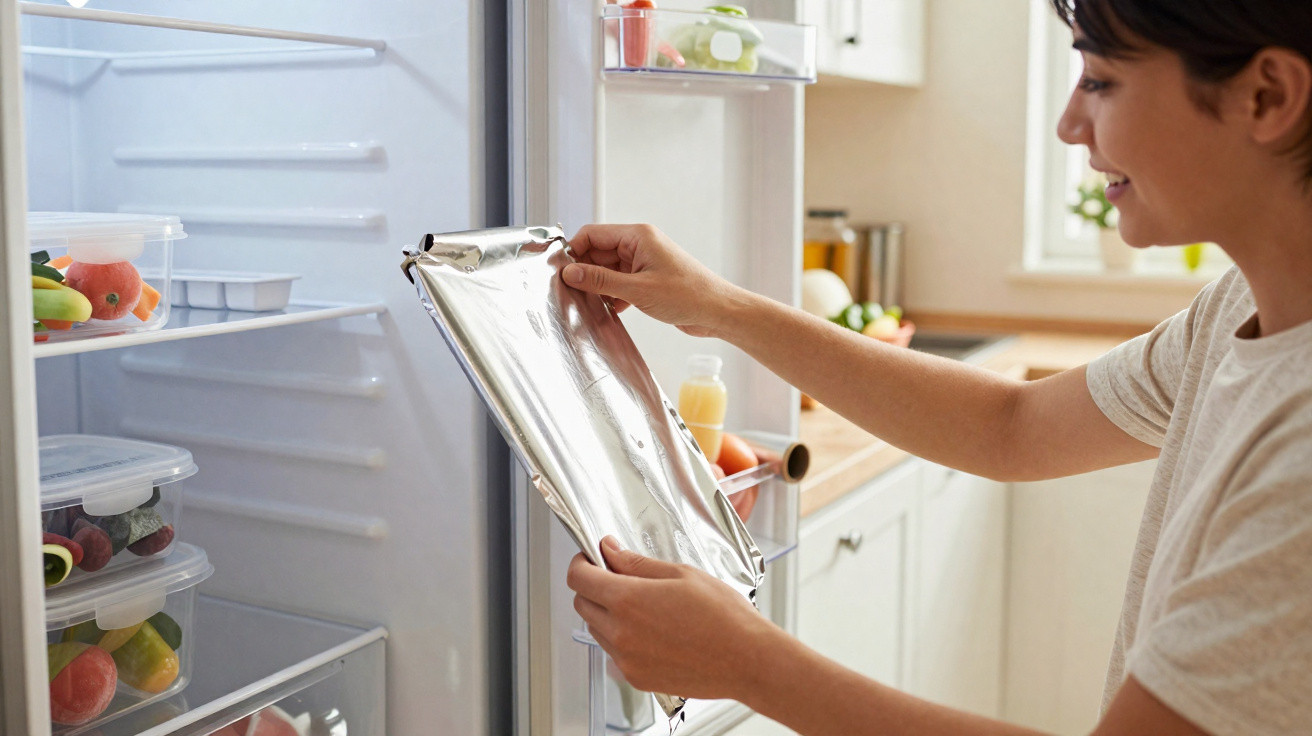
We examined household tips in detail to find out what this aluminium method really achieves, when it is useful, and when it is best avoided.
Why the foil-in-freezer trick is trending
Frost forms as moist air meets freezing-cold surfaces and becomes ice. This icy layer takes up valuable room, holds on to odours and can cause drawers to jam. Because it insulates the freezer, the appliance must work harder too. A simple, low-cost tip is now widely shared on social media: place smooth aluminium foil sheets over areas prone to frost so the ice can be removed in seconds when cleaning. It sounds tidy, and it can work well when applied properly.
Use aluminum foil only in static-cooling freezers, and never cover vents, probes, or defrost heaters.
How it actually helps
Foil does not stop frost from developing; instead, it alters the surface it clings to and makes removal quicker.
Two characteristics make the difference. Firstly, ice grips a smooth foil surface less firmly than a textured plastic liner, allowing the sheets to lift away with much of the frost during defrosting. Secondly, aluminium transfers heat rapidly. Once the appliance is switched off for defrosting, the metal warms a little sooner than the ice around it, weakening the bond and hastening the initial release. A full defrost is still necessary, but it takes less time and requires no scraping.
Step by step, without hurting the appliance
- Leave the freezer running normally. If you are installing the foil after defrosting, begin with the freezer empty.
- Work out where frost collects most heavily, such as the rear wall, beneath shelves or on drawer bases.
- Trim flat foil sheets to fit. Keep them smooth, as folds may leave marks on soft plastic.
- Position every sheet flush against the surface. Never obstruct air routes, fan intakes, sensors or drains.
- Do not use strong adhesive tape. Where necessary, make small folds to secure the edges while keeping the sheets easy to remove.
- Return the food to the freezer. At the following defrost, remove the sheets, shake off the ice and fit fresh ones.
Swap the sheets at each defrost cycle. Skip sharp tools; a knife can puncture coolant lines.
When to skip the hack
This approach is intended for static-cooling appliances that require manual defrosting. A freezer labelled “no frost” uses fan-powered airflow and scheduled defrost cycles. Additional layers may interfere with that airflow while providing no advantage. Avoid foil as well where it could contact heating elements or temperature probes, or where the instruction manual advises against using any type of liner. Keep it away from acidic spills, including citrus syrup, as these can discolour or pit metal over time.
| Freezer type | Foil use | Note |
|---|---|---|
| Static-cooling chest or upright | Yes | Fit removable sheets to walls or drawer bases, while leaving vents unobstructed. |
| No frost / frost-free | No | Air channels control moisture; extra sheets could disrupt the designed airflow. |
| Mini-freezer inside a fridge | Maybe | Space is limited; use foil only where it cannot block the thermostat dial or drain. |
A material with smart side gigs
Aluminium foil has uses beyond freezer storage. Scrunch a used sheet into a loose ball to make an abrasive scrubber for baked-on deposits on barbecue grills and steel pans. Do not use it on non-stick coatings, which are easily scratched. For another everyday use, place a foil sheet below the ironing-board cover. It bounces heat back into heavier fabrics, cutting a few minutes from ironing denim and cotton when time is short.
Some DIY enthusiasts also place a small foil shim beneath a loose battery terminal in a remote control to restore the connection. This is a short-term contact fix, not a way to extend battery life. Metal conducts electricity, and poor positioning may short-circuit the device. Replace the battery as soon as possible.
Think of foil as a tool: smooth, conductive, and disposable. Use it where those traits help; park it where they don’t.
Energy, hygiene and money
Clean liners help reduce odours and make labels easier to read, which is already a good reason to speed up defrosting. There is a cost consideration too. Just a few millimetres of frost can make compressor cycles run longer. Where a typical upright freezer uses around 250 kWh annually, a 10% increase caused by heavy frost amounts to roughly 25 kWh. At typical household tariffs, better routine maintenance could save a few pounds. Small improvements accumulate over the seasons.
Habits that beat frost at the source
- Shut the door promptly, particularly in humid weather.
- Let leftovers cool before freezing them, and wrap food tightly to retain moisture.
- Maintain a setting close to -18 °C (0 °F) for a reliable balance between food safety and efficiency.
- Arrange baskets so that air can move around food packages.
- Clean the door seals and inspect them for gaps; a light coating of petroleum jelly can help restore flexibility.
- Vacuum the condenser coils or rear grille once or twice yearly.
- Arrange a defrost once frost reaches about 3–5 mm, rather than allowing thick layers to build up.
What users report right now
Household communities and online forums describe broadly similar results. Owners of older static-cooling freezers say that the sheets come away with a satisfyingly solid layer of frost during defrosting, making the final wipe-down faster. Some have had untidy results where foil was creased or touched a vent, concentrating frost around the edges. Others found that thin budget foil tore too easily, with two layers resolving the issue. Outcomes depend on how often the door is opened, humidity levels and how the freezer is loaded. The success of the method depends entirely on careful installation.
Environmental angle
Give each sheet two uses: first as a liner, then as a scrubber for a metal grill or pan. Rinse and dry it before recycling in areas where kerbside schemes accept clean aluminium. Keep acidic substances away from both the foil and freezer walls. Wipe up orange juice or tomato sauce promptly if spilled. This helps prevent staining on plastics and avoids metal pitting.
Keep it simple: flat sheets, clear airflow, quick swaps. That’s the recipe for faster defrosts and fewer headaches.
Extra context to go further
Static cooling versus no frost, in plain words
Static-cooling freezers chill their walls directly. Moisture settles on the liner and freezes, which is why manual defrosting is required. No-frost appliances circulate air using a fan and warm their coils at set intervals. Moisture is removed before it reaches the cabinet surfaces, then drains away. The former type can benefit from removable liners, while the latter depends on clean and unobstructed airflow routes.
A quick weekend routine that pays back
Set aside 10 minutes each month. Look for early rings of frost, wipe the seals, dispose of outdated food and identify warm areas with an inexpensive fridge thermometer. Once frost exceeds a few millimetres, schedule a complete defrost and place fresh foil in the target areas afterwards. Combine this with efficient packing: flat, labelled bags freeze more quickly and stack more neatly, meaning the door stays open for fewer seconds and both moisture and energy use are reduced.






Comments
No comments yet. Be the first to comment!
Leave a Comment