
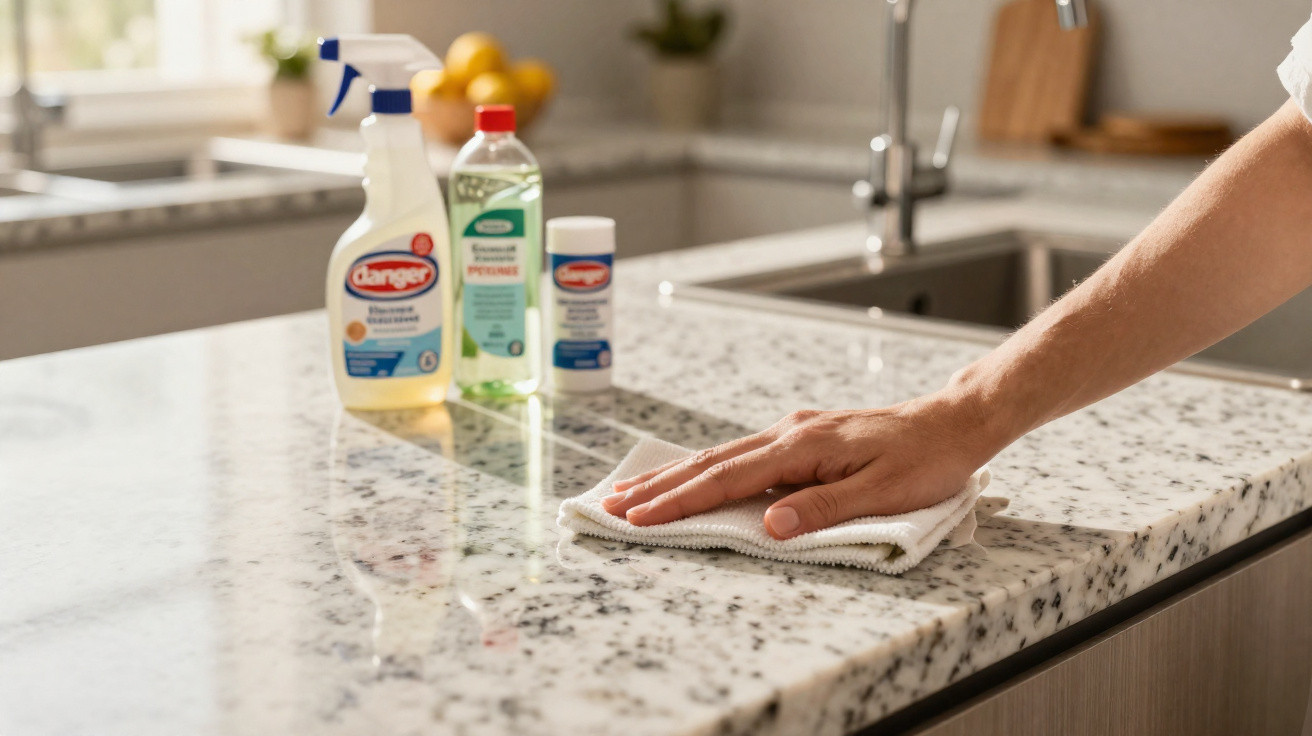
Coffee has just spilt beside the stand mixer. In the rush, you grab the nearest sponge-the one left by the sink with its sharp lemon smell-and start scrubbing. It seems like an insignificant action. Yet on a granite or quartz worktop, that reflex can leave a dull patch, a pale mark or, worse still, a small scratch that will not vanish with the next clean. We all know the moment when the kitchen has to look spotless before guests arrive. But these elegant surfaces cannot withstand everything. Some bottles stored beneath the sink are genuine silent enemies. They offer no warning.
Strong surfaces, but not indestructible
Granite and quartz convey an almost reassuring sense of toughness. You put a saucepan on them, perhaps cut a lemon on them, or let a few drops of water dry without a second thought. Granite is a natural stone, often protected with a water-repellent treatment, while quartz is a composite material made from quartz powder and resins. What do they share? They respond best to gentle care, however capable of handling anything they may look.
In a family kitchen, damage seldom follows one dramatic accident. A neighbour once described noticing a dull ring near her sink after spraying limescale remover “just once”. The product had run underneath her washing-up liquid bottle and remained there all afternoon. That brief lapse cost her professional treatment. A premium worktop can lose its lustre because of only a few millilitres.
The first products to keep away from these surfaces are strong acids: limescale removers, drain unblockers, toilet cleaners, cement removers and certain rust treatments. White vinegar, often promoted as a household miracle solution, also calls for real caution on granite. It gradually damages the stone’s protective seal and can dull certain finishes. On quartz, the resins may react badly to repeated exposure. Natural does not always mean harmless.
Products to keep off granite and quartz worktops
The safest approach is a quick 30-second routine: use a soft microfibre cloth, warm water and a neutral soap, then dry the surface straight away. Avoid scouring powders, abrasive creams and overly rough green sponges. They do not always leave an obvious scratch on the first pass, which makes the trap even more frustrating. Over time, the light exposes a less glossy, hazy-looking area, often around the sink or hob.
Bleach is a common mistake, particularly after handling raw meat or cleaning up a coloured stain. The intention is sound: you want to disinfect quickly and restore a hygienic kitchen. Let’s be honest: after a long day, nobody really reads every label on their cleaning products. Even so, concentrated bleach can discolour certain quartz resins and weaken granite’s surface treatment. Solvents, including acetone, paint strippers and oven cleaners, are just as hazardous.
A stonework specialist often sums it up with a straightforward rule:
“If a product can strip, bleach or dissolve limescale, it has no place on a stone or quartz worktop.”
Keep this list by the sink, especially when several people use the kitchen:
- acidic limescale removers and undiluted vinegar;
- bleach, chlorine-based cleaners and harsh disinfectants;
- abrasive powders, metal scouring pads and rough scourers;
- oven cleaners, drain unblockers and solvents;
- highly alkaline products, often intended for floors or grout.
A good habit is better than a repair
When a stain appears, the worst response is to scrub harder with the first product to hand. Instead, blot it immediately with kitchen roll, rinse with clean water, then clean gently with a pH-neutral product made for natural stone or composite surfaces. A wine, lemon juice or oil mark left for several hours will behave differently depending on the worktop finish. On porous or poorly protected granite, it can soak in faster than you might expect.
Quartz also needs particular care around heat. It is not a cleaning product, but a saucepan lifted from the hob or a hot dish can mark the resin, cause a fine crack or alter the colour in one area. Using a trivet seems obvious-until the evening when you are cooking for six and every centimetre of worktop is occupied. The simplest precaution is often the one forgotten at exactly the wrong time. One measured action can prevent years of visual regret.
For granite, a discreet test can be useful before applying a new cleaner: place a few drops of water on an inconspicuous area and see whether the stone absorbs them quickly. If it darkens, the protective treatment may need renewing by a professional or with a suitable product. Never mix several cleaners, even when tackling a stubborn stain. The combination can release harmful fumes and become even more aggressive towards the surface.
Ultimately, maintaining a granite or quartz worktop does not require a collection of expensive bottles. Above all, it means moving away from the reflex that “stronger = cleaner”. That idea is persistent because harsh products can sometimes create an immediate impression of deep cleanliness. Yet a hard-wearing surface retains its lustre through modest, repeated actions rather than forceful treatment. A soft cloth, neutral soap and drying after use can seem almost too simple to work. They do. Every kitchen then shows the difference: a respected material that ages well, rather than a beautiful worktop gradually worn down by products meant to make it shine.
| Key point | Detail | Benefit for the reader |
|---|---|---|
| Avoid acids | Undiluted vinegar, limescale remover and toilet cleaners can dull granite or damage resins. | Preserves shine and reduces difficult-to-remove rings. |
| Steer clear of abrasives | Scouring powders, metal pads and rough sponges create micro-scratches. | Prevents the dull appearance that gradually develops around frequently used areas. |
| Choose gentle cleaning | Warm water, neutral soap, microfibre and prompt drying are enough for everyday care. | Provides lasting protection for an often costly investment. |

Comments
No comments yet. Be the first to comment!
Leave a Comment