
On Saturday morning, everything appears to be going perfectly: the shelf has just been fitted, the books are neatly arranged and the plant trails attractively over one side. A few days later, though, there is a faint crack. One screw starts to shift, the level tilts, and you begin removing the heaviest items “just in case”. We all know that point when a small DIY job, meant to make the home more practical, becomes a cause for concern every time you walk past the wall. The shelf itself is not always to blame. The issue is often concealed behind it, in a detail that went unnoticed or was overlooked because the fixing seemed secure at the time. That is where everything is decided.
The wall is not just a backdrop: it determines how secure the shelf will be
A wall-mounted shelf that starts to sag has not necessarily been fitted badly. In many cases, it was installed on the assumption that every wall is alike: a wall plug, a screw, a hole, and the job is done. Yet plasterboard, hollow brick, concrete and old, crumbly stone all respond very differently. Plaster can feel firm to the touch, then break away around the screw once the weight pulls forwards. A wall does not hide its true nature for long. Eventually, it will reveal it.
The most common situation occurs in newer homes: an attractive solid-wood shelf is fixed to plasterboard using two small universal wall plugs. At first, it holds a few framed pictures and a candle. Then come the novels, vinyl records and storage boxes. An 80-centimetre shelf filled with books can easily exceed 20 kilograms, even before allowing for the leverage created by its depth. It is not simply the weight sitting on the shelf that strains the fixing; it is the constant pulling force acting on it.
Think of a shelf as an outstretched arm. The deeper it is, the farther the weight sits from the wall and the more sharply the screws are pulled. This is why a shallow 20-centimetre shelf can sometimes hold perfectly well where a larger 35-centimetre shelf eventually tears its support from the wall. The risk is not always apparent before the shelf falls. A secure fixing therefore relies on three elements working together: the wall material, the type of wall plug and the actual load you intend to place on it.
The right method for fitting a wall-mounted shelf: identify, drill and secure it properly
The first useful step is to identify the surface before you even take out the drill. Tap the wall gently: a hollow sound often suggests a hollow partition, while a solid sound may indicate concrete, brick or breeze block. A material detector gives a more dependable answer and can also locate metal studs, electrical cables and pipes. On a plasterboard partition, fastening the shelf into a stud remains the most reassuring option. If that is not possible, use fixings designed for hollow walls, which spread the load behind the board.
For concrete or solid brick, good-quality nylon wall plugs combined with sufficiently long screws will usually do the job very well. Hollow brick needs a different approach: expansion plugs or suitable anchoring systems prevent the material from breaking away around the hole. Let us be honest: nobody checks the diameter of every drill bit every day. Even so, drilling too wide is one of the costliest mistakes. A wall plug that slides in without resistance will never provide a lasting hold, however sound it may seem for ten minutes.
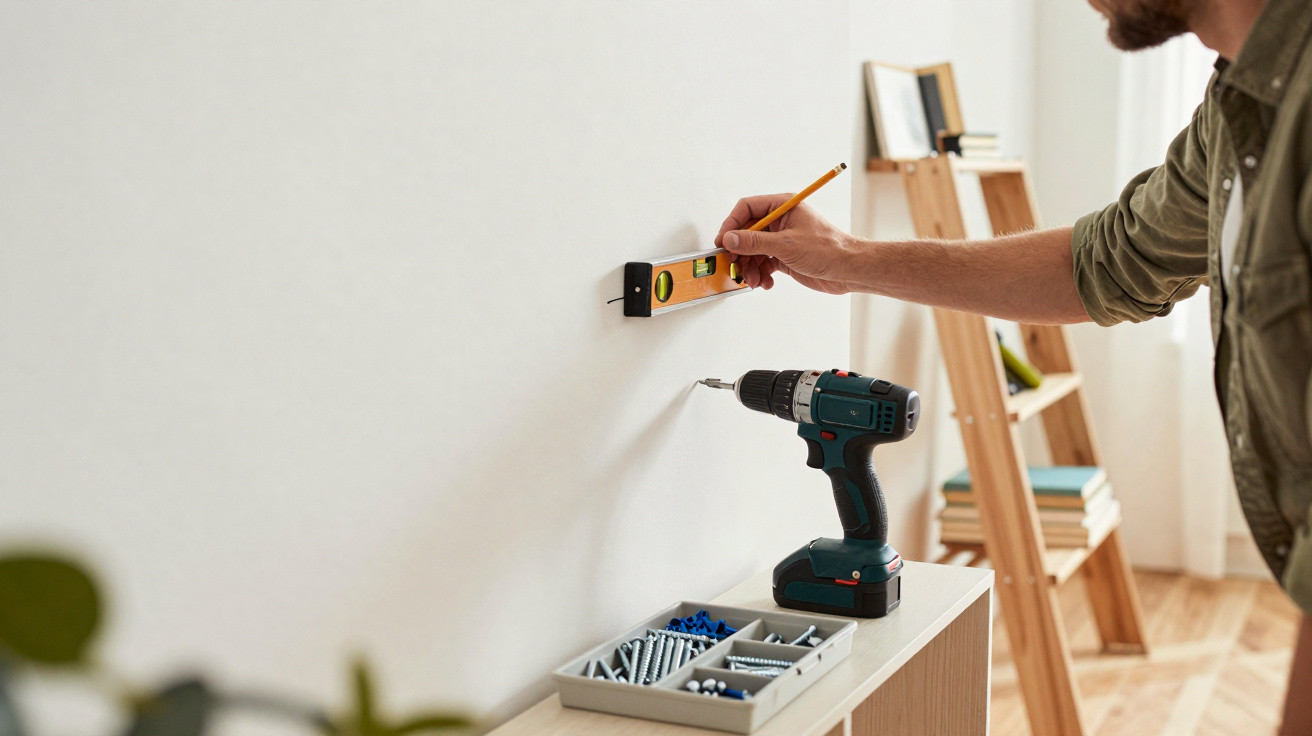
Before tightening anything permanently, hold the shelf against the wall, check that it is level and mark every fixing point in pencil. Drill straight, clear the dust from each hole, then fit the wall plugs without crushing or twisting them. A good fixing is not judged by the number of turns of the screwdriver, but by the clear resistance you feel as it tightens.
“A reliable shelf does not depend on a larger screw: it depends on a consistent system between the wall, the load and the support.”
- Plasterboard: favour metal expansion plugs or fixings driven into studs.
- Concrete: select a nylon wall plug suited to the screw diameter and the intended weight.
- Hollow brick: choose a fixing designed for cellular materials.
- Older walls: test an inconspicuous area, as the surface may conceal fragile masonry.
Overlooked details that make shelves fall
Wall plugs are often blamed, although the real problem can sometimes lie with the brackets. Supports that are too short, too thin or spaced too far apart can turn a sturdy shelf into an unstable board. On a long shelf, using only two brackets at the ends creates a weak point in the middle. The wood eventually bows, the screws come under greater strain, and then the entire assembly begins to move. Adding a central support costs little and transforms its stability. It is not especially dramatic, but it is remarkably effective.
The weight is also frequently underestimated. A stack of hardback books, a coffee machine, glass jars or a few vinyl records weigh far more than they appear to. Allow for a margin, particularly in a kitchen, garage or child’s bedroom, where the shelf invariably fills up over the months. A shelf is never loaded only once. It changes with the home: items are put on it, taken off it, and a bag may be hung from it for a few seconds, sometimes without a second thought.
Once the fixings are in place, test them gradually. Start by placing a moderate load on the shelf, check that it remains completely level, then increase the weight slowly over several hours. A screw edging out slightly, a crack around the hole or a sharp noise should be an immediate warning. Do not try to “tighten it very hard” when a fixing spins freely: this only damages the wall further. It is better to take everything down, fill the holes properly and begin again with the correct hardware. That half-hour can sometimes prevent broken furniture, a badly damaged wall or an object falling onto someone.
| Key point | Detail | Benefit for the reader |
|---|---|---|
| Identify the wall | Plasterboard, concrete, hollow brick and older walls each require different fixings. | Avoid using an unsuitable wall plug from the outset. |
| Calculate the actual load | Books, crockery and everyday objects create a weight that is often underestimated. | Choose brackets and screws with a safety margin. |
| Add more support points | A long shelf becomes more stable with a central bracket or additional fixing points. | Reduce the risk of bowing and the wall fixing tearing out. |




Comments
No comments yet. Be the first to comment!
Leave a Comment