
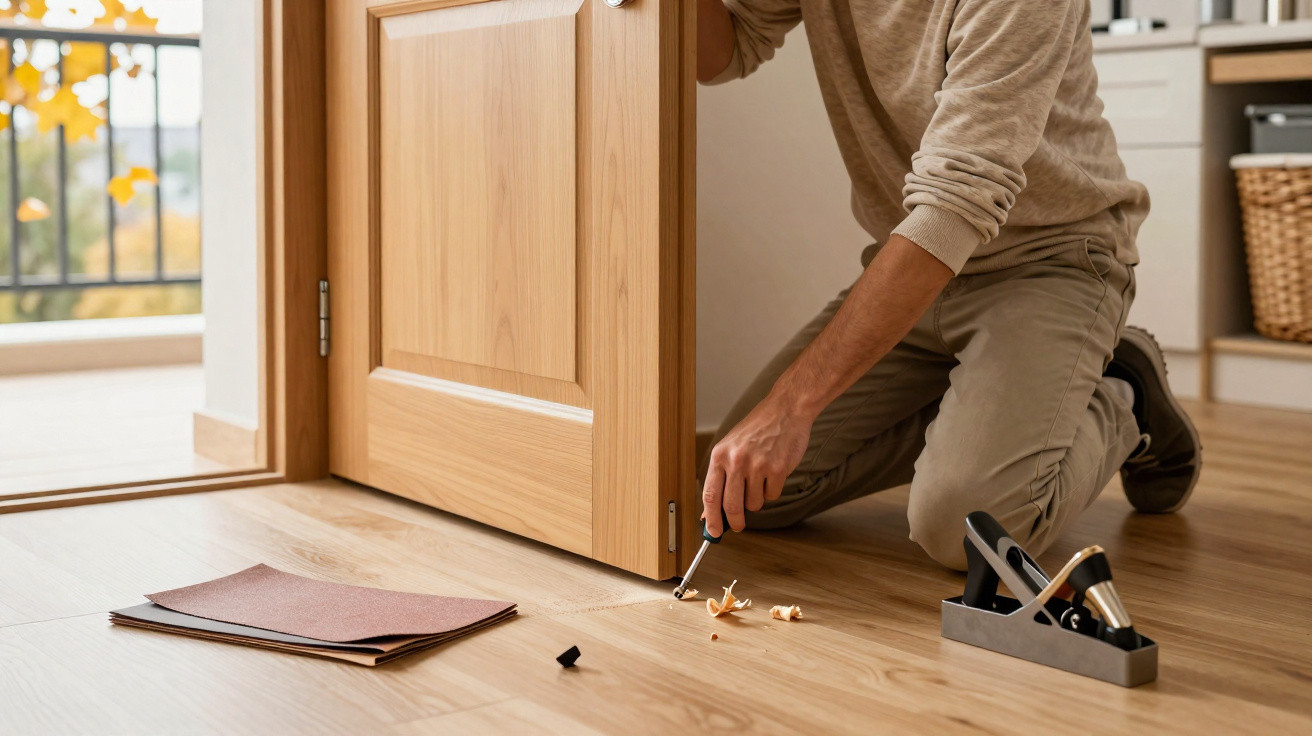
Does your door close perfectly in summer but scrape along the floor in autumn? This unusual behaviour has a very simple physical explanation.
The practical advice website Maison & Travaux has examined a problem that catches many homeowners in France by surprise: a door that opens smoothly throughout the warmer months can suddenly start rubbing as temperatures fall and humidity returns. The publication explains the mechanism behind it and sets out a quick repair method that most keen DIYers can manage.
Why a door rubs when autumn arrives
At first, it may seem as though the door itself is at fault. In fact, the biggest changes between summer and autumn occur in the door's surroundings: the humidity level in the air and the temperature of the materials in the home. Door frames, flooring and sometimes even walls respond to these fluctuations.
Wood is the material most commonly affected. It is “hygroscopic”, meaning it naturally absorbs and releases moisture from the air. During hot, dry weather, it contracts slightly. Once the air becomes damp in autumn and winter, it expands.
“A wooden door can gain a few millimetres in thickness or height as a result of humidity, enough for it to rub against parquet or tiled flooring.”
The issue is not necessarily confined to the door leaf itself. The frame fixed into the wall can shift too, particularly in older or poorly insulated properties. Slight settlement in the floor, movement in the walls or a screed that lifts in places can, over time, alter the alignment of the whole assembly.
Humidity, materials and movement in the building
The specialists cited by Maison & Travaux point out that each material responds differently:
- Wood: expands with humidity and contracts in heat and dry conditions.
- Metal: expands mainly when heated, but is not very sensitive to humidity.
- Plaster and mortar: can crack or deform slightly as temperatures vary.
- Floor coverings (parquet and laminate): can swell where insufficient expansion space has been left around their edges.
If a door was already rubbing slightly without causing much inconvenience, the seasonal expansion of the wood may then be enough to make it stick when opening or closing.
How to identify where the door is catching
Before reaching for any tools, Maison & Travaux advises establishing exactly what is causing the rubbing. A quick, simple test will often reveal where the issue starts.
Open and close the door slowly, watching carefully for the following:
- The bottom edge: does the door catch the floor over only a few centimetres, or across its full width?
- The sides: is there resistance at the top, middle or bottom of the vertical edge?
- The top of the door: is the upper section making contact with the frame?
Rubbing only against the floor is more likely to indicate an expanded door panel or slight sagging at the hinges. Contact at the top or along one side may point to a shifted frame or a door that has “warped” over time.
“Simply marking the point where the door catches with a pencil makes the subsequent correction much easier.”
To make contact points clearer, some tradespeople advise applying a little chalk or felt-tip pen to the edge thought to be causing the problem, then closing the door. The marks transferred will show where it is rubbing.
The 15-minute repair: essential steps
According to Maison & Travaux, the good news is that a minor adjustment is sufficient in most cases. For an internal wooden door that rubs on the floor in autumn, removing a few millimetres of material or adjusting the hinges will usually resolve the problem.
First check: inspect the hinges
Seasonal changes can cause screws to loosen slightly, so a quick inspection is worthwhile:
- Check every hinge, screw by screw.
- Carefully tighten them with a suitable screwdriver, without overtightening.
- Test the door after each small adjustment.
If the rubbing reduces when you lift the door slightly by hand as you close it, it has probably dropped a little on its hinges. In that case, tightening the screws or replacing a worn screw may be all that is needed.
Sanding the door: the most common repair
Where the issue is caused by swollen wood at the bottom of the door, sanding remains the standard solution. Maison & Travaux outlines an accessible approach, provided you have some basic equipment.
“In a large number of cases, removing two to three millimetres of wood from the area that rubs is enough to restore smooth opening throughout the year.”
The usual recommended steps are:
- Remove the door by taking out the hinge pins or pins, preferably with two people to prevent damage.
- Lay it flat on trestles or on a protected floor.
- Mark the area to be trimmed with a pencil, following the marks found during the opening tests.
- Use a plane or sander, removing material gradually.
- Rehang the door for an initial test, then carry out a second light pass if necessary.
Once the correct fit has been achieved, use fine sandpaper to smooth the edge. It is advisable to apply a fresh coat of varnish, paint or wood stain to the sanded section, protecting it from moisture again.
What if the problem is not just the door?
A door that rubs only during autumn and winter may also reveal a wider issue within the property. Maison & Travaux highlights several points worth checking:
- High indoor humidity: inadequate ventilation, water ingress or condensation in rooms that receive little heating.
- Swollen parquet or laminate: no expansion gaps, a water leak or moisture beneath the screed.
- Floor settlement: common in some older buildings.
Where several doors or windows show the same type of sticking, particularly in the same area of the home, it may be sensible to arrange a more thorough assessment by a professional.
Managing this problem in a home in France
In French homes, this type of inconvenience often returns in autumn, especially in damp regions or older, poorly insulated houses. The measures suggested by Maison & Travaux are widely applicable.
Before using a plane, French tradespeople often recommend taking a few preventative steps:
- Air rooms regularly, even in cool weather, to keep humidity levels down.
- Check the condition of seals around windows and external doors.
- Look out for signs of mould or condensation on walls.
In newer buildings, internal doors can sometimes be adjusted at the hinges, allowing slight distortion to be compensated for without sanding. If in doubt, a joiner or general tradesperson can assess and adjust the door in a short visit.
Why the issue should be dealt with promptly
Some homeowners simply force the handle a little during damp periods, assuming the issue will disappear when warmer weather returns. However, Maison & Travaux warns against making this a habit.
“Regularly forcing a sticking door eventually puts strain on the hinges, marks the floor and further distorts the wood.”
Over time, the pressure applied can:
- pull out or enlarge the screw holes in the wood, leaving hinges unstable;
- damage parquet or laminate flooring, particularly if it is already vulnerable;
- cause cracks in the paint around the frame.
Addressing the issue early, even with a minimal adjustment, limits this damage and helps avoid more substantial repairs later. With a front door, resolving the problem quickly also improves airtightness and reduces heat loss.
A seasonal issue linked to comfort in the home
Although it may appear minor, this type of problem can provide useful clues about the general condition of a home. A door that rubs in autumn may indicate excessive humidity, inadequate insulation or poor ventilation.
In a well-ventilated interior, where changes in temperature and humidity remain moderate, wood still moves but the effects are less noticeable. Tackling the underlying cause - the indoor climate - is therefore as helpful as mechanically adjusting the door.
For a reader in France, regularly checking doors, windows and skirting boards is a useful way to monitor the health of a property. A door that sticks every autumn is not merely an everyday annoyance: it is also a sign that should not be ignored if comfort, energy savings and the durability of materials are to be protected.


Comments
No comments yet. Be the first to comment!
Leave a Comment