
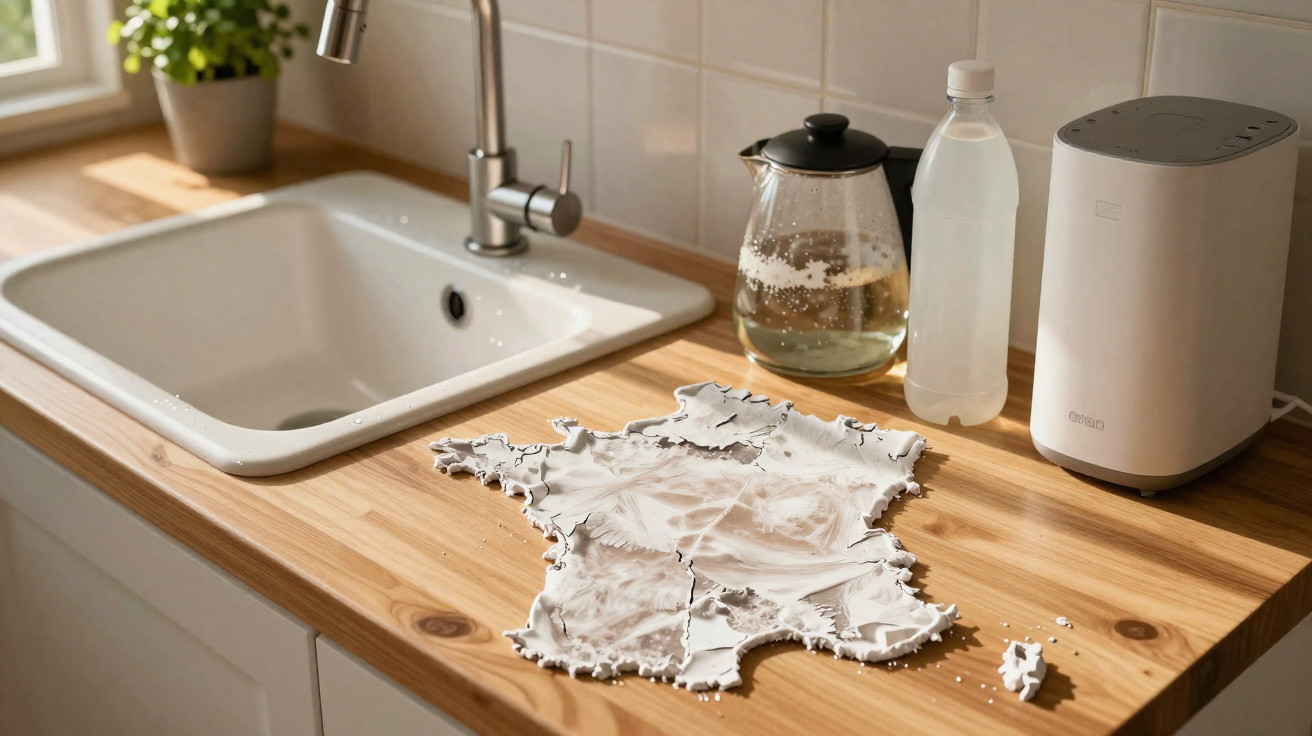
Each morning, the kettle boils, the coffee drips, and then a small white residue appears at the bottom of the cup. In the bathroom, the shower head gradually loses pressure, while glasses emerge from the dishwasher with a dull film. We have all wondered whether an appliance is ageing too soon - or whether the water is partly to blame. Depending on the area, tap water may be soft, moderately hard, hard or heavily limescale-rich. Although this geological feature is invisible when the tap runs, it affects everyday life and household budgets. The French map has a few surprises in store.
France’s limescale map: the areas most affected
In areas with limestone-rich rock, water passes through the ground, absorbs calcium and magnesium, and then enters the pipework. This applies across much of the Paris Basin, the North and the East. Areas including Nord, Pas-de-Calais, Somme, Oise, Aisne, Ardennes, Marne, Aube, Yonne, Eure-et-Loir and Loiret are often among those where water is hard or very hard. Île-de-France is also widely affected, although levels vary considerably between towns and supply networks. An area-by-area map provides a general indication; your own tap water tells a more local story.
By contrast, granite regions often have softer water. Parts of Brittany, Limousin, the Massif Central, the Vosges and Corsica are less prone to limescale deposits, although no rule applies entirely from one town to the next. In Finistère, for instance, naturally soft water may leave almost no marks on shower surfaces, whereas a few hundred kilometres away in Seine-et-Marne, scale can quickly build up on appliance heating elements. This contrast is not caused by poor maintenance. It starts beneath the ground.
Water hardness is measured in French degrees, written as °f: below 15 °f, water is generally classed as soft; between 15 and 30 °f, it is moderately hard; above 30 °f, limescale is highly present. Figures published by the Regional Health Agencies and the official Eaufrance website make it possible to check results for each distribution network. Two villages in the same area can receive very different water. The source used, the blending carried out by the supplier and local treatment can sometimes alter the result dramatically.
What limescale really costs at home
The easiest place to start is with the most obvious warning signs: a whitened kettle element, a blocked tap aerator, marked seals or a washing machine that needs more detergent. Limescale does not make water unsafe to drink; it remains monitored and potable. It can even contribute calcium and magnesium to dietary intake. The issue lies elsewhere: a layer of scale around a heating element slows heat transfer. The appliance takes longer to heat, uses more energy and wears out sooner.
A scaled-up hot-water cylinder is often the costliest problem. Just a few millimetres of deposit can reduce its efficiency, causing energy bills to rise gradually without being immediately noticed. A household may also have to replace a coffee machine, kettle or iron earlier than expected, sometimes after only a few years of intensive use. Manufacturers regularly advise descaling, but let us be honest: no one really does it every day. The cost of limescale is rarely dramatic in one go. Like the deposit itself, it builds up.
Before spending money on equipment, check your actual water hardness with the local council, your supplier or the health information sheet for your town. Test strips available in shops can also offer an initial indication, provided they are read correctly.
“Hard water is not dangerous water: it mainly requires maintenance suited to appliances that heat water.”
A few habits can already limit the damage:
- descale kettles and coffee machines with a suitable product;
- set the dishwasher according to local water hardness;
- clean tap aerators and the shower head;
- have an older hot-water cylinder checked.
Water softeners, vinegar and maintenance: avoid paying more than necessary
A water softener can be tempting in very limescale-heavy areas, particularly when a hot-water cylinder or boiler is already showing signs of wear. It can limit scale formation, provided it is correctly adjusted and maintained. If poorly set, it may soften the water more than necessary, increase salt and water use, and even create recurring costs that wipe out some of the expected savings. For a household in an area with moderately hard water, regular maintenance and a few appliance adjustments may be more sensible. The right option depends on the property, not an advert.
White vinegar remains useful for a kettle or shower head, but it is not suitable for every surface. On certain delicate materials, seals, marble or acid-sensitive finishes, it can cause damage that is difficult to repair. Another common mistake is using multiple anti-limescale products in the washing machine without considering local water hardness and detergent dosage. More product does not necessarily mean cleaner laundry. Precision costs less than excess. The correct setting is better than a cupboard full of bottles.
The area map is chiefly there to encourage awareness. In Nord, the Paris Basin, some parts of Grand Est and Centre-Val de Loire, greater attention should be paid to water-heating appliances. In Brittany and several parts of the Massif Central, the challenge may differ: depending on the installation, soft water can sometimes encourage more pipe corrosion. Hardness does not tell the whole story about water quality. Taste, pH, nitrate, chlorine and the condition of the pipes also matter. Looking only at limescale would mean missing what is most important.
| Key point | Detail | Benefit for the reader |
|---|---|---|
| Areas often affected by limescale | Nord, the Paris Basin, Centre and part of Grand Est are frequently affected | Quickly identify areas where appliances need more attention |
| Water hardness | It is expressed in French degrees and can vary from one town to another | Avoid relying solely on an area-wide trend |
| Most effective response | Local test, appropriate settings and targeted descaling before buying a water softener | Cut unnecessary spending and extend equipment lifespan |

Comments
No comments yet. Be the first to comment!
Leave a Comment