
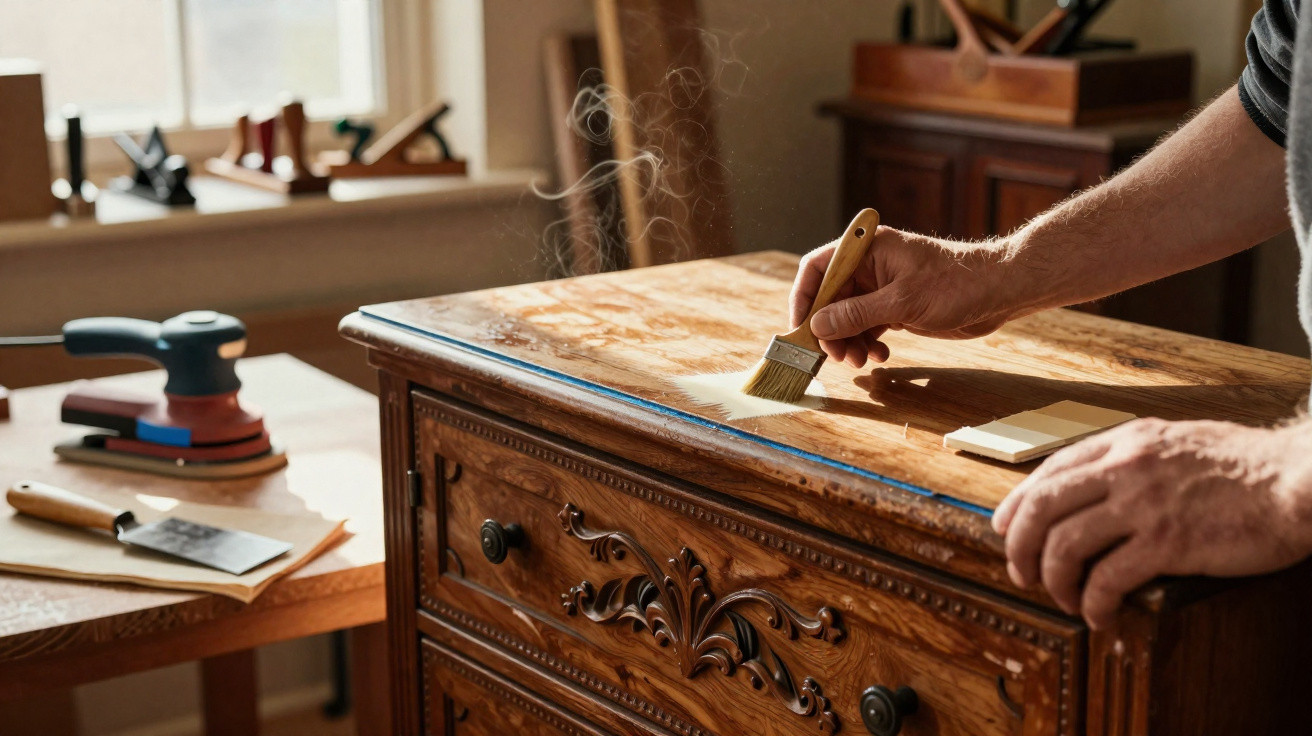
The old sideboard has been waiting in a corner of the garage, beneath yellowed varnish and a few wax marks that nobody has dared tackle for years. We all know the feeling: you can already picture the pale wood restored, the handles gleaming and its ideal spot in the living room… then comes the less glamorous, practical question: should you reach for a sander or use paint stripper? That decision can mean hours of work, some dust, occasionally lingering smells and, above all, the risk of spoiling a piece of furniture that has survived several generations. A cabinetmaker is unequivocal: the right tool depends less on your determination than on the wood’s actual condition. That changes everything.
Sander or paint stripper: the furniture often provides the first answer
Before plugging anything in, inspect the furniture at eye level, then run your hand across its surfaces. A flat solid-oak table coated in a thin varnish will generally cope very well with gradual sanding; a carved chest of drawers, with mouldings and dark recesses, is an entirely different proposition. A sander is at its best on broad, even areas, where its pad can work without biting into raised details.
In a workshop, a cabinetmaker can often spot the issue within seconds: delicate veneer lifting at an edge, a thick varnish applied in the 1980s, or paint built up in three layers. On old veneer, which may be less than a millimetre thick, an overly aggressive random orbital sander can go through the decorative layer before you have time to react. The damage happens quickly. Repairing it never does.
This is where paint stripper becomes a gentler option for detailed areas, though not necessarily an easier one. It softens layers of paint, stain or varnish so they can be removed with a scraper, without abrading the wood. Its real strength is reaching places a machine simply cannot access. Let us be honest: nobody actually does this every day, and patience matters more than force.
The cabinetmaker’s method for protecting old furniture
For a flat solid-wood surface, begin with an inconspicuous test beneath a top or behind a leg. The cabinetmaker will often recommend 120-grit paper, using a random orbital sander kept flat and without pressing down as though you were trying to erase the furniture from the map. Make steady passes along the grain, then finish with 180- or 220-grit paper to prepare the surface for a clean finish.
When dealing with old paint or exceptionally thick varnish, paint stripper can save time, provided you do not regard it as a miracle product. Apply a generous coat, leave it for the stated time, then lift away the softened material with a suitable scraper, ideally a plastic one on vulnerable sections. A common mistake is scraping too hard: wood marks easily, particularly pine, fir or veneered parts.
A cabinetmaker sums up the approach with one straightforward rule: first remove what conceals the wood, then refine what remains. In practice, this often means combining both methods, without feeling guilty or trying to find the perfect solution from the outset.
“The sander is designed to level surfaces, while paint stripper frees the details. Reverse their roles and the furniture will make you pay for it.”
- Choose a sander for tops, smooth doors and solid wood with only light finishing layers.
- Opt for paint stripper on mouldings, carvings, deep corners and fragile veneer.
- Protect yourself with gloves, goggles, proper ventilation and a mask suited to dust or vapours.
- Avoid using a heat gun on old paint, which may contain harmful substances.
The best choice is not always the one you first imagined
There is something deeply satisfying about seeing wood grain emerge from beneath an old brown coating, even if the finish is not completely even. Antique furniture retains its small signs of life: a key mark, a faint water ring or a darker patch near a handle. Trying to remove every trace can strip away what makes it appealing, especially with a family sideboard or a chair picked up at a market.
The choice between a sander and paint stripper also depends on your workspace. In a flat, sanding dust finds its way everywhere, including rooms you thought you had protected; in a poorly ventilated garage, paint-stripper fumes soon become unpleasant. Opening windows wide, working in short sessions and cleaning between stages may sound obvious, but these are the habits that stop a renovation project becoming an unhappy memory.
Many successful restorations ultimately rely on a hybrid approach: paint stripper on ornate sections, light sanding on flat surfaces, followed by a finish tested on an unseen area. Oil often brings out the wood with warmth, while varnish offers better protection for a heavily used top. Before aiming for a magazine-ready look, ask yourself how this furniture will genuinely be used in everyday life: the answer is what gives the work its purpose.
| Key point | Detail | Added value for the reader |
|---|---|---|
| Sander | Best used on solid wood and large flat surfaces | Fast, even work with less manual effort |
| Paint stripper | Suitable for mouldings, thick paint and delicate veneer | Preserves raised details and reduces the risk of excessive sanding |
| Mixed method | Strip detailed areas and sand smooth sections lightly | A more precise restoration that remains true to the furniture’s character |


Comments
No comments yet. Be the first to comment!
Leave a Comment