
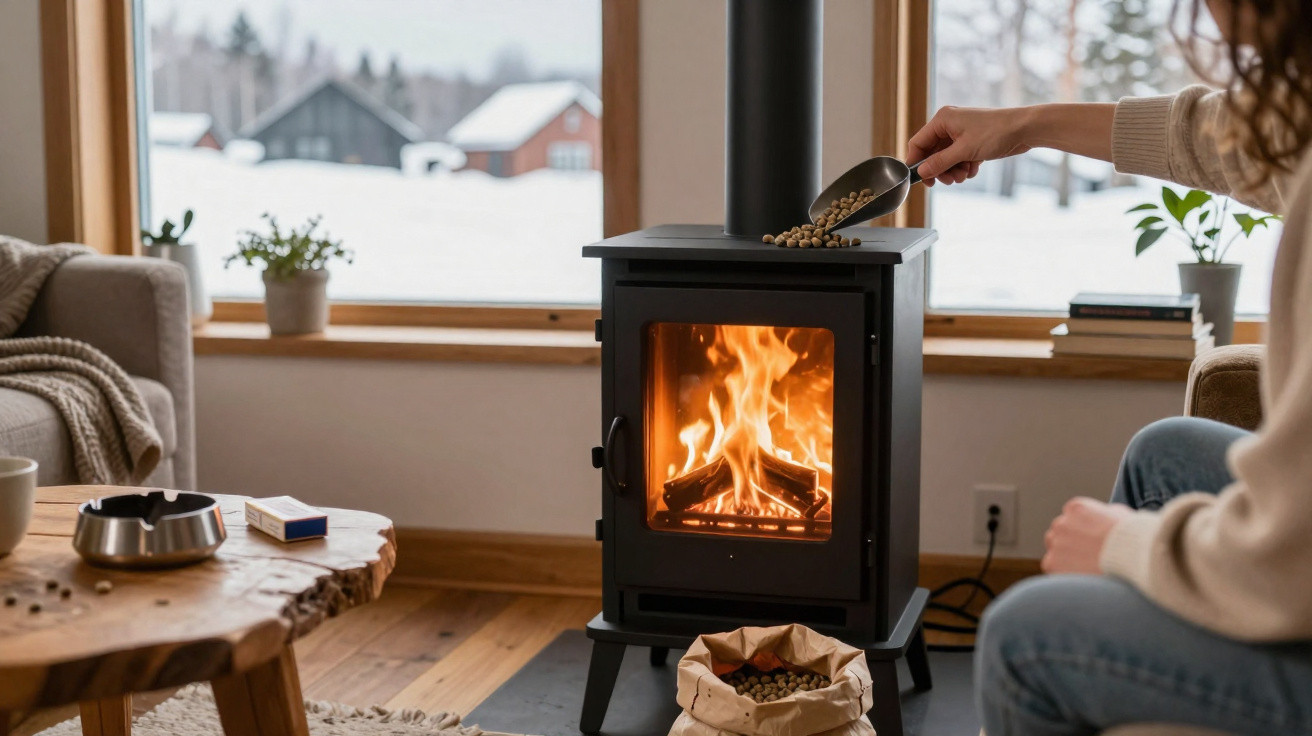
A particular type of pellet stove can give households a surprising degree of independence – with no cables at all.
Growing numbers of homeowners are looking for heating that keeps working when the power goes out or energy costs soar. Electricity-free pellet stoves are seen as an “analogue answer” to a digital energy system that can be vulnerable to faults. Operating entirely mechanically and without electronics, these appliances can provide comfortable warmth even during a blackout.
How an electricity-free pellet stove works
At first glance, an electricity-free pellet stove looks much like an ordinary pellet stove. The key difference lies inside: there is no circuit board, control unit or display. Instead, gravity and the flow of air control how it operates.
Gravity-fed pellet supply
The pellet hopper is positioned above the combustion chamber. Wood pellets fall into the burner pot solely under their own weight. There is no need for a motorised auger, while sensors and control wiring are also unnecessary.
“Less technology means fewer possible sources of faults – and, when in doubt, rooms stay warm for longer.”
This significantly lowers the risk of malfunctions, and there are no electronic components that can fail because of power surges or lightning strikes.
Lighting by hand rather than at the press of a button
Lighting is done in the traditional way: place a firelighter on the pellets, light it with a match and open the air supply slightly – that is all it takes. Anyone familiar with a wood burner or fireplace will quickly understand the process. Once the fire has taken hold, the pellets burn calmly and relatively evenly.
Sliders or rotary controls at the air vents allow the flame intensity to be adjusted. More air delivers greater output; less air extends the burn time and reduces the temperature.
Gentle heat without fan noise
Heat is circulated purely through physics: warmed air rises while cooler air flows in to replace it. At the same time, the heated steel or cast-iron body radiates warmth into the room. The result is a quiet, natural circulation of heat.
Many people find this approach considerably more pleasant in living rooms and bedrooms than the constant rush of a fan, which is almost always running in conventional electric pellet stoves.
Why more households are choosing electricity-free models
Independence during power cuts and grid problems
Power cuts have a severe effect on modern heating systems: heat pumps stop, circulation pumps in traditional heating systems cease running, and many “smart” pellet stoves stop functioning entirely without electricity. A stove that does not require a plug socket provides an important safety net in this situation.
- Heating remains possible even during an extended blackout
- No risk of an electronic circuit board failing
- No reliance on complex control technology
Interest is rising especially in rural areas with a less robust electricity grid, or in places where grid operators are already announcing demand management and possible disconnections.
Durable technology with a long service life
Where there is no circuit board, there is no circuit board to burn out. At their core, electricity-free pellet stoves are made up of sheet metal, cast iron, seals and a small number of mechanical parts. These components can generally still be repaired or replaced many years later.
Doing without fans, motors and displays also means fewer wearing parts, fewer service visits and, in many cases, a longer usable life than highly digitised heating appliances.
A noticeable reduction in energy costs
All the stove’s electrical components – the auger motor, ignition, fan and electronics – are eliminated completely. This reduces the heating system’s electricity use to zero. At a time of high electricity prices, that factor is becoming crucial for many households.
Pellets themselves remain among the comparatively affordable fuels, particularly as they are produced from waste wood and sawdust. Many owners buy in stock when seasonal pellet prices are low.
Quiet operation and a homely atmosphere
Anyone who has tried to watch television in the evening while a fan is running knows how intrusive the hum of a conventional pellet stove can be. Electricity-free versions provide heat much more quietly, sometimes almost silently.
Their flame is more reminiscent of a traditional fireplace, which many users consider cosier and more “authentic”. This particularly appeals to people who want atmosphere as well as warmth.
What prospective buyers should know before purchasing
More hands-on cleaning and operation
The trade-off for the simple technology is that owners need to do slightly more themselves. The burner pot should be cleared of ash regularly so that the air supply remains correct and the flame burns cleanly. The flue pipe also requires routine inspection and cleaning.
Depending on pellet quality, the viewing window can soot up more quickly because there is no directed airflow to keep the glass clear. Those who enjoy an unobstructed view of the flame should build a regular cleaning routine into their schedule.
Efficiency slightly below leading electric models
Modern electronically controlled pellet stoves achieve very high efficiency levels. Electricity-free versions are usually a little lower, typically in the region of 80 to 85 percent. For many households, this difference has little day-to-day impact, although it can affect eligibility under certain support schemes.
In return, the simpler models stand out for their dependability. For people primarily seeking a reliable heating “lifeline”, this often matters more than the final percentage point of efficiency.
No app, remote control or timed programmes
What may sound like a backwards step to technology enthusiasts is liberating for others: electricity-free pellet stoves do without an app, room thermostat and internet connection. They cannot be started while away on holiday or programmed down to the minute.
Choosing this route means deliberately opting for a manual system. Many users value precisely that direct experience: turning a control, opening a flap, watching the flame and feeling the heat straight away.
Who electricity-free pellet stoves are particularly suited to
These appliances are suited to households that value self-sufficiency and do not want to depend entirely on the gas grid, district heating or high-tech electric appliances. They are particularly practical in:
- detached houses with a chimney
- mountain cabins, weekend homes and holiday properties away from dense infrastructure
- areas with more frequent power cuts or a weak electricity grid
- households that already heat with wood and are looking for a cleaner alternative
As supplementary heating alongside an existing central heating system, an electricity-free pellet stove can substantially reduce reliance on the main system. On very cold days, it can ease the load on a heat pump or cut gas consumption. During milder periods, the stove alone is often enough to bring living spaces up to temperature.
Pellets, storage and safety
Anyone heating with pellets should pay attention to their quality. Certified pellets with a low dust content burn more cleanly and leave behind less ash. Keeping bags dry, or using a protected storage room, prevents moisture damage and mould growth.
As with any stove, basic safety rules apply: a proper connection to the chimney, sufficient clearance from furniture, tested smoke alarms and, ideally, a carbon monoxide alarm. Regular inspection by a chimney sweep remains essential.
A building block for greater independence in home heating
Alongside solar panels, good insulation and energy-efficient household appliances, an electricity-free pellet stove can form part of a personal strategy for resilience during energy crises. If the heat pump fails or gas suddenly becomes scarce, a dependable heat source remains available in the living room.
For many people, there is also the feeling of regaining some control: not every problem can be solved through an app. Sometimes a simply built appliance that works independently of tariffs, updates and wireless standards is what keeps doing its job – and keeps the house warm when it matters most.



Comments
No comments yet. Be the first to comment!
Leave a Comment