
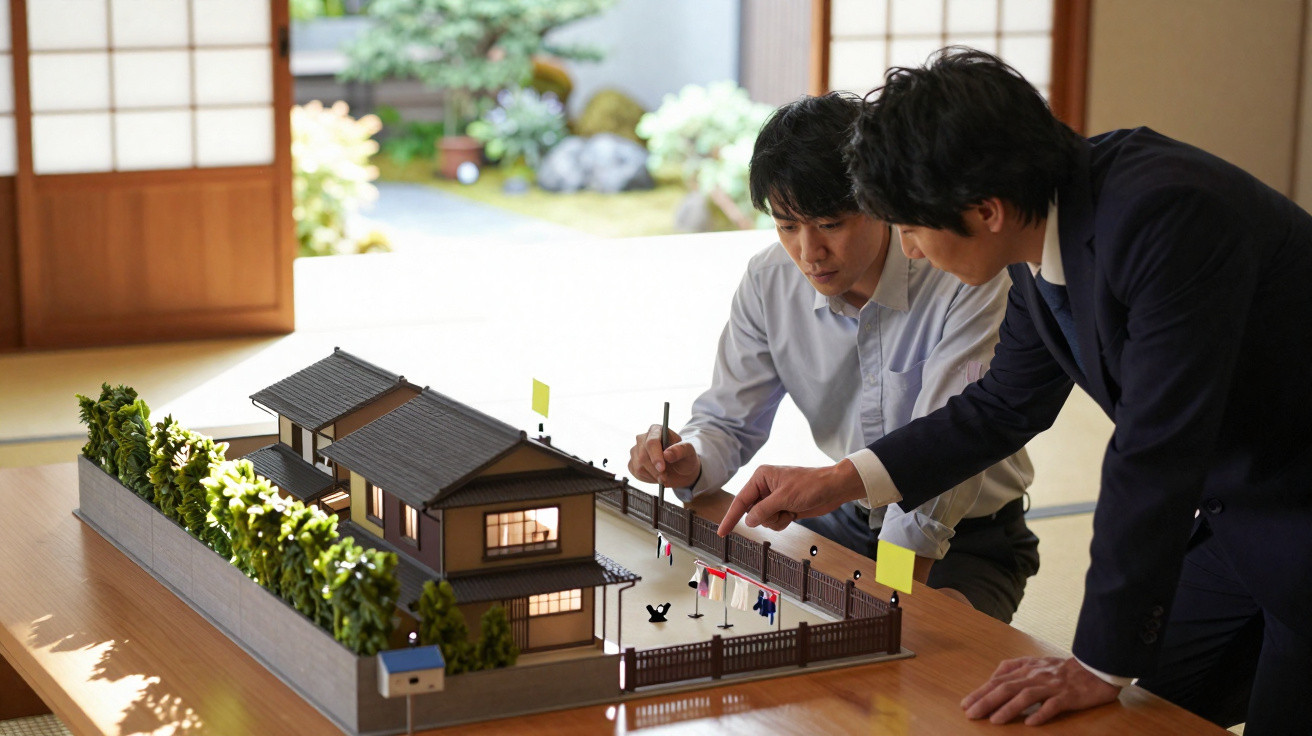
At a trade fair in Kyoto, Japan, the centre of attention was not a high-tech robot but a piece of plastic: an unassuming model home complete with a garden, fence and road. Two almost identical houses stand side by side, yet in reality a huge divide separates them: one invites burglars in, while the other puts them off. The security company behind it has used the model for years to show people how strongly small choices in construction and everyday living can affect the risk of burglary.
How a small model reveals what really attracts burglars
The model was created by a Japanese company specialising in security solutions. It was originally built at the police's request to give residents practical burglary-prevention advice. It features two houses immediately next to each other, each with a garden, driveway, balcony, letterbox and fence.
At first glance, the scene appears harmless. Security specialists explain, however, that burglars view these homes very differently. The model on the left represents an “attractive” target, while the one on the right shows an “unattractive” house that criminals are more likely to pass by.
The central message: it is not primarily the value of the furnishings that matters, but how easily someone can approach unnoticed, get inside and leave again.
The model makes precisely these factors visible, with a clarity that many people only recognise once they see them for themselves.
Common mistakes that make a house especially appealing
Security planners have reported the same pattern for years: burglars mainly look for places where they have time and privacy. The Japanese model illustrates this through specific details.
High walls and dense hedges: supposed protection, genuine risk
For many homeowners, a tall privacy fence means greater seclusion. For a burglar, it means an ideal place to work. Anyone concealed behind a wall or hedge cannot be seen from the street and is often hidden from neighbouring properties as well.
The model's “burglar-friendly” side includes, among other things:
- High, solid walls enclosing the property
- Dense, overgrown hedges with no clear views through them
- Numerous angles, corners and hidden areas with no view from the street
- Concealed access points at the rear of the garden with poor lighting
These are exactly the spots offenders favour, as they can force open windows or doors without being noticed.
Letters, laundry and lighting: subtle signs of absence
A second issue concerns the signals residents send themselves, often without realising it. They are deliberately exaggerated in the Japanese model, but can be just as clear in real life.
According to specialists, common signs that nobody is home include:
- An overflowing letterbox or advertising leaflets piling up by the door
- Laundry left hanging outside unchanged for days
- Curtains remaining in the same position for weeks
- No change in lighting during the evening: always dark or always the same lamp on
Burglars generally watch a property for several days before striking. They walk past, check letterboxes and pay attention to sounds and lights. A house clearly signalling that “nobody is home” is more quickly added to their mental list.
What makes houses unattractive to burglars
The other side of the model shows the opposite: a home that is not necessarily a fortress but presents a clear risk to criminals. The aim is not to live in fear, but to raise the effort involved and the likelihood of discovery so much that offenders move on.
Clear views rather than a fortress mentality
Instead of a solid wall, the “unattractive” house is bordered only by a waist-high fence. The property remains visible from the street and neighbouring homes. This is exactly what deters many offenders.
Anyone who could be seen as soon as they enter a property will often abandon the attempt before it has even begun.
In practice, this means:
- Choosing fences that can be seen through
- Cutting hedges back regularly, leaving gaps rather than creating a green wall
- Deliberately keeping sightlines to neighbouring houses clear
- Planning lighting so that dark corners are eliminated
A tidy front garden that can be seen into appears riskier to criminals than a fenced-off, supposedly “private” space behind thick bushes.
Technology that quietly keeps watch
The model also incorporates technical aids designed to make break-ins more difficult. The Japanese company combines traditional security thinking - namely visibility and neighbour awareness - with modern solutions.
These include, for example:
- Motion sensors that illuminate entrances and paths
- Infrared sensors that trigger an alarm when someone crosses the property
- Night-vision cameras for entrances and patio doors
- Connected alarm systems with app integration that send alerts directly to a smartphone
At the fair where the model was displayed again, the company also presented newer technology such as facial recognition and particularly light-sensitive cameras. Its core message remained the same: combining lighting, visibility and straightforward technical obstacles takes away many offenders' confidence.
How burglars think - and how to use that knowledge
Security planners repeatedly stress that the thinking of burglars has changed little over the decades. They are highly sensitive to noise, sudden lighting and contact with people. They usually operate in the evening and at night, or during holiday periods when many homes are empty.
An expert from the company that built the model identifies three constants:
- Burglars avoid places where they might attract attention.
- They give up quickly if gaining entry proves more complicated than expected.
- They actively look for weak points before taking action.
Anyone who understands these basic rules can adapt their home accordingly. Every additional obstacle - from stronger window fittings to an illuminated driveway - increases the risk for offenders. Beyond a certain point, the effort simply ceases to be worthwhile for them.
Practical advice for the house, garden and everyday life
The Japanese model offers useful ideas that can easily be applied in the UK. Several of the points it highlights can be addressed with little expense.
Checklist: is your home more likely to be avoided or targeted?
| Aspect | Higher risk | More secure |
|---|---|---|
| Fence / hedge | High wall, dense screening, blind spots | See-through fence, cut-back hedges |
| Lighting | Dark driveway, unlit patio door | Motion sensors on paths and at entrances |
| Letterbox | Overfull after a holiday or business trip | Neighbours collect post, advertising deliveries paused |
| Signs of occupancy | Always dark, laundry unchanged for long periods | Timers, changing lights, an occupied appearance |
| Rear access | Unsecured garden gate, unlit rear entrance | Lockable gates, sensors, camera or lighting |
If several warning signs become apparent when working through these points, this provides a realistic picture of the risk. Even individual changes can significantly alter the overall impression.
Why the old rules still apply despite new technology
Whether facial recognition, an app-controlled alarm system or a smart camera, the trade fair in Kyoto displayed the full range of modern security technology. Yet the Japanese company made clear that the core principles represented by the twenty-year-old model are not outdated.
Burglars will not bypass a heavy steel door simply because there is a camera somewhere that nobody uses. Equally, even the best sensors offer limited protection if hedges block every view and neighbours cannot recognise suspicious behaviour. Technology works most effectively when it is built on a sensible basic approach: visibility, an active surroundings and clear signs that people are present.
For many homeowners, a two-stage approach is therefore worthwhile: first establish a basic level of security with straightforward structural and organisational measures, then add technology selectively where it is genuinely useful - for example, at typical weak points such as basement windows, patio doors or the driveway.
Anyone planning or renovating a home can apply the thinking behind this model directly: less fortress, more controlled openness. A garden in which people feel comfortable can at the same time be a place where a burglar feels deeply uncomfortable - because they know that every step could be seen and heard.

Comments
No comments yet. Be the first to comment!
Leave a Comment