
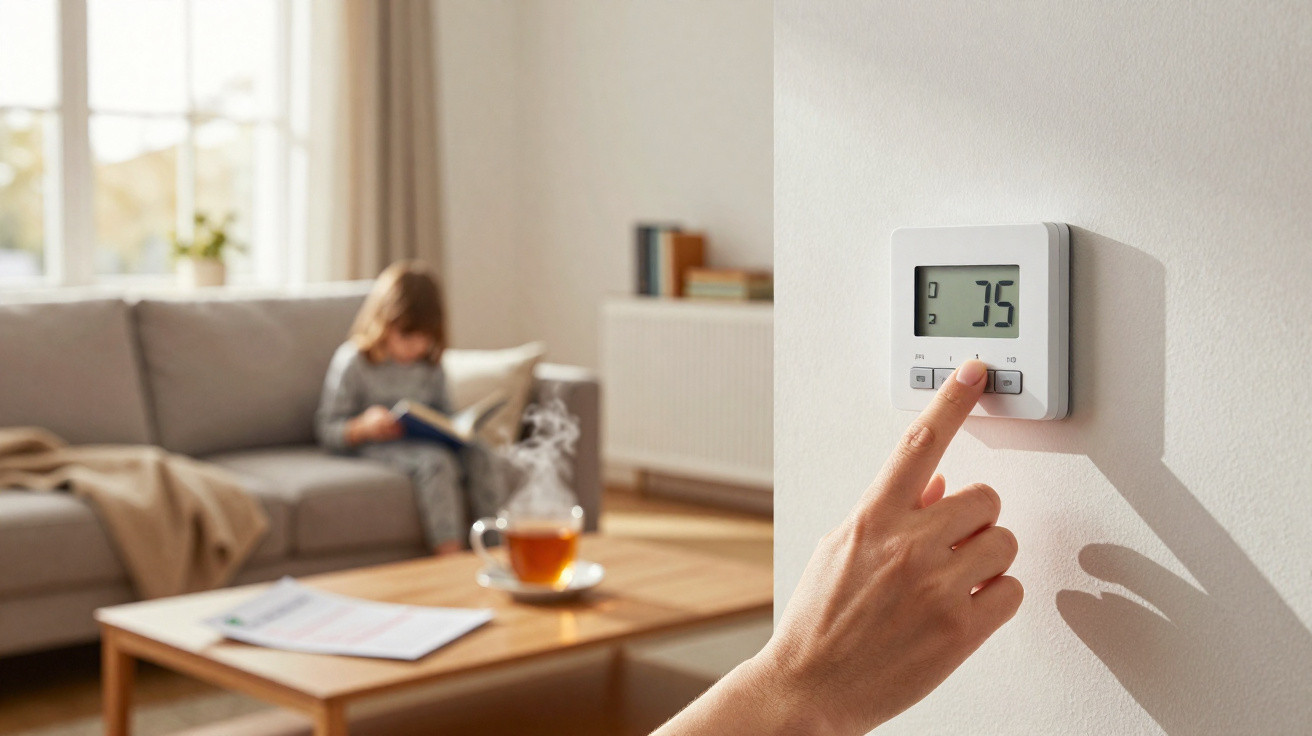
Yet this very instinct can push the bill upwards.
When popping out to the shops or collecting the children, it is easy to turn the thermostat right down at home. It seems sensible: less heating means lower costs. In reality, however, the picture can be different. Buildings respond slowly, retaining cold and moisture – and when they are heated up again, they can often reclaim the energy supposedly saved twofold. Here is how to handle it better, step by step.
Why an ice-cold home can use more energy in the end
Heating systems are not designed to force living spaces repeatedly from “very cold” to “comfortably warm”. Their main strength is maintaining a reasonably steady temperature. That is precisely why the popular habit of turning the heating down sharply, or off altogether, before leaving can backfire.
When rooms become very cold, the following happens:
- Walls, floors and furniture absorb cold and moisture.
- Surfaces can feel chilly and damp for a long time.
- Once restarted, the heating has to run for considerably longer and at a higher output.
“A home that has cooled down substantially needs considerably more energy to return to a comfortable temperature than a room that has only been lowered slightly.”
This effect is especially noticeable on freezing winter days, when outdoor temperatures fall below 0 °C. You turn on the heating, then wait – and wait. Although the air and radiators warm up more quickly, cold walls act like a huge cooling battery, drawing away the heat.
As a result, the heating operates at a higher output for anything from minutes to hours. That uses energy and can ultimately cost more than reducing the temperature only moderately while nobody is home.
Steady warmth beats extreme temperature swings
Flats and houses have what is known as thermal inertia. Put simply, they react slowly. Driving the temperature sharply up and down forces the heating system to work at full capacity time after time.
“The best balance between comfort and cost comes from a gentle temperature reduction – not from switching the heating off completely.”
There are several reasons for this:
- The building fabric remains slightly warm.
- Moisture is less likely to condense on cold surfaces.
- The heating system operates within a more efficient performance range.
For short absences of a few hours, specialists generally recommend reducing the temperature by only around 2 to 3 degrees. For instance, if the living room is 20 °C during the day, it can be lowered to 17–18 °C while you are at work, rather than to 14 or 15 °C.
Never turn the heating off completely – with one exception
For everyday situations such as a working day, shopping trips or evening plans, the advice is clear: lower the temperature slightly, but do not switch the heating off altogether. A basic level of warmth keeps walls and furniture at a suitable temperature and stops the home from turning into a fridge.
The position changes for longer absences, such as a week-long winter holiday. A larger reduction can then be worthwhile, but limits still apply:
- Keep the home at no less than 14–16 °C, depending on the condition of the building.
- In very poorly insulated houses, do not reduce the temperature too far, to help prevent damp damage and mould.
- In areas subject to severe frost, always follow the manufacturer’s instructions and any guidance from the property manager to prevent pipes from freezing.
The heating should be switched off completely only if frost-protection operation is guaranteed or if specialist systems explicitly allow it. Otherwise, any savings can quickly be swallowed up by damage.
The thermostat: a discreet money-saving helper
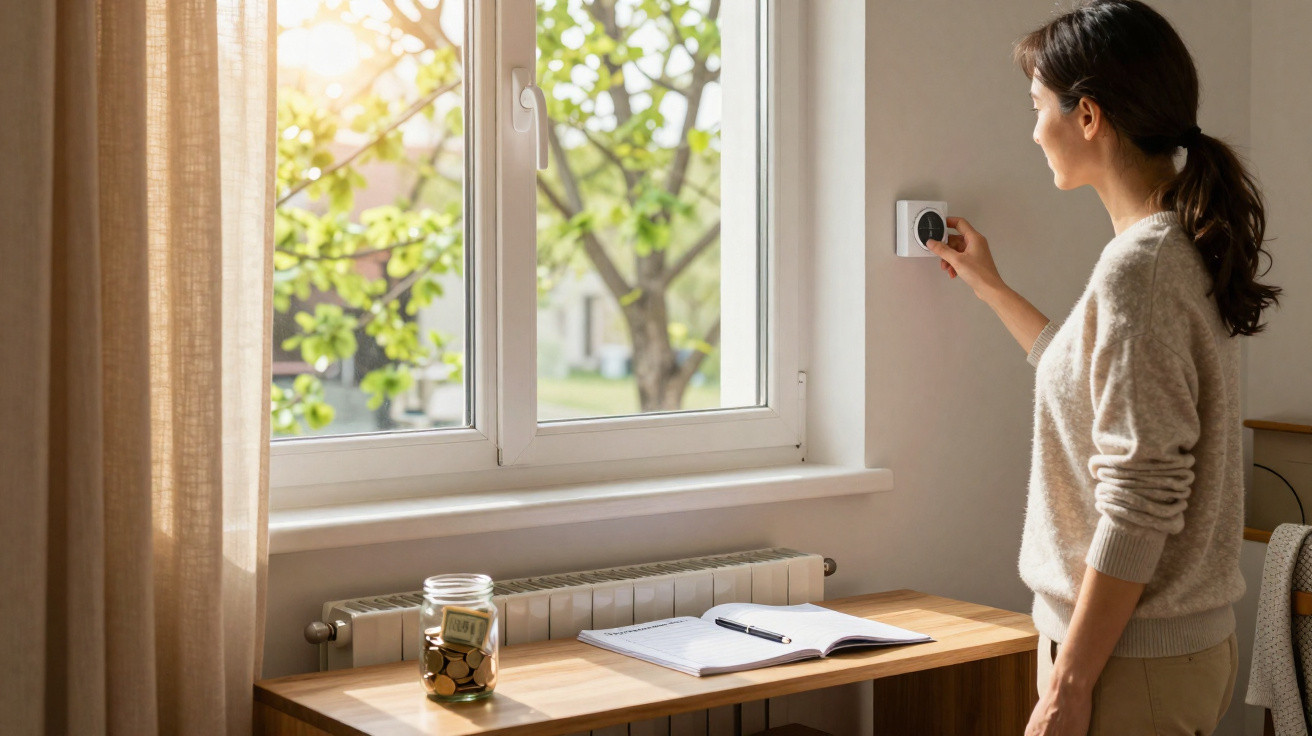
Anyone who does not want to keep adjusting the controls manually can use a programmable thermostat. These devices are among the simplest and most effective ways to cut heating costs without feeling cold.
“A thermostat that lowers the temperature automatically and turns it back up in good time saves energy while adding convenience.”
Sensible basic settings for a typical household
- During daytime absences: reduce to around 16–17 °C.
- Before returning home: automatically raise it to around 19–20 °C, for example 30–60 minutes before arrival.
- At night: make a small reduction to 16–17 °C in living rooms; bedrooms are often kept a little cooler still.
Modern thermostats can often be controlled through an app and can also adapt to unexpected changes of plan. If you are getting home later, for example, simply move the heating-up period back. This keeps the flat comfortable without heating it fully throughout the entire day.
What studies and specialists actually recommend
Reviews of consumption data and measurement series reveal a clear pattern: large swings between very cold and warm use more energy in the long term than continuous operation at a slightly lower setting. The more a building cools down, the more output the heating system needs to overcome the cold stored in walls, ceilings and floors.
There is another consideration as well: if the room temperature drops too far, the risk of condensation forming on cold surfaces increases. Moisture can collect particularly in corners or behind furniture, encouraging mould over time. This raises not only heating costs but also health risks.
“For short and medium-length absences, specialists clearly advise leaving the heating running in a reduced mode rather than turning it off completely.”
The ideal approach is therefore not radical action, but carefully balanced adjustments that fit everyday life. Anyone who understands their routines can set up the heating system accordingly instead of having to improvise every day.
How much does each degree really save?
One useful rule of thumb is that each 1 °C reduction in room temperature can save roughly 6 per cent of heating energy over a year, depending on the building and system. That may not sound like much, but it adds up significantly – especially when it applies to the entire flat rather than just one room.
That does not mean 10 °C is better than 18 °C. Below a certain level, energy losses, reheating times and reduced comfort become so substantial that the saving disappears. The aim is a sensible reduction, not survival training in your own living room.
Practical examples: what a sensible heating schedule can look like
| Situation | Recommended temperature | Note |
|---|---|---|
| At home on weekdays, during the day | 19–21 °C in living areas | In a well-insulated home, 19–20 °C is often enough. |
| At work on weekdays | 16–17 °C | Set the thermostat to start heating before you return. |
| Overnight in living rooms | 16–18 °C | A small reduction cuts costs and can often improve sleep. |
| Weekend, with plenty of time at home | A steady 19–21 °C | Avoid major fluctuations; make only minor adjustments. |
| Away for 5–7 days in winter | 14–16 °C | Keep frost protection and mould risk in mind. |
Common misconceptions – and what is really behind them
“If I turn it off, I always save money”
It sounds logical, but it applies only to very long absences, and even then only to a certain extent. If the system has to heat everything up again after days or weeks, energy demand can rise sharply.
“The higher I turn it up, the faster it gets warm”
Many people turn the thermostat to its highest setting when they get home. This does not make the heating warm the room faster; it only keeps it hotter for longer. Reheating time depends mainly on the system’s output and the starting temperature, not on the maximum selected setting.
“Cold rooms are not a problem; I can simply close the door”
Rooms that have cooled down heavily next to warmer areas create temperature differences within the building. Warm, humid air moves into the colder zones, condenses there and increases the risk of mould – particularly in older properties.
When it is worth having the heating system checked
If bills remain high despite adjusted thermostat use, it is worth having the overall system inspected. An improperly set flow temperature, air in the radiators or an ageing boiler can all significantly reduce efficiency. Hydraulic balancing and modern thermostatic radiator valves can deliver noticeable savings in many homes without anyone having to feel cold.
Insulation matters too: in well-insulated buildings, the strategy of maintaining a slightly lower temperature works particularly well because walls and windows lose less heat. Thoughtful controls still offer benefits in poorly insulated older homes, but it is also worth considering straightforward measures such as window seals or insulation behind radiators.
A conclusion without clichés: a small adjustment, a big impact
Those who stop instinctively turning the heating sharply down, and instead reduce it moderately and programme it intelligently, can make noticeable savings during the heating season. The key is not switching the system off completely, but keeping temperatures steady and slightly lower in a way that suits everyday life. The home stays warm, bills remain manageable – and the next winter becomes far less daunting.




Comments
No comments yet. Be the first to comment!
Leave a Comment