
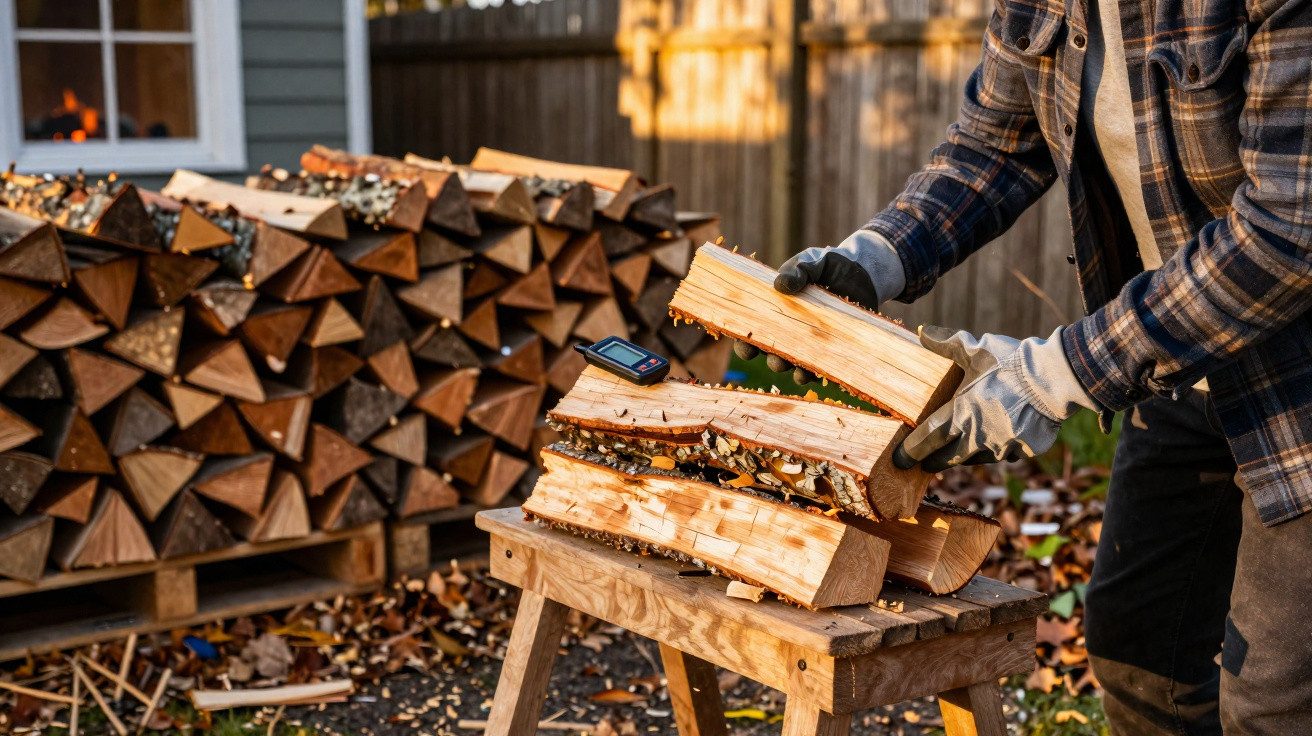
When you heat with wood, you will usually focus on having enough logs and the right stove. Yet the most important factor lies elsewhere: the condition of the wood itself. Properly prepared firewood can seem to provide twice as much heat, burn more cleanly and protect your chimney at the same time. One straightforward method, together with a few professional tips, can make a noticeable difference within just a few days.
Why dry logs suddenly provide far more heat
Water in the timber is the biggest destroyer of heat when burning wood. Every percentage point of moisture uses energy that should be warming your living room but instead disappears up the chimney.
Only genuinely dry wood converts its stored energy into noticeable room heat – rather than steam and smoke.
Wet or partially seasoned logs must first evaporate their water content. This demands a great deal of energy, which is simply wasted during heating. It creates several problems:
- The flames appear weak and the fire produces heavy smoke.
- The stove gives off considerably less heat, even though you are adding more wood.
- Creosote, a highly flammable deposit, builds up inside the chimney.
- The stove glass becomes blackened and indoor air quality worsens.
Well-seasoned wood with a residual moisture content of below roughly 20 per cent burns hot and steadily, producing clear flames. Your stove operates more efficiently and wood consumption falls noticeably.
The simple technique that boosts the heat output of your logs
The key is to increase the surface area available for evaporation dramatically while ensuring maximum air circulation. In practical terms, that means splitting the wood consistently, stacking it with plenty of airflow and positioning it well – as early as possible, rather than at some later point.
Anyone who consistently splits their wood, stacks it with airflow and stores it in the sun will often notice a clear difference when heating after only a week.
Many stove owners simply stack newly delivered timber into a dense wall beside the house. It may look tidy, but it is disastrous for heating efficiency. Moisture becomes trapped, drying takes much longer and even supposedly seasoned wood can still be too damp at its core.
Split firewood early and into sufficiently small pieces
The rule after sawing or delivery is simple: split the wood as soon as you can. Every blow from an axe or log splitter opens up the timber structure, creating more routes for moisture to escape.
Useful guide values:
- Log length: around 30–35 cm for most wood-burning stoves.
- Diameter: favour slimmer pieces over thick blocks – two small logs are better than one huge piece.
- Irregularly shaped pieces are fine, provided they are not overly bulky.
This has an unexpectedly useful side effect: smaller, thoroughly dried logs are easier to light and ignite more cleanly. Lighting the fire becomes quicker, and the stove reaches operating temperature sooner.
How to tell whether your wood is truly dry
Many people rely on how the wood feels in their hands – and are surprisingly often mistaken. The following signs indicate dry firewood:
- Colour: generally light grey to slightly yellowed, rather than freshly glossy.
- Cracks: clear drying splits visible on the cut ends of logs.
- Weight: compared with fresh timber, dry wood feels surprisingly light.
- Sound test: striking two logs together produces a bright, dry sound rather than a dull one.
- Smell: little to no resin scent; it should smell fairly neutral.
For a precise reading, use a basic wood moisture meter. Domestic models are inexpensive and readily available. Push the probes into a freshly split surface of the log. Readings below 20 per cent moisture are ideal for your stove.
Perfect firewood storage: let nature improve your heating performance
Drying requires air and time. The right storage method gives you both, with sunshine acting as an extra accelerator.
The best storage spot in a garden or yard
A good log store meets three requirements:
- Avoid contact with the ground: Place logs on pallets, timber bearers or old beams. Otherwise, they will draw moisture up from below.
- Keep the sides open: Air needs to circulate through the sides and underneath the stack. Do not build enclosed compartments.
- Make use of sunshine: Choose a south- or south-west-facing position so the wood receives as many hours of sun as possible.
Many experts favour a simple log shelter: a roof protects against rain and snow, a rear wall blocks driving rain, and the front remains open. This keeps the timber dry without allowing it to become “stifled”.
Stack logs correctly: gaps are worth real heating money
The biggest stacking mistake is packing logs too tightly. If you arrange wood like a solid wall, you prevent air from reaching it.
The more freely air can pass through the log stack, the faster residual moisture drops – and the greater the heating performance becomes.
For the best stack:
- Lay logs lengthways in rows instead of wedging them across each other.
- Leave small gaps between individual logs rather than pressing them together.
- Set out several rows with a few centimetres of space between each one.
- Build the top with a slight slope so rainwater cannot collect there.
A simple tarpaulin or sheet-metal roof is often enough to keep rain off. Crucially, the cover must not seal the sides completely, or moisture will accumulate in the stack.
How long to store firewood – and which species are worthwhile
Even with every drying trick, wood needs time. These are broad guide times for conventional firewood to dry properly:
| Wood species | Type | Recommended storage period | Special feature |
|---|---|---|---|
| Spruce, fir | Softwood | approx. 1 year | dries quickly, burns away rapidly |
| Pine | Softwood | 1–1.5 years | resin-rich, good for lighting fires |
| Beech | Hardwood | at least 2 years | very high calorific value, long-lasting embers |
| Oak | Hardwood | 2–3 years | very dense and needs plenty of time |
A smart approach is to combine the two: use softwood for quick lighting, then hardwood for a long, even period of warmth. Both must be properly seasoned, otherwise you lose this advantage.
How to prevent fully dried wood from becoming damp again
One issue that is often overlooked is that wood can absorb moisture again after drying. The risk is particularly high in autumn, when fog, persistent rain and wet ground are common.
- Stack wood intended for winter closer to the house, where it stays dry and is easy to reach.
- Cover the top of the stack carefully, while leaving the sides as open as possible.
- Keep one or two days’ supply indoors so the logs become fully “room-dry”.
If you use a cellar, take care: only dry, well-ventilated cellar spaces are suitable. Otherwise, the wood will take on moisture again and lose heating performance.
Everyday stove use: how you will notice the improved heat output
Anyone who changes their storage method will generally notice the results sooner than expected. Users often report achieving the same room temperature while using less wood. Typical signs that your firewood is now “working properly” include:
- The stove reaches temperature more quickly after lighting.
- You need fewer logs each evening.
- The stove glass stays clear for longer.
- The chimney sweep finds fewer deposits.
Comfort improves as well: rather than sitting in front of a smouldering pile that produces more smoke than heat, you get a steady, calm flame pattern. The indoor environment feels more pleasant because less fine particulate matter and fewer condensates are produced.
Risks reduced by using properly dried firewood
Regularly burning damp wood does not only increase costs; it can also cause damage:
- Heavy creosote deposits increase the risk of a chimney fire.
- The stove wears out faster, with seals and firebricks particularly affected.
- Emissions values deteriorate, which can become a problem during inspections.
Properly dried wood reduces all of these risks considerably. Combined with a correctly adjusted stove and regular chimney sweeping, it creates a safe, efficient heating system that saves money over the longer term.
How to increase the effect even further
If you want to get the maximum from your logs, several further adjustments can help:
- Improve the lighting method: Lighting from the top with small, very dry logs reduces smoke and brings the chimney up to operating temperature faster.
- Set the air supply correctly: Too little air causes the fire to smoulder, while too much sends heat up the chimney. It is worth consulting your stove’s operating manual.
- Choose wood to suit your needs: Lighter softwood is sufficient for mild evenings; for long winter nights, choose high-density hardwood instead.
Anyone who combines these measures with consistently dried wood will often experience exactly what many stove owners describe: after making the change, the stove heats far more powerfully, wood consumption drops, and every log delivers noticeably more warmth.






Comments
No comments yet. Be the first to comment!
Leave a Comment