
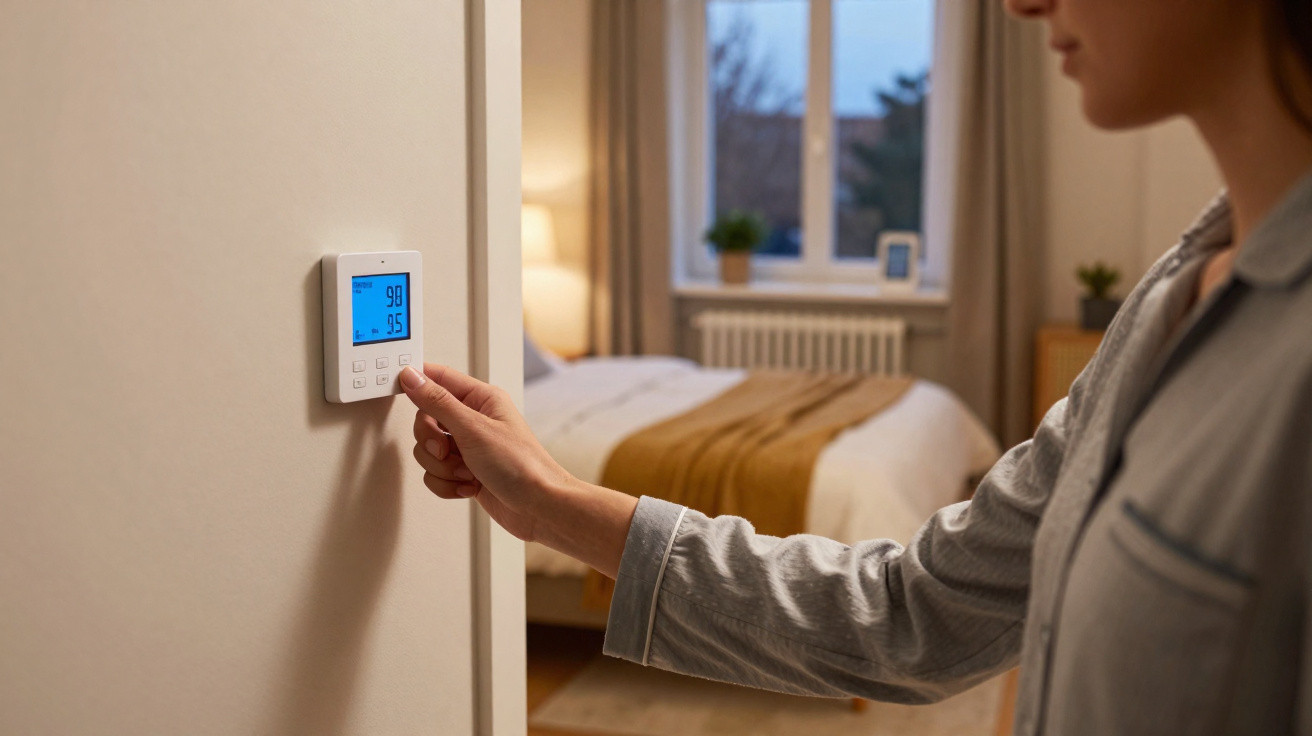
Many people turn the heating off completely at night, hoping to cut their bills.
But this often does not work out as expected.
As the first warmer days of spring arrive, millions of households ask the same question: should they switch the heating off entirely overnight to save money? It sounds sensible and has become common advice, yet in many cases it is still the wrong approach. Experts now make it clear that taking it too far can sometimes cost more in the long run, while also increasing the risk of mould and poor indoor air quality.
Why switching the heating off at night can backfire
At first glance, the reasoning seems straightforward: if the heating uses no energy for six to eight hours, the bill should fall. In reality, however, the outcome depends heavily on the flat, the building and the heating system.
Heating accounts for the largest share of energy costs. In a typical household, space heating alone represents around 60 to 75 percent of energy use. Reducing the room temperature by just one degree saves an average of about seven percent of heating energy. Even so, turning the heating off altogether does not necessarily deliver major savings.
The key issue is heat loss. In poorly insulated buildings, heat escapes very quickly through walls, windows, doors and the roof area. If the heating stays off for several hours, the home cools down considerably. The system must then work at full power in the morning to restore a comfortable temperature.
“Particularly in unmodernised or only moderately insulated buildings, reheating in the morning can use more energy than was saved during the overnight break.”
This effect is especially noticeable with heating boilers that respond slowly, such as older oil and gas systems. When they are restarted, these systems work particularly intensively and require more fuel initially than is needed simply to maintain a slightly lower temperature.
Typical everyday problem cases
In practice, the same situations repeatedly show that switching the heating off completely overnight can do more harm than good:
- Uninsulated older property: Walls feel cold in the morning, rooms fall well below 17 °C, and the heating then runs at full power for hours.
- Individual heaters or old gas boilers: Long warm-up periods, high consumption when starting up and uneven heat distribution.
- Damp rooms: Bathrooms or bedrooms cool down sharply, humidity rises and condensation forms on cold surfaces.
Anyone using the big “off switch” overnight in precisely these circumstances often creates higher peak demand in the morning, losing part of the expected saving.
What experts recommend: lower the temperature rather than turn the heating off
A much more practical option is not to shut the heating down completely at night, but to reduce the temperature deliberately. The usual recommendation is around 16 to 17 °C in bedrooms, compared with roughly 19 °C in living rooms during the day.
“Even a moderate overnight temperature reduction delivers noticeable savings without allowing the home to cool down and turning reheating into an energy drain.”
This approach offers several benefits at once:
- It prevents major temperature fluctuations in rooms.
- It reduces peak demand in the morning, when every radiator would otherwise turn up at the same time.
- It keeps walls and furniture slightly warm, reducing moisture exposure.
Thermostatic radiator valves or programmable controls can automatically manage the overnight temperature reduction. They can be set so that the temperature gradually drops in the evening and rises slightly again shortly before getting up.
Practical overnight temperature guidelines
Many households are unsure how far to lower the temperature. The following ranges provide useful guidance:
| Room | Day | Night |
|---|---|---|
| Living room | 19–20 °C | 17–18 °C |
| Bedroom | 17–18 °C | 16–17 °C |
| Kitchen / hallway | 18–19 °C | 16–17 °C |
| Bathroom | 21–23 °C | 17–19 °C (depending on comfort preference) |
These figures are not strict rules but values based on experience. Anyone who feels the cold quickly can of course set a slightly higher temperature, while those who tolerate cooler conditions can test lower settings, provided no moisture problems develop.
When it really makes sense to turn the heating off completely
There are certainly times when switching the heating off entirely is worthwhile. Spring is a classic example, once daytime outdoor temperatures remain comfortably mild and nights become warmer.
In many areas, it is useful to consider the typical “heating season”: it often ends around the middle of April, when daytime temperatures of around 19 °C become consistent. This point may be reached earlier in the south, where winters are milder, and later at higher altitudes or in the north, where nights are cooler.
“What matters less is a fixed date than how the rooms feel in your own home – and the trend shown in the weather forecast.”
If, for several consecutive days, nobody feels genuinely cold either in the morning or evening and there is barely any need for heating, the system can usually be turned off without much risk. A gradual method is sensible: first reduce temperatures significantly, then stop heating individual rooms, and only afterwards switch the heating off altogether.
When nobody is at home
A complete shutdown is also tempting during a longer absence. Here, experts advise caution. For short trips lasting a few days, a substantial reduction is normally enough, to around 15 to 16 °C throughout the home. This keeps the building frost-free and makes it harder for moisture to settle.
Only in very well-insulated homes with modern technology – such as a heat pump and underfloor heating – may a temporary shutdown be sensible when outside temperatures remain above freezing. Even then, it is worth checking the heating system documentation or consulting an installer, as every system responds differently.
Heating system and insulation: the two key factors
Whether turning the heating off overnight is worthwhile largely comes down to two factors: the heating system and the building fabric.
- Slow-reacting systems such as oil or gas boilers and underfloor heating respond gradually. In these cases, a substantial overnight reduction or switching off completely offers little benefit and can sometimes increase consumption.
- Fast-reacting systems such as modern heat pumps with effective controls or infrared heating are more flexible. In well-insulated homes, they can make better use of short-term temperature reductions.
- Good insulation stops rooms from cooling down dramatically. Anyone living in a renovated home or a new-build can experiment somewhat more confidently with lower temperatures.
- Poor insulation causes heat to escape quickly. In this situation, a gentle overnight temperature reduction over several hours is more useful than a drastic shutdown.
Anyone uncertain can carry out a simple test: reduce the temperature substantially for one night, then observe the time and duration for which the heating runs the following morning, while measuring the room temperature. If the system takes a very long time to return to its normal level, the reduction has been set too low.
Keep health, sleep and mould risk in mind
Room temperature matters not only for heating costs, but also for health and the condition of the building. Many people sleep better in slightly cooler rooms, especially when the air is not too dry.
However, allowing rooms to become too cold can create ideal conditions for mould at the critical point: cold walls, high humidity from breathing and showering, and little air movement. When moist air reaches very cold surfaces, water condenses – and that is exactly where mould spores can take hold.
“The best combination is: slightly cooler, but not freezing cold – air rooms regularly instead of letting them cool down completely.”
Bedrooms require particular attention: briefly air the room before bed, turn the heating down slightly and close doors to colder rooms. Air the room again in the morning so that moisture can escape. Those who measure humidity with a hygrometer will quickly notice whether readings remain above 60 percent – in which case there is a risk of mould.
Practical tips for heating smartly at night
Finally, here are several straightforward but effective everyday measures that many households can put into practice immediately:
- Use programmable thermostats and set fixed overnight periods.
- Do not cover radiators with curtains, furniture or laundry.
- Close shutters and heavy curtains in the evening to reduce heat loss through windows.
- Do not turn heating off entirely in seldom-used rooms; instead, set a low continuous temperature.
- Have the heating system serviced once a year so that it operates efficiently.
This gradually creates a realistic heating plan: comfortable temperatures during the day and controlled cooler conditions at night – without an expensive false start in the morning or feeling frozen when getting up.



Comments
No comments yet. Be the first to comment!
Leave a Comment