
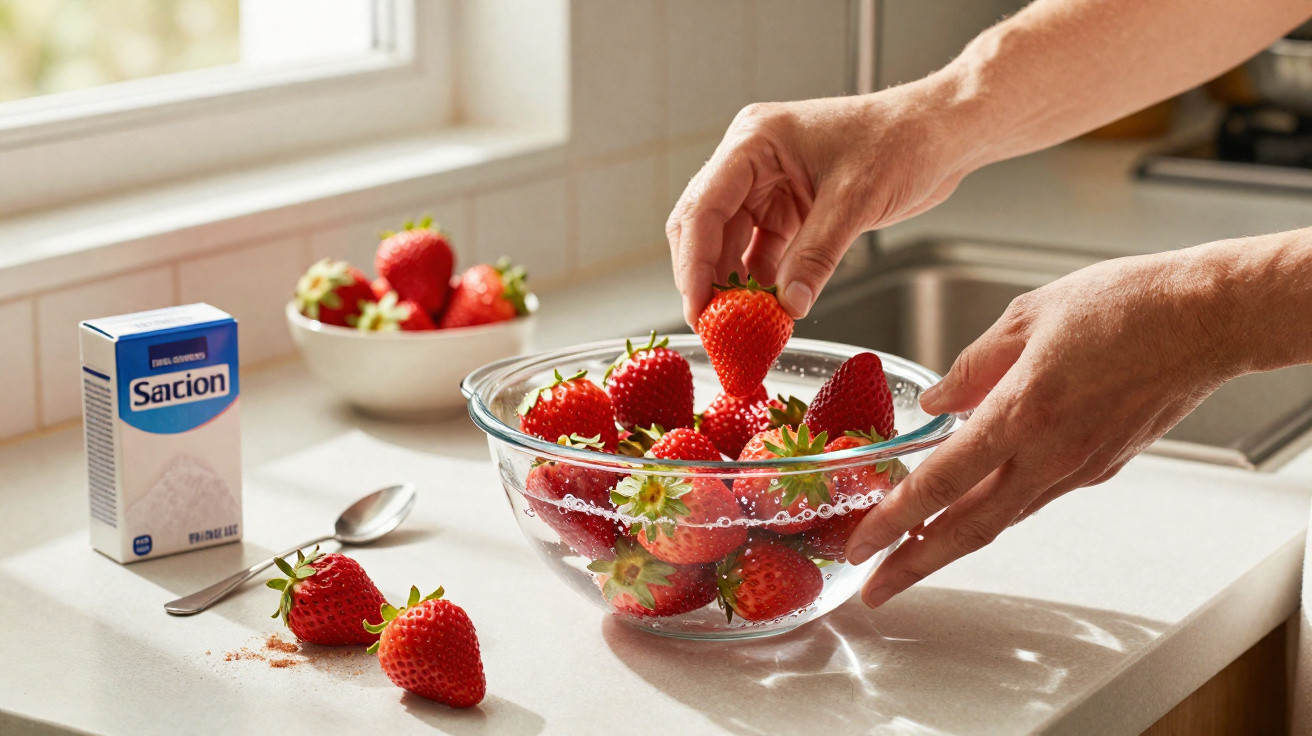
Many people in Germany give strawberries only a quick rinse under the tap – a reassuring habit that, in reality, offers little protection from residues.
Plump red strawberries, briefly held beneath running water, left to drain and then eaten straight away: this is how they are handled in many kitchens. It looks clean and seems hygienic. However, evidence from international studies suggests otherwise: strawberries are among the fruits most heavily affected by pesticide residues. A quick rinse will remove dust and grit, but not the actual chemical mixture sitting on their surface.
Why strawberries carry so many residues
Strawberries are delicate fruits that grow close to the ground and are often treated repeatedly in intensive farming. Their sweet, soft flesh splits easily and is susceptible to fungi and insects. To prevent crop losses, many growers use several active substances one after another, sometimes in combination.
Analyses by the US Department of Agriculture and other bodies illustrate just how extensive this can be: almost every sample of conventionally grown strawberries contains measurable residues. Some samples contain several active substances at the same time, in some cases more than ten different ones. This is not merely a trace from one spraying, but a varied chemical mix.
Frequently detected substances include fungicides such as carbendazim and insecticides such as bifenthrin. Both are suspected of being problematic with long-term intake, particularly for children, pregnant women and people with pre-existing conditions. Although limit values are intended to restrict precisely these risks, studies often do not adequately account for mixtures containing numerous active substances.
A quick stream of water removes dirt – not the chemicals on a strawberry’s skin.
Why plain tap water does very little
At first, tap water appears to be the obvious answer: it supposedly rinses away anything that does not belong on a strawberry. The problem is that modern plant-protection products are formulated to withstand rain, irrigation and UV radiation for as long as possible. Many active substances adhere firmly to the fruit’s waxy outer layer and are partly fat-soluble.
Tap water, by contrast, is neutral and simply runs over these residues. Laboratory tests show that plain water removes only around 10 to 20 per cent of detectable residues on average, mainly those that dissolve in water. The remainder stays in place, especially in the tiny indentations and around the seeds on the surface.
The most common mistake: removing the hull first
Another familiar kitchen habit makes matters worse: many people cut off the hull before washing their strawberries. This creates an opening directly into the flesh. When the fruit is rinsed, contaminated water containing residues can enter the strawberry through this exposed area.
Treating the berries while they are still whole and removing the hull only afterwards significantly reduces this transfer. Their protective layer remains intact for longer, and the water stays where it should: on the outside.
Washing strawberries better with bicarbonate: how the method works
Studies show that one straightforward approach performs surprisingly well: soaking fruit in water with baking bicarbonate, or sodium bicarbonate. It is usually sold as “bicarbonate of soda” or “baking soda” in the baking aisle. The mildly alkaline solution can chemically weaken certain residues, or at least loosen them from the fruit’s surface.
In laboratory tests, a bicarbonate soak can substantially reduce up to around 90 per cent of surface residues.
Step-by-step instructions for home use
- Choose a large bowl: Pour in one litre of cold water.
- Stir in bicarbonate: Fully dissolve 1 heaped tablespoon of baking bicarbonate.
- Add the whole strawberries: Do not remove the hulls; simply submerge them gently.
- Move them carefully: Lightly turn the fruit through the water with your hand, without squeezing it.
- Leave for 10 to 15 minutes: Allow the soak to work rather than repeatedly lifting the fruit out.
- Drain and rinse briefly: Transfer the strawberries to a colander and rinse under running water for about 30 seconds.
- Dry thoroughly: Spread them over a clean tea towel and gently pat them dry.
The combination of chemical action, time and gentle movement removes surface residues far more effectively than a brief rinse. Experts point out that the method works similarly well with other fruits, including apples and pears.
What about vinegar, salt or warm water?
Many households rely on vinegar water. In fact, mixtures of water and clear household vinegar can have a noticeable cleaning effect. In trials, a solution made from one part vinegar and five parts water removed roughly 60 to 70 per cent of detectable residues on average.
Warm salted water ranks in the middle. Depending on the temperature and concentration, it can reduce residues by 40 to 60 per cent. Its drawback is that strawberries soften more quickly, lose flavour and become mushy if the water is too warm or contains too much salt.
Bicarbonate solutions often perform clearly better than these methods and, when used correctly, protect both texture and taste. Washing-up liquid, soft soap and household cleaners do not belong on food. Any residue from such products would ultimately be at least as undesirable as the original plant-protection products.
Common mistakes when washing strawberries
- Giving them only a quick rinse under cold water
- Removing the hulls before washing the strawberries
- Leaving the fruit in water and then storing it wet in the fridge
- Using soap, washing-up liquid or cleaning products
- Using water that is too hot, making the berries soft and more vulnerable
Organic strawberries: less concern, but not risk-free
Choosing organic reduces many risks, but not every one. Products are also used in organic cultivation – different from those used in conventional agriculture, but still containing active substances. There may also be spray drift from neighbouring fields, or residues in the soil and water.
Measurements of samples from different countries of origin show that organic strawberries contain considerably fewer residues on average, but they are not entirely residue-free. Cleaning them with bicarbonate or mild vinegar water is therefore just as worthwhile. The effort is modest, while the potential benefit is considerable.
How much does reducing residues lower the risk?
Thoroughly washing strawberries significantly reduces the total amount of pesticide residues consumed. This matters especially for children, who can eat surprisingly large quantities of strawberries relative to their body weight. Every reduction in exposure lowers long-term intake.
Experts are particularly concerned about so-called cocktail effects: individual substances may be present at levels that are still officially regarded as acceptable. When many active substances occur together, however, they can reinforce one another. Personal factors also play a role, including pre-existing conditions, sensitivities and genetic differences in how these substances are broken down.
Practical advice for buying, storing and eating strawberries
Anyone wanting to play safe can start at the point of purchase. Locally produced fruit, short transport distances and seasonal produce reduce the pressure to make fruit “keepable” through maximum chemical use. Farm shops and pick-your-own strawberry fields often offer greater transparency about how the fruit has been treated.
A few simple rules are useful in everyday life:
- Eat strawberries as fresh as possible instead of keeping them in the fridge for several days
- Wash them only shortly before eating, so they are not left sitting in moisture
- Consistently discard berries with bruised patches, as germs multiply particularly quickly there
- For highly sensitive people, choose smaller portions that are higher quality and thoroughly cleaned
If a bicarbonate soak is not appealing, at least extend the soaking time in plain water and gently move the fruit around in it. The effect remains much weaker, but it is still better than the usual approach of “just holding them under the tap for a moment”.
The aim is not to demonise strawberries. They provide vitamin C, folate and secondary plant compounds, while being low in calories. With a better washing routine, those benefits reach the plate much more cleanly – and the quick rinse beneath the tap then looks more like an outdated kitchen ritual from before the evidence was available.




Comments
No comments yet. Be the first to comment!
Leave a Comment