
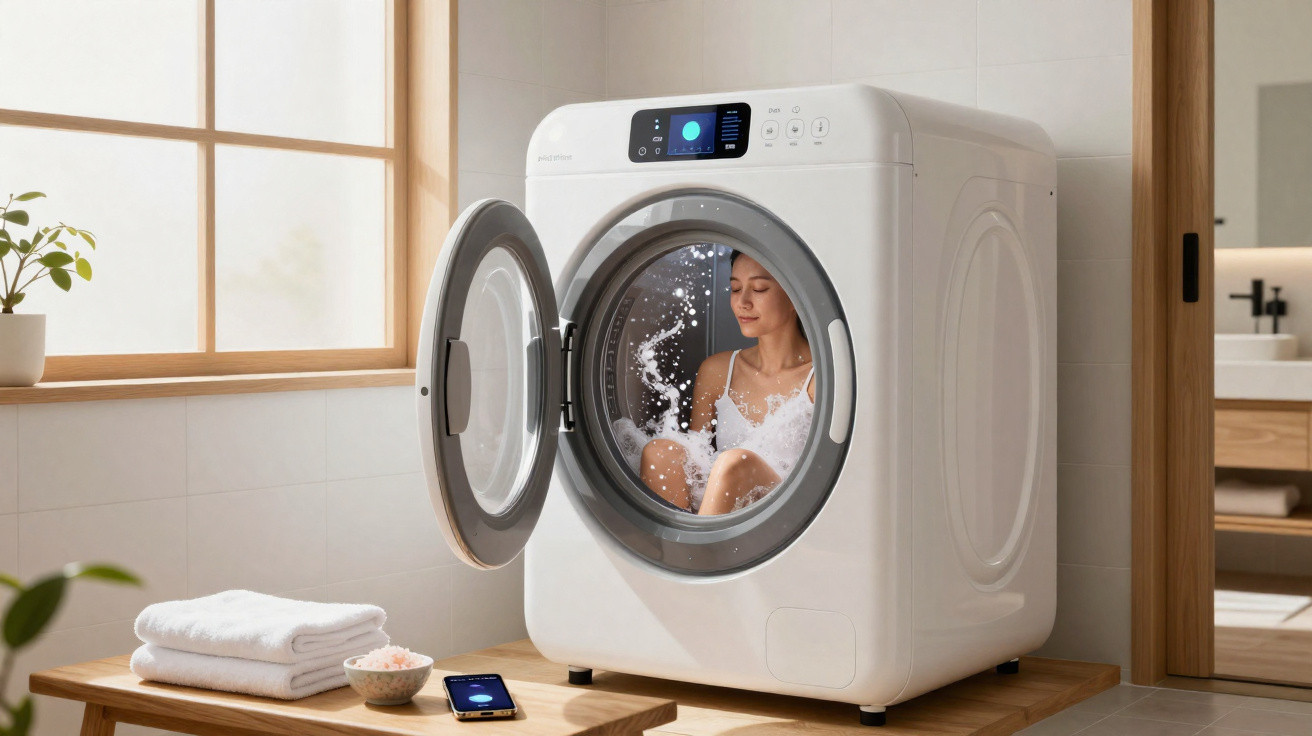
An Osaka company is developing a high-tech capsule that automatically washes and dries the entire body while also assessing health data. Many experts regard it as a possible successor to the conventional shower enclosure, while others call it a wild spa gadget for technology enthusiasts.
What lies behind the “human washing machine”
The futuristic capsule is called the “Mirai Ningen Sentakuki”, a name that roughly translates as a washing machine for the person of the future. The principle is simple: rather than stepping into a shower, the user sits inside an enclosed capsule and lets the system handle everything else.
The concept itself is not entirely new. A first body-washing machine prototype was displayed at the Osaka Expo in the 1970s, but it remained a trade-show attraction at the time. Today, the sector has access to sensors, AI and more refined water technologies - precisely the advances that Osaka-based Science Co. is using.
“The capsule is intended to clean, relax and dry the entire body in around 15 minutes - without reaching for shower gel even once.”
How a human “wash cycle” works
To use the capsule, a person steps inside, sits down and closes the door. A fully automated programme then begins, much like the cycle of a real washing machine - except that it is designed for the human body.
- Filling with water: The cabin fills with water that gently flows around the body.
- Microbubble cleaning: Tiny air bubbles are intended to penetrate deep into skin pores and loosen dirt.
- Sensor-led adjustment: Biometric sensors record pulse rate and other physical data.
- Personalised settings: AI adapts the temperature, water jets, lighting and sound.
- Built-in drying: Once cleaning is complete, a drying phase takes place within the same capsule.
The complete process is expected to take around a quarter of an hour. The user then leaves the capsule clean and dry - and, ideally, considerably more relaxed than after a quick everyday shower.
Microbubbles: gentle cleansing without scrubbing
One of the capsule’s most striking technologies is its use of microbubbles. These are extremely small air bubbles in water, already used in wellness facilities and medical applications.
The benefits of this technology include:
- The tiny bubbles can reach the skin’s surface more effectively.
- They loosen dirt and skin oils without vigorous rubbing.
- Cleansing is often more pleasant and gentler.
- Water consumption may be lower than with conventional showers.
Such a system could be particularly relevant for older people, those with sensitive skin and care settings. The device takes much of the effort out of washing and avoids harsh scrubbing with a flannel or sponge.
When the shower becomes a mini spa
The capsule is intended to do more than simply wash its user; it aims to turn the whole process into a kind of short break. This is where the combination of sensors and artificial intelligence comes in.
During the wash cycle, sensors capture heart rate and other bodily signals. The control system uses this information to modify several factors:
- Water temperature - warmer or cooler depending on the person’s condition.
- Water-jet pressure - from a gentle massage to more powerful cleaning.
- Interior lighting - calming colours or clear light.
- Soundscape - such as the sound of waves, music or complete silence.
“The developers want to transform the daily bathroom chore into a individually controlled wellness moment - part hygiene, part spa.”
Hygiene meets a health check
The link between personal care and health monitoring is particularly interesting. Throughout the washing cycle, the system continuously gathers physiological data. The technology is still at an early stage, but the approach goes far beyond a luxury shower.
Potential future scenarios include:
- Early indications of increased stress by assessing pulse patterns and breathing.
- Trend analysis of sleep and recovery quality when the capsule is used regularly.
- Warning signals for noticeable changes, such as sudden blood-pressure fluctuations, provided the appropriate sensors are integrated.
- Links to digital health records or apps.
In an ageing society such as Japan’s, systems like this could ease the workload on care staff. Part of daily personal care could be automated while relevant data could also be passed on to medical professionals - naturally, only with the user’s consent.
A threat to the shower enclosure or an expensive toy?
Whether the human washing machine will genuinely become part of daily life remains uncertain. At present, it looks more like a design object from a science-fiction film. Its price is unlikely to appeal to average earners initially, and details are scarce in any case.
Realistic locations during an early rollout include:
| Location | Potential benefit |
|---|---|
| Luxury hotels | An exclusive spa experience that sets the venue apart |
| Care homes | Gentle cleansing and reduced pressure on care staff |
| Rehabilitation clinics | Monitoring vital signs during personal care |
| Wellness studios | A technology-led premium treatment offered as an extra service |
For private bathrooms in the UK and Europe, questions of space requirements and conversion costs would arise first. A conventional shower enclosure is relatively simple to install and robust. A high-tech capsule requires electrical connections, water technology, maintenance and possibly software updates.
Benefits and risks in everyday use
The advantages are clear: convenient washing, stress-reducing functions and potential health monitoring. At the same time, the technology raises sensitive issues - above all, around data.
Anyone collecting health and behavioural data in a bathing capsule must define exactly who may access that information, how it is stored and whether it could be used for other purposes, such as by insurers.
There are practical considerations too:
- Malfunctions: What happens if the capsule suffers a system fault or power cut?
- Cleaning the device: How demanding is it to keep the capsule itself hygienic?
- Privacy protection: Who is allowed to view or alter settings?
- Dependence on technology: If the system fails, there may, in the worst case, be no way to wash at all.
Why the idea is gaining momentum now
It is no coincidence that concepts such as this are reappearing today. Three trends are converging: rapid population ageing in countries including Japan, a desire for greater everyday convenience and the boom in artificial intelligence for smart homes.
Many people already spend significantly more on premium shower systems, rain showers, baths with lighting and sound features, or smart toilets. A fully automated body-washing capsule fits this development exactly - simply at the top end of the scale.
How realistic is the “human washing machine” for UK bathrooms?
In the UK, the technology is likely to become a media subject and a trade-show centrepiece before it becomes a mass-market product. Over the longer term, pared-back versions could enter ordinary bathrooms, such as shower systems with more sensors, microbubble technology, personalised programmes and straightforward assessments of health indicators.
Anyone planning a bathroom today will probably still choose a shower and bath. Yet the idea of simply sitting in a capsule and leaving the rest to a machine clearly shows the possible direction of travel: hygiene is becoming more digital, more closely monitored and far more focused on convenience.






Comments
No comments yet. Be the first to comment!
Leave a Comment