
On the first properly chilly evening in October, my sitting room sounded like a dragon that hadn’t had a day off. The boiler clattered into life, the radiators spat and sighed, and the smart meter blinked a nasty little figure that turned my stomach. Like most people, I shuffled over in my socks, edged the thermostat up “just a bit”, and told myself I’d sort it out properly another time. That “another time” usually turns up as a frightening bill on the doormat.
But when you talk to HVAC engineers - the people who spend their working lives under floorboards and in boiler cupboards - they keep coming back to the same quiet point: the real influence isn’t only the boiler you install, it’s how you set the small brain on the wall. The thermostat. And the way most of us run it? They visibly cringe.
The uncomfortable truth about your thermostat habits
HVAC engineers repeated one theme to me over and over: households often get the fundamentals wrong. We pay for programmable or smart thermostats, select a quick “auto” or “eco” setting, and then… leave it alone for years. One engineer in Manchester said, with the weary half-grin you see on tradespeople, that he could guess a home’s energy bill by asking a single thing: “Do you ever change your thermostat schedule?” Nearly everyone answered no.
And, to be fair, few of us want to spend an evening poking through tiny touch-screen options to build time blocks. It’s fiddly and dull - like trying to programme a microwave from 1998. So instead, we wing it. We bump the temperature up when our feet feel frozen, then knock it down when the cost bites or we start sweating under a throw. That back-and-forth feels normal, but it’s a reliable way to waste money.
A London-based engineer summed it up without much sympathy: “People think comfort is about cranking the heat when they’re cold. Comfort is about not letting your house swing like a yo-yo.” When your indoor temperature leaps around, your heating has to work harder, uses more fuel, and never quite settles. Their advice is to let a schedule do the thinking, keeping the background temperature steady while you just get on with your day.
The schedule HVAC engineers actually recommend
If you ask three HVAC engineers for the perfect thermostat schedule, you’ll get three slightly different versions of the same principle: heat the house when you’re in and awake, cool it down when you’re asleep or away, and avoid big spikes and drops. It sounds almost too obvious. Yet when they walk into homes, they find thermostats either locked at one temperature all day or running bizarre patterns that were accidentally created years ago. One engineer even came across a timer still set for the previous owner’s shifts from 2011.
The “sweet spot” they kept returning to was this: a gentle, consistent daily rhythm, rather than a string of temperature crises. Think heartbeat, not rollercoaster. Exact figures vary with insulation, boiler type, and where in the UK you live, but the shape stays the same. You don’t need an engineering degree - you just need to stop using the thermostat like a light switch.
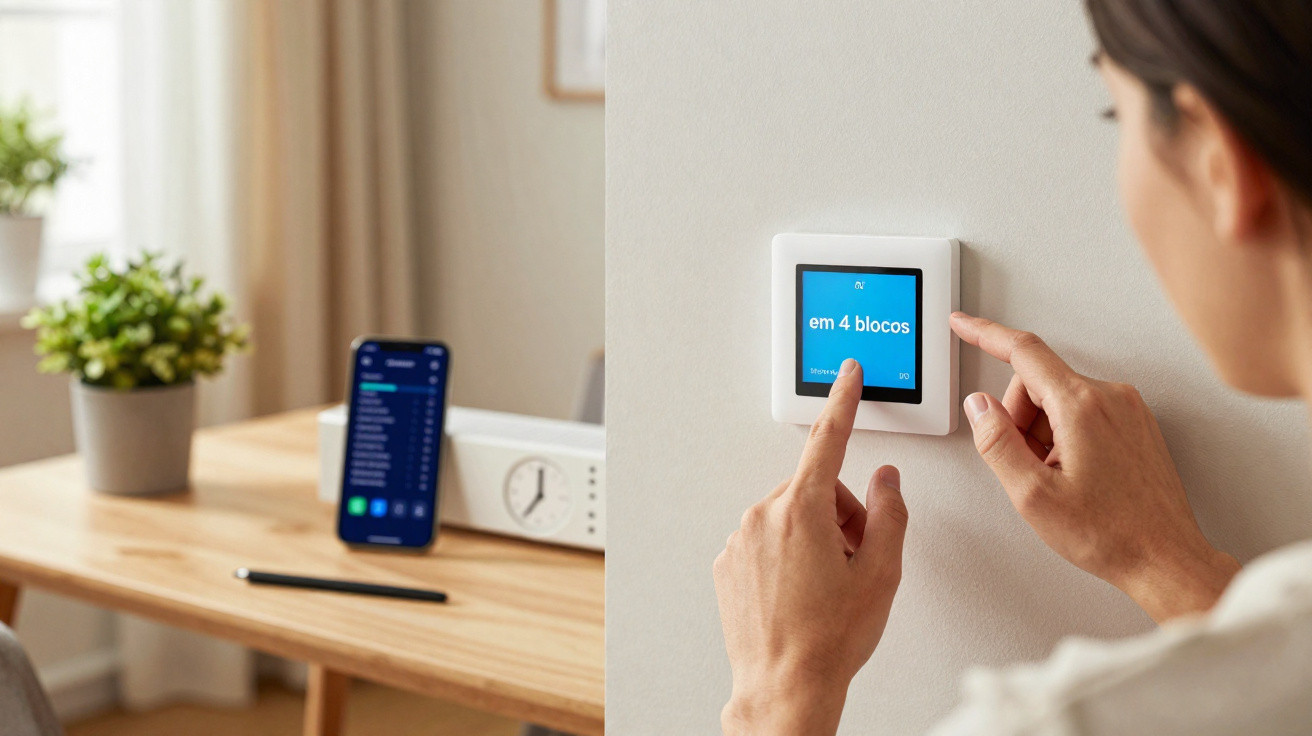
The “4-block” day most engineers swear by
When I pushed for something you could copy and paste tonight, most of them described a straightforward four-block heating day (for winter or any cold spell). For many UK homes with central heating, it typically looks like this:
1. Morning (wake-up): around 30–60 minutes before you get up, set it to roughly 19–20°C.
2. Daytime (out or working): reduce it to about 16–17°C when the house is empty or you’re fairly active.
3. Evening (home and relaxed): bring it back to 19–20°C from late afternoon until roughly 10–11pm.
4. Night (sleep): let it fall to around 16–17°C again until the morning block starts.
That’s the whole idea. No frantic button-mashing because you’ve returned to an icy corridor. The heating ramps up smoothly before you walk in. One engineer likened it to driving: “You’ll use much less fuel if you keep a steady speed on the motorway than if you slam the accelerator and brakes every few minutes.” Boilers respond much the same.
Why small drops beat dramatic switches
Most of us have done it: you come home, the place feels like a fridge, and you whack the thermostat up to 25°C “to get it moving”. It seems sensible - higher setting, quicker warm-up. What HVAC engineers will mutter, however, is that a boiler doesn’t behave like a kettle. Turning it up doesn’t make the house heat faster; it simply encourages overshooting and burns energy you never meant to buy.
Instead, they recommend modest, predictable adjustments of roughly 2–4 degrees. So, rather than dropping from an evening comfort of 20°C down to 12°C and waking up feeling like you’re waiting at a bus stop in January, you ease down to 17°C overnight. Your home cools more slowly, the system isn’t forced to haul the temperature up a steep cliff in the morning, and you avoid that deep, miserable chill that makes you abandon every good intention.
A Leeds engineer explained the logic like this: “The bigger the temperature difference between inside and outside, the faster you lose heat. So if you let your house drop too far, you spend more time and money pulling it all the way back up again.” That quiet 16–17°C overnight setting becomes a sort of safety net: warm enough to discourage damp, low enough to trim costs, and not so low that the radiators have to roar at dawn.
The schedule that works in summer (and on stuffy nights)
In summer, the problem flips. You’re no longer trying to hold onto warmth; you’re after a bit of cool - or at least trying to stop the house becoming an oven. If you’ve got air conditioning or a heat pump, engineers still apply the same rule: gentle shifts, not extremes. You’re aiming for comfort, not the Arctic.
For cooling, their guidance often runs along these lines: target around 23–24°C when you’re in and awake, allow it to loosen to about 25–26°C while you’re out, and avoid going below 22°C unless there’s a health reason. Your body acclimatises; your bank balance doesn’t. A frosty 19°C sitting room feels lovely for ten minutes, and then the system runs endlessly while you end up pulling on a jumper in August.
Nighttime cooling without the guilt
Night-time is where people punish their systems. Some blast cooling until morning; others switch everything off and then lie awake in sticky, overheated quiet. HVAC engineers tend to propose a middle ground: keep it at around 24–25°C for the first half of the night, then let it creep up by roughly half a degree as the outdoor air cools towards early morning. Add a fan on a low, steady hum and you can sleep comfortably without that dread when the bill arrives.
The mildly dull reality is that comfort sits in the middle, not at the edges. Once you experience it at home - how a steady, moderate cool or gentle warmth is actually enough - it’s oddly liberating. The thermostat stops being an emotional emergency button and becomes a background rhythm. And, once it’s set, you mostly leave it alone, which is precisely what the engineers want.
What engineers secretly wish you’d change today
When I asked what one thing they’d fix in every house if they could, most didn’t mention boilers or radiators. They pointed to behaviour. One engineer let out a sigh and said, “If people just stopped using ‘on’ and ‘off’ and started trusting the schedule, they’d probably shave 10–20 per cent off without really noticing.” A system can’t work intelligently if you keep overriding it.
They also wish we’d stop trying to create a room-by-room tropical resort. Keeping the entire house at 22–23°C every evening feels pleasant briefly, but it’s costly and often unnecessary. Quietly, engineers suggest picking a “comfort zone” - usually the living room - and accepting that bedrooms and hallways can be a bit cooler. Put socks on. Grab a blanket. It may sound old-fashioned, but it’s how British homes were lived in for a long time before smart meters started giving us lectures.
The 10-minute reset that changes everything
This is the part nearly every engineer insists on: spend ten minutes, just once, programming the thermostat properly. Not fine-tuning it every day - resetting it. Clear out whatever odd settings were left from a previous winter or a previous owner, and put in your own four-block day.
They recommend doing it in this sequence: start by setting your usual wake-up and bed times. Next, add your main “out of the house” period, if you have one. Then choose your two anchor temperatures: one for comfort (around 19–20°C for most people in winter) and one for economy (around 16–17°C). The minor tweaks can come later. One quiet evening on the sofa with the manual, a cup of tea, and perhaps a bit of swearing tends to pay you back month after month.
One engineer told me about a retired couple who eventually did this after years of “just turning the dial until it feels right”. Three months later, their bill dropped by almost a quarter. Nothing else changed - same boiler, same draughty Victorian semi - just the timing and the size of the swings. “It felt almost insulting,” the husband told me, laughing. “All that worry and the answer was just… doing it properly once.”
What if your house is badly insulated or a bit odd?
At this stage, there’s usually someone ready to say, “That’s all very well, but my house leaks heat like a colander.” Engineers roll their eyes - not because it’s wrong, but because they’ve heard it endlessly. Leaky homes are real. Single-glazed terraces are real. Rented flats with windows that rattle in the wind are very real. They still maintain that a schedule helps.
In homes with poor insulation, the headline temperatures may need a small adjustment - perhaps your night-time minimum sits closer to 17–18°C, or you reduce the length of the lower periods. But the rule doesn’t change: avoid big swings. Treat your home less like a perfectly sealed thermal box and more like a slightly scruffy friend you’re trying to keep comfortable without going broke. Smaller, predictable changes often suit these properties even more, because they cool down quickly.
For people on unusual shifts, the engineers simply say, “Flip the pattern.” Your “morning” might start at 6pm, and your “evening” might land at 2am. The heating doesn’t care what the clock reads; it only needs a consistent shape. The sad part is that many shift workers end up living permanently too hot or too cold, even though they’re among those who could gain most from a personalised schedule.
That quiet moment when the bill arrives
There’s a sound that sits behind all of this: the crisp flap of an envelope being opened on a Thursday morning. You stand in the kitchen in your dressing gown, notice the faint metallic tick as the radiator warms, and stare at the number. Everyone recognises that sinking feeling - the mix of “I need to do something” and “I don’t even know where to begin”.
HVAC engineers operate on the other side of that moment. They’ve seen inside our lofts and airing cupboards; they know how heavy-handed most of us are with energy. When they talk about recommendations and efficiency, it isn’t a cold spreadsheet exercise. It comes from years of watching people panic in winter, and years of seeing the same errors repeated across different postcodes.
Their thermostat schedule isn’t glamorous. Nobody is going to boast in the pub, “I set a beautifully modest 17°C overnight.” Even so, if there’s a quiet way to push back against spiralling bills, it probably starts there: a boring four-block pattern; a couple of numbers you stick to; less drama at the thermostat and less drama at the letterbox.
You don’t have to fall in love with your boiler, your radiators, or the plastic box on the wall. You only need to give it a sensible rhythm. Then you can ignore it for weeks and just live. And on a surprisingly mild evening in February - when the meter isn’t screaming and the room feels gently, unremarkably comfortable - you may find yourself admitting the engineers were right: the savings are in the schedule, not the panic.





Comments
No comments yet. Be the first to comment!
Leave a Comment