
Many people still treat wooden chopping boards, cooking spoons and spatulas exactly as they learnt from their parents or grandparents. Put them in a saucepan, use hot water, scrub vigorously – job done. However, an expert from a television morning programme is now strongly challenging this routine, explaining how wood can genuinely be cleaned hygienically without damaging it.
Popular kitchen trick exposed: boiling wooden utensils does more harm than good
The idea initially seems sensible: if hot water kills germs, boiling water must disinfect wooden spoons particularly thoroughly. This reasoning has become established in many homes – and is cheerfully passed around on social media as a “life hack”.
A kitchen specialist appearing on a well-known TV morning programme firmly disagrees. He describes boiling wooden utensils as a “huge mistake”, one that benefits neither the spoons nor hygiene.
When wood is boiled, its natural components are released, the material swells and, over time, becomes soft, stained and unattractive.
The expert explains that when wood boils vigorously in a pan, its fibres release tannins and colourants into the water. This is familiar from new chopping boards, whose surface can discolour after extensive contact with water. At the same time, the wood absorbs more liquid, swells and may warp.
Rather than staying hygienically smooth and solid, the surface becomes dull and slightly spongy. Dirt can then settle again in these small indentations. The supposed hygiene trick therefore creates exactly the porous structure that germs thrive in.
Expert-recommended care: clean gently, then mechanically “refresh” the wood
During the programme, the TV expert revealed how he looks after his own wooden utensils. The first step sounds unremarkable but is dependable: ordinary washing-up with a mild cleaning product.
- For everyday use: warm water and gentle washing-up liquid
- For strong odours: a little vinegar in the washing-up water
- For deep cleaning: fine sandpaper and cooking oil
For a “full refurbishment”, he does not reach for a saucepan but for fine sandpaper, such as 180 grit. This is used to carefully remove the worn upper layer of wood.
The result is that the surface feels smooth again, small grooves disappear and discolouration is substantially reduced. Unlike boiling, this does not soften the wood; it gently smooths and compresses it.
A quick sanding with fine sandpaper can make old wooden spoons look remarkably fresh – almost newly bought.
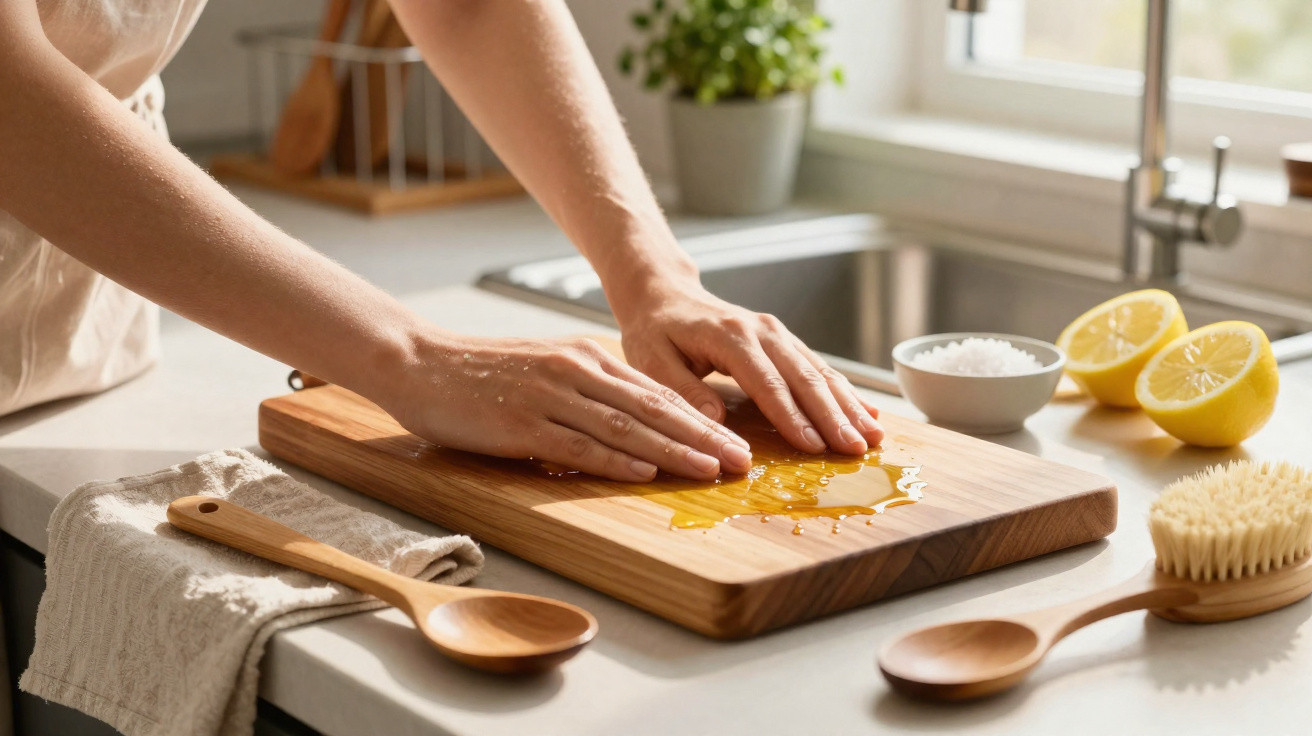
To finish, the expert recommends applying a thin layer of vegetable cooking oil. Oiling lightly seals the pores, protects against moisture and brings out the natural grain. This keeps spoons, boards and spatulas hard-wearing without losing their character.
Step-by-step guide: how to care for wooden kitchen utensils properly
Everyday cleaning after cooking
After every use, just a few simple actions will usually suffice:
- Rinse the wooden utensil under warm water immediately after use.
- Clean it with a soft sponge and a small amount of washing-up liquid.
- Briefly rinse again with clean water.
- Dry it thoroughly with a clean tea towel.
- Ideally, leave it to finish drying in the air, standing up or lying flat rather than on a radiator.
Anyone who has cut garlic, onions or fish will know the issue: the smell can linger in the wood for days. A straightforward remedy can help: apply a little vinegar or lemon juice to the dampened board, allow it to work briefly, then rinse it off. The acid neutralises odours and has a mildly antibacterial effect.
A regular “wellness day” for wooden boards and cooking spoons
Depending on how often they are used, wooden utensils benefit from more thorough treatment every few months. All that is needed is a small “workbench” on the kitchen table:
- fine sandpaper, around 180–240 grit
- a cotton cloth or kitchen roll
- a neutral cooking oil, such as sunflower or rapeseed oil
The method is as follows:
- Make sure the wooden surface is clean and dry.
- Sand in the direction of the grain using light pressure, until the surface feels smooth.
- Remove dust with a dry cloth.
- Apply a few drops of oil and massage it in as a thin layer.
- Wipe away any surplus oil after a few minutes.
Important: the wood should not be drenched. An extremely thin coating is entirely sufficient. Too much oil can turn rancid and, in turn, cause unpleasant smells.
Why wood is the clear kitchen favourite over plastic
Wooden utensils are not only warm and attractive in appearance; they are increasingly regarded as the considerably healthier choice too. A well-known doctor, often invited onto television health programmes, has for some time highlighted the potential risks associated with plastic in the kitchen.
His criticism is that many plastics contain substances that may be released by heat, fat and acid, allowing them to pass into food. These substances are suspected of interfering with hormonal balance.
Plastic kitchen utensils are coming under increasing scrutiny because the chemicals they contain can be released and may affect health over the long term.
The doctor cites, among other concerns, a raised risk of hormone-dependent cancers such as breast or prostate cancer. He also links certain plastic components to disruptions in children’s development. His forceful recommendation is therefore that anything in the kitchen made of plastic and coming into contact with heat or food should gradually be removed.
Compared with plastic, wood offers several benefits:
- No plasticisers or other soluble additives
- Gentle on non-stick frying pans and saucepans
- Pleasant to hold and less likely to slip in the hand
- A warm, timeless appearance
- Can be sustainably sourced, including from local timber
Switching to wood is therefore not only an aesthetic choice but, above all, one that makes sense for health – provided it is cared for correctly.
Wood is durable – but not indestructible
Despite all its advantages, several pitfalls need to be considered. Wood does not tolerate prolonged, high moisture levels. Spoons, boards and bowls should neither go in the dishwasher nor be left in washing-up water for hours. The combination of heat, harsh detergents and pressure inside the machine damages the structure, causes cracks and encourages warping.
Wood also dislikes major temperature changes. Icy-cold water immediately after contact with hot oil can create tension and, in the worst cases, lead to hairline cracks. Such cracks can barely be kept hygienically clean.
| Do | Don’t |
|---|---|
| Wash by hand with mild washing-up liquid | Put them in the dishwasher |
| Dry immediately and store where air can circulate | Leave them sitting in water for a long time |
| Sand lightly and oil regularly | Boil in a pan or pour boiling water over them |
| Use separate boards for meat and vegetables | Cut everything permanently on one old board |
How long can wooden utensils be used?
With proper care, wooden kitchen utensils can last for many years. Nevertheless, there are points at which it is better to dispose of them. A spoon that is badly cracked or noticeably soft and spongy belongs in the bin. The same applies to boards with deep, dark grooves that still do not feel clean after sanding.
A practical guideline is this: if a wooden item can no longer be made genuinely smooth, or it permanently smells unpleasant, it should be replaced. For everyday cooking, it is worthwhile having a small basic set of sturdy items – around two to three spoons, a spatula and at least two chopping boards for different food groups.
Why stopping the practice of boiling makes a noticeable difference
Anyone accustomed to sterilising wood in a saucepan will need to change their routine. In practice, however, it takes hardly any more effort: instead of putting a pan of water on to boil, simply reach for sandpaper and oil. The utensils retain their shape, remain hard and smooth, and absorb unpleasant odours far less often.
Mechanical cleaning also creates greater awareness of the condition of kitchen utensils. Cracks, discolouration and soft patches become immediately noticeable during sanding. This makes it possible to see early on when an item should be replaced – preventing a spoon that appears “clean” from having long since become a magnet for bacteria.
Those who consistently avoid plastic, choose wood and care for it correctly improve several things through simple measures: fewer chemicals around food, longer-lasting kitchen utensils and a far better feeling when cooking. There is just one habit that should be abandoned for good: “disinfecting” wooden spoons and boards in a vigorously boiling pan.




Comments
No comments yet. Be the first to comment!
Leave a Comment