
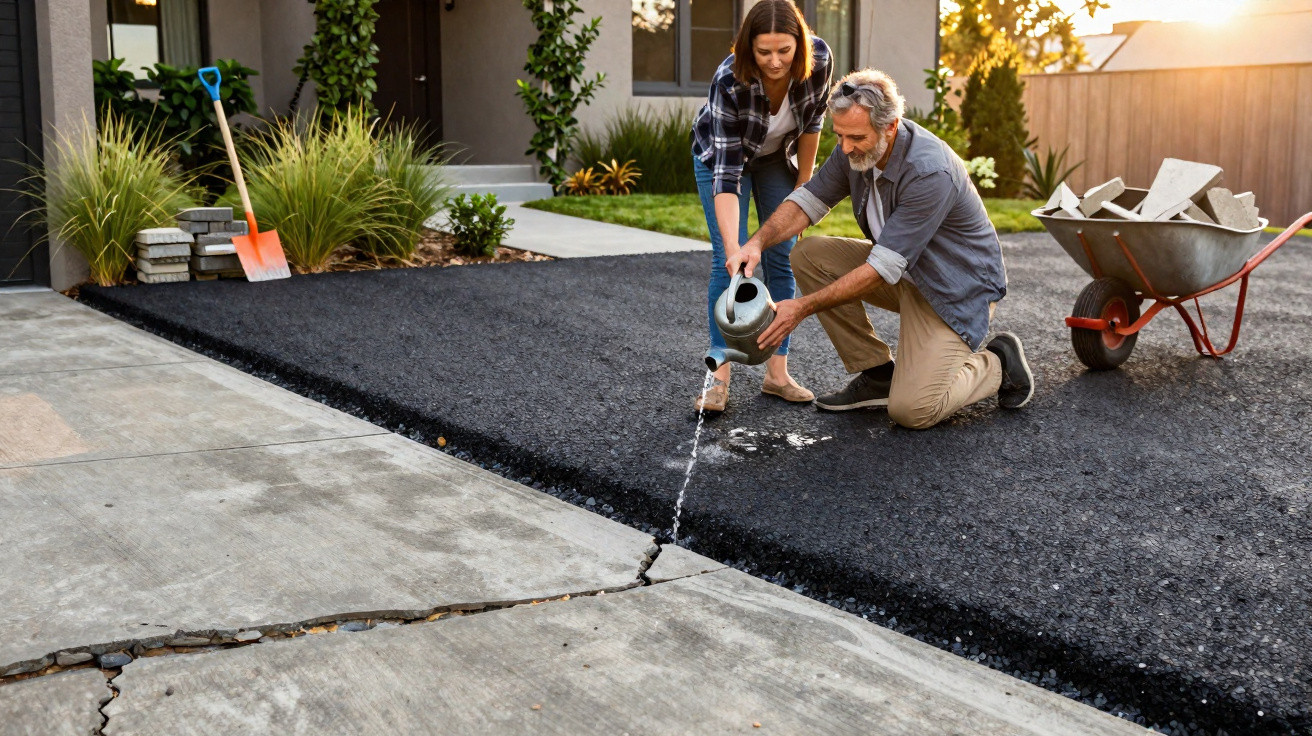
Across Europe and North America, homeowners are increasingly moving away from the traditional concrete driveway in favour of recycled, water-permeable surfaces that offer a more contemporary appearance and a lighter climate impact.
Why concrete driveways are losing their shine
For years, concrete appeared hard to beat: it was durable, familiar and regarded as requiring little upkeep. The assumption was that it could be poured and then ignored. That perception is now beginning to unravel.
The climate impact is one reason. Cement, the binding ingredient responsible for concrete’s strength, is made in kilns heated to extremely high temperatures by fossil fuels. Worldwide research links cement manufacture alone to almost 10% of global greenhouse gas emissions. A broad, impermeable concrete surface outside a “low‑carbon” home can therefore seem contradictory.
Practical performance is another concern. As a rigid material, concrete struggles with ground movement, freeze–thaw conditions and inadequately prepared sub-bases. Small fractures can soon spread; water enters them, while frost accelerates deterioration. Repairs to limited sections are generally conspicuous and seldom match the surrounding surface.
The price can also be unwelcome. In Europe, installed decorative or coloured concrete that provides a tidy finish commonly costs €70–€120 per square metre, with comparable pound figures in the UK. At the premium end of the North American market, a concrete driveway may cost homeowners up to $20 per square foot.
Concrete driveways can last a long time, but they lock in emissions, trap heat, and are expensive to repair once things start to go wrong.
In response, a growing number of homeowners are seeking a surface capable of supporting vehicles while allowing water to drain away and reducing the use of virgin materials.
What recycled asphalt can offer that concrete cannot
An increasingly popular alternative has a surprising origin: worn-out roads.
From motorway to front drive
Driveways sold as “recycled asphalt” generally use material known within the trade as RAP, or Reclaimed Asphalt Pavement. Contractors mill or plane away ageing road layers, crush the recovered material and rework it with new binder to form fresh surfacing.
Asphalt consists of aggregate - sand, gravel and crushed stone - bound with bitumen, a petroleum-based material. It is not the former coal-derived tar, which is now avoided for health reasons. Using RAP retains much of the original stone along with part of the old binder.
This circular process brings several benefits:
- Less material going to landfill
- Reduced need for freshly quarried aggregate
- Lower energy and water consumption in manufacture
- Shorter transport distances where processing takes place locally
Price is a significant attraction. North American case studies put a RAP driveway at roughly $7.50 per square foot, compared with up to $20 for concrete. Across European markets, installed recycled asphalt surfaces frequently cost €30 to €70 per square metre, making them cheaper than many decorative concrete alternatives.
Recycled asphalt driveways tend to cost a fraction of high-end concrete, while still enduring 15 to 30 years with sensible maintenance.
When expertly installed and properly cared for, concrete can occasionally last 30 to 40 years, potentially giving it a decade more than a recycled asphalt driveway. However, when recycled surfacing begins to wear, it is comparatively straightforward to repair a local area or apply a new overlay. Damaged concrete often requires extensive cutting, visibly mismatched patches or complete removal of the slab.
Drainage: letting rain go where it should
Standard concrete acts much like a roof laid on the ground: rainfall quickly flows towards drainage systems or nearby soil, increasing flood risk when those networks are already under pressure.
Authorities in many countries are challenging this model. France’s “Zéro Artificialisation Nette” policy seeks to stop the ongoing sealing of land. Planning policy in England is likewise placing greater emphasis on permeable options for front gardens and driveways.
Permeable, or “draining”, asphalt addresses the issue directly. Its aggregate is graded to create greater gaps between stones, enabling rainwater to pass through the top layer and into the sub-base.
Such porous surfaces are more expensive to manufacture - typically 15% to 25% more than conventional asphalt - but they can reduce pooling, ease pressure on sewers and encourage healthier soil beneath the driveway.
Draining asphalt turns the driveway into a sponge rather than a slide, cutting standing water and easing local flood pressure.
Greener binders: from petroleum to plants
Bitumen remains a fossil-derived material. To lower the carbon impact of driveways further, certain manufacturers are now substituting part of the binder with plant resins or bio-sourced oils. These “vegetable binders” do not make asphalt an impact-free solution, but they do lessen its direct dependence on petroleum.
Manufacturers are also increasingly incorporating 30% to 35% recycled aggregate. Together with low-temperature manufacturing methods, these blends can have a substantially smaller carbon footprint than both ordinary asphalt and concrete, particularly when transport distances are included.
Planning a recycled driveway: questions to ask
Replacing concrete with recycled asphalt involves more than choosing another type of delivery lorry. A sound sub-base and an experienced installation team are decisive to the outcome.
Choosing the right contractor
It is best to use specialist contractors with experience of RAP and permeable surfaces. Some homeowners say that, after comparing quotations, they found that only some contractors possessed genuine practical knowledge of these newer mixtures.
Before agreeing to any work, obtain clear information on three areas:
| Key point | What to ask |
|---|---|
| Recycled content | What percentage of the mix comes from reclaimed asphalt or recycled aggregates? |
| Thickness | How many centimetres of base and surface layers will be laid for a car-rated driveway? |
| Drainage | Is the surface permeable, and where does infiltrated water go? |
The local climate should also influence the decision. Where winters are severe, ask about frost resistance and the maintenance required to stop water freezing within the driveway structure.
Everyday use and maintenance
A recycled asphalt driveway performs somewhat differently from concrete. It is generally darker and more flexible, and can feel slightly softer in warm weather, particularly in its first few months.
Routine care involves:
- Not turning heavy vehicles sharply while stationary immediately after installation
- Preventing oil spills and solvents from reaching the surface wherever possible
- Inspecting edges and boundaries from time to time, especially where the driveway adjoins grass or a flowerbed
In contrast with concrete, small surface defects can often be addressed through light patch repairs or a thin overlay rather than demolishing the entire driveway.
How eco is “eco-friendly” really?
No driveway surface comes without environmental effects. Recycled asphalt still contains bitumen, needs industrial processing and usually requires heavy lorries. Although concrete is energy-intensive to produce, it can have a very long service life.
For homeowners aiming to reduce their environmental footprint, the choice commonly comes down to three issues: the quantity of new material required, the surface’s permeability, and whether it can be repaired rather than replaced.
A well-designed recycled, permeable drive that lasts 20 years and can be refreshed in stages may cause less lifetime impact than a longer-lived but fully sealed concrete slab that ends up in a skip.
Regulation is also moving towards these principles. In numerous European towns, approval for new driveways increasingly requires evidence that rainwater will not simply be diverted into drains. Some insurers already take a more positive view of properties that handle surface water within their own grounds.
Practical scenarios and tips for homeowners
Consider a standard suburban property with a two-car driveway laid over old, fractured concrete. One option is to break up the existing surface and pour another slab. The alternative is to remove the concrete, create a compacted permeable sub-base and install recycled asphalt that allows rainfall to infiltrate.
The initial estimate for the permeable recycled option may remain lower than the cost of high-specification decorative concrete. Across 20 years, the ability to renew individual areas, alongside reduced flood risk and less water collecting around the property, can make the choice more favourable still.
On denser urban roads, another approach is emerging. Some homeowners retain narrow concrete wheel-track strips to provide additional rigidity, while using permeable recycled material or gravel held in honeycomb grids through the central area. This lowers the overall carbon cost and improves drainage without entirely giving up the familiar qualities of concrete.
Kerb appeal remains important when selling. Recycled asphalt is no longer restricted to the coarse black finish associated with old car parks. Coloured aggregate, smart edging stones and careful compaction can create a crisp, modern surface that leaves older slabs looking dated rather than “solid”.
For those preparing a refurbishment, one final question is worthwhile: find out whether milled material from the existing driveway can be reused in the new mix, either on site or at a local plant. Completing that loop reduces lorry journeys and waste costs, while making yesterday’s cracked surface an important component of tomorrow’s quieter, cooler and more climate-conscious driveway.

Comments
No comments yet. Be the first to comment!
Leave a Comment