
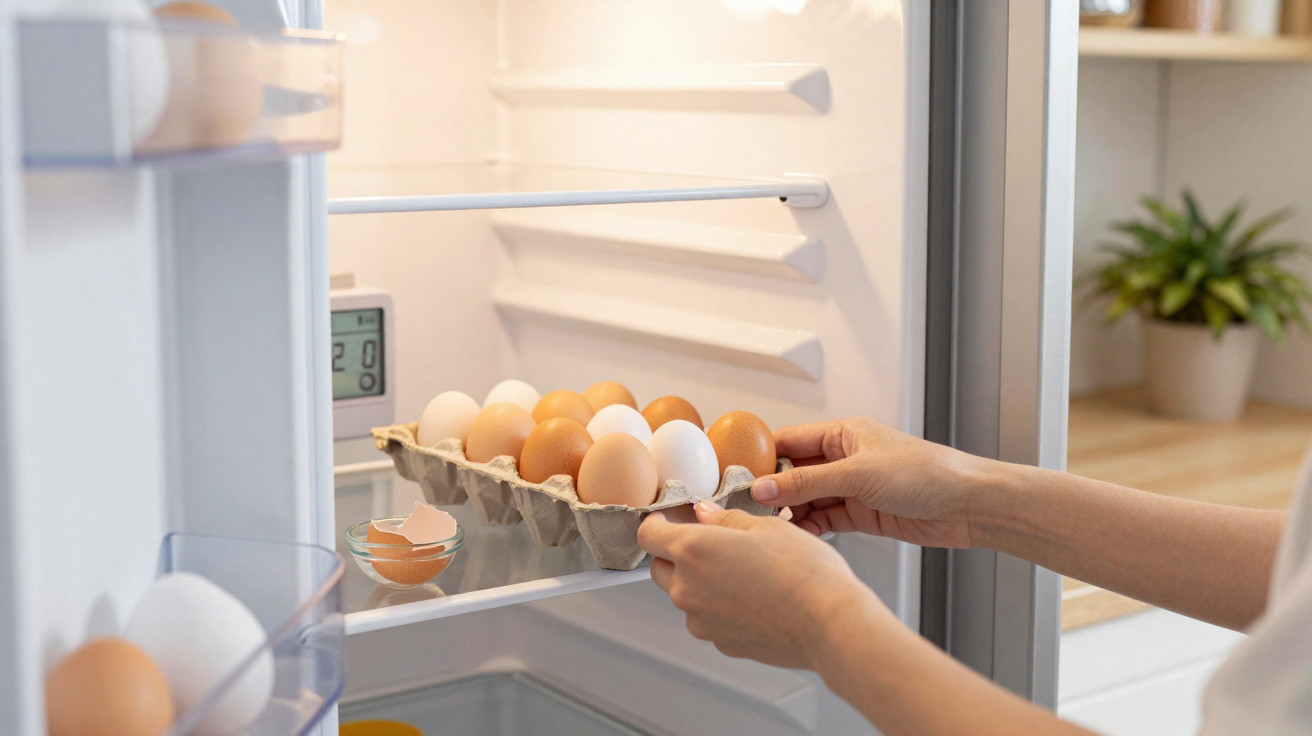
When people put away their shopping, fresh eggs often go almost automatically into the holder in the fridge door. It seems perfectly designed for them, looks convenient and, for many, is simply part of a tidy kitchen. Yet this routine conflicts with both food-storage advice from specialists and the appliance manufacturers’ original intention.
Why fresh eggs do not belong in the fridge door
A look inside the fridge door is enough to confirm it: in countless homes, eggs are lined up neatly there. The rounded recesses in the plastic holder appear to be an unmistakable invitation. The shape fits, there is space available, so in they go.
This is how many people were brought up. After shopping, milk cartons go on a shelf, cold meats and cheese into drawers, and eggs into the small holder in the door - job done. Very few people question whether this habit could create a problem.
However, anyone who considers how a fridge works will quickly spot the issue: the door is the least stable area of the entire appliance. Each time it is opened, warm air enters, causing greater temperature fluctuations than in the rear sections of the shelves.
“Fresh eggs do not like sudden temperature changes - they are sensitive to the fridge door constantly opening and closing.”
Food-safety authorities therefore recommend keeping eggs somewhere as consistently cool as possible. Stable temperatures can make a genuine difference, particularly for eggs, which may be vulnerable to germs such as salmonella.
Why temperature fluctuations can pose a risk
When eggs repeatedly warm up briefly and then cool down again, condensation can easily form on their shells. This damp surface may make it easier for microorganisms to penetrate. It often goes unnoticed in everyday life, but the risk increases quietly in the background.
For this reason, experts advise keeping eggs inside the fridge rather than in its door, ideally on a middle shelf towards the back. Temperatures there remain far more consistent.
The real purpose of the egg holder: not what most people assume
That raises an interesting question: if the space in the door is not ideal for fresh eggs, why does almost every fridge have an egg holder there?
Manufacturers and domestic-appliance specialists offer a surprising explanation: the holder was originally intended mainly for eggs that had already been cooked, especially hard-boiled eggs.
The thinking was straightforward. In the past, people more often prepared hard-boiled eggs for salads, sandwiches and picnics. Several would be cooked at once to keep in reserve, and it made sense to have them close at hand. The fridge door, which is quick to open and easy to see into, was ideal for that purpose.
“The holder in the door was more of a parking place for ready-to-eat snacks - not a permanent home for an entire carton of eggs.”
This also explains why many of these inserts are relatively small. They hold a few eggs rather than a full box of ten. As eating habits changed, this original idea was gradually lost, while the holder remained and its initial purpose was forgotten.
How the “misuse” became standard practice
Over time, an unspoken assumption developed: egg-shaped indentations must mean that eggs belong there. Many people simply learnt this by watching their own family. Who would suspect that the fridge manufacturer had intended something else?
Today, most households use the holder for fresh eggs - and, yes, in many cases this works for years without any obvious issue. What matters is how sensitive a particular fridge is to frequent opening, how warm the kitchen is and how carefully food is generally handled.
How to store fresh eggs properly
Anyone wishing to minimise the risk and make the best use of the eggs’ shelf life can achieve a lot with a few simple rules. Most are easy to incorporate into daily life.
- Store eggs inside the fridge, not in the door.
- Use the original packaging whenever possible.
- Place the carton towards the back of the shelf, rather than near the edge.
- Take out only as many eggs as will be used straight away.
- Avoid major temperature changes, for example by not leaving the fridge door open for a long time.
The cardboard carton does more than protect eggs from knocks. It also limits exposure to other odours and to light, both of which can affect quality. Many packs also display the best-before date - information that is lost when eggs are transferred individually into another holder.
Should eggs be washed before they are put away?
The urge is understandable: an egg with a little dirt on it does not look particularly appetising. Even so, specialist bodies clearly advise against washing eggs before storing them.
Eggshells have a natural protective layer that slows the entry of germs. Water and rubbing can damage this coating. If an egg needs cleaning, it should only be done shortly before use, followed by prompt preparation.
What the fridge-door egg holder can still be used for
Although the holder in the door is not the best place for fresh eggs, it does not have to remain unused. It is still highly suitable for already cooked eggs. They sit securely, do not roll around and can be seen at a glance.
The holder can also be repurposed for items such as:
- small bottles of sauce;
- mini yoghurt pots;
- halved lemons, with the cut side facing upwards;
- capsules or small bottles of supplements that should be kept cool.
People who like to prepare food in advance can also use it for snack eggs: hard-boiled eggs, peeled or unpeeled, for a quick protein boost between meals. Families with children in particular often like these easy-reach zones in the fridge.
Common egg-storage mistakes - and how to avoid them
| Mistake | Result | Better option |
|---|---|---|
| Storing eggs in the door | Major temperature fluctuations | Keep them on an internal shelf, as far back as possible |
| Taking eggs out of the carton | The date is lost and protection is reduced | Leave them in the original carton |
| Washing eggs in advance | The protective coating is damaged | Clean them only shortly before cooking |
| Leaving the fridge open for long periods | Frequent temperature changes | Put shopping away promptly and close the door quickly |
What many people do not realise: eggs do not always have to be refrigerated
In Germany, retailers generally sell eggs unrefrigerated. At home, many people automatically put them in the fridge simply out of habit. The fact is that fresh eggs can remain stable at room temperature for a certain period, provided they have not been washed and their surroundings are not too warm.
Once eggs have been chilled, however, they should remain in the fridge. Continually moving between cold and warm conditions increases the risk of condensation. Those who bake frequently and use eggs quickly can keep part of a pack unrefrigerated in a dark, relatively cool place, such as a pantry.
Why everyday details like egg storage matter more than expected
The story of the egg holder demonstrates how strongly habits shape everyday kitchen routines. A feature in the fridge door can be used in the same way for decades without anyone knowing the original idea behind it.
There are plenty of similar examples: drawers beneath ovens used for storage even though they were designed to keep food warm, or compartments in dishwashers whose purpose hardly anyone fully understands. Kitchen appliances are creatively repurposed until a new norm emerges.
Taking a conscious look at kitchen equipment from time to time often reveals opportunities: food may last longer, less may be wasted and organisation can improve. The egg holder then becomes more than a talking point and, ideally, a useful little helper in everyday life.


Comments
No comments yet. Be the first to comment!
Leave a Comment