
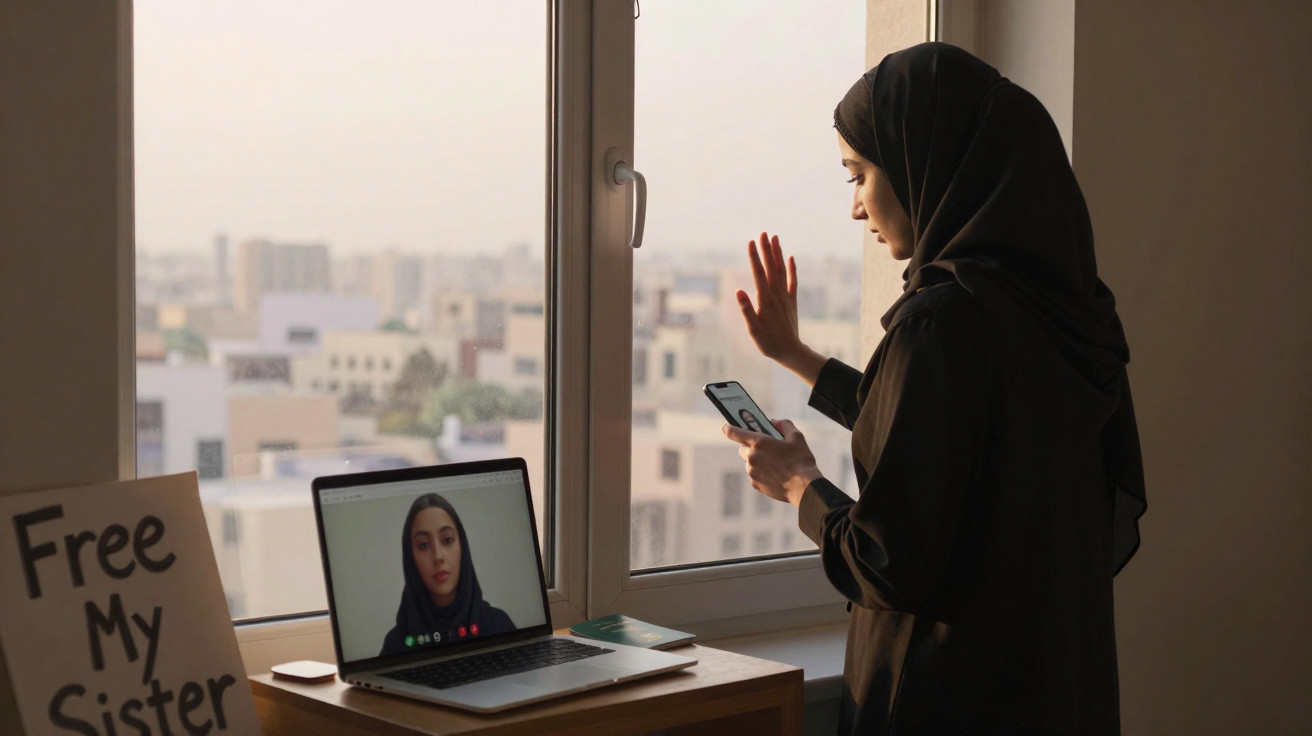
Fawzia al-Otaibi fled Saudi Arabia after being summoned by the authorities. Her two older sisters were not as fortunate: Maryam is banned from travelling, while Manahel remains imprisoned by the regime. The three sisters have become symbols of opposition to the “male guardian” system, in a movement that emerged on social media ten years ago to publicly challenge laws and customs that place Saudi women under male authority.
Living in exile in Scotland, Fawzia leads the international campaign to secure Manahel’s release. In an interview with Jornal de Notícias, the activist describes the contrast between the supposedly progressive reforms advanced by Mohammed bin Salman and the persecution of women who dare to exercise and publicise their rights.
“I never expected to become a role model”
Your family has become a symbol of resistance in Saudi Arabia. Did you ever imagine that demanding autonomy as a woman would come at such a high cost?
I never imagined that I would become a hero or a role model for women in Saudi Arabia. I began responding to the situation by defending women’s rights peacefully, without violence or confrontation. I did not expect to be outside my country, pursued by the regime’s most important body. I am alone in a country that has nothing in common with Saudi Arabia. Yet, from another perspective, my family has been completely destroyed. One sister is imprisoned, another is banned from travelling, and the third - me - is barred from returning to her country.
How has exile changed your identity as a Saudi woman, an activist and a sister separated from her family?
I thought that, in exile, I would continue speaking anonymously, without revealing my name or truly discussing our family. But I was forced to speak publicly and disclose my identity, first to defend my family and then to defend other women. I never thought I would one day carry this responsibility on my shoulders. My entire family in Saudi Arabia is waiting for me to speak out, protect them and defend their rights. It is a huge responsibility.
Did the freedom you found in exile come as a shock?
When I was 12, I suffered greatly and began to become aware of the regressive laws. I was shocked by the reality in which I lived. I started thinking that I did not want that life. From then on, I began to defend myself. When my father told me I was facing a terrorism charge, I thought he was joking. I had done nothing that deserved punishment for terrorism. Our home was raided and I was detained on that charge, but I managed to escape the country. When I left Saudi Arabia, I realised that my aspirations amounted to the ordinary life that every person should be able to live.
You are physically free, but your sisters remain trapped by the system. What is it like living with that contradiction every day?
This is very difficult for me. I am forced to live with this emotional contradiction and, for now, I have no other solution. I have to accept the challenges I face every day because I have a family to save. We were tortured simply for expressing an opinion, without creating any conflict and without using any weapon. We were not even against the Government; we were only against the law that prevents us from living freely. It is very hard, but at this stage I will continue to adapt.
Manahel al-Otaibi and the criminalisation of dissent
Manahel was accused of “terrorism” over social-media posts. What does that tell us about how Saudi Arabia defines dissent?
That sentence tells us that all the propaganda Saudi Arabia has promoted - through changing laws - is false and has produced no benefit for us or for them. We were shocked when sporting deals took place that year, as they too were propaganda intended to conceal the campaign of detaining women. Many women were in prison.
What is currently known about Manahel’s condition?
When Manahel was detained, she was tortured and placed in solitary confinement, unable to speak to anyone. Every time we spoke publicly about her case, Manahel and the women imprisoned with her were tortured. Manahel was stabbed in the face and suffered a broken leg. She received no medical care and not even the most basic human rights. Her sentence has now been reduced from 11 to five years, and she is a little better following the pressure that has been applied.
How do you communicate?
Through the immense pressure we exerted on the Government and world decision-makers, with the support of Amnesty International and other organisations, we managed to improve her conditions. We can now speak to her once a week, but the calls are always monitored and she cannot say anything about her current situation in prison. We can say whatever we want, but she cannot answer. She told us she is given medication every time there is a call. She does not know what type of medication it is, but she feels pain in her body. It does not make her unconscious, but it leaves her “drowsy”, so that she cannot pass on any message. Whenever we speak, she asks for help, whether medical assistance or international intervention.
If you could send your sister a message of support, what would you say?
I would like to tell her that the whole world is with her and that I will never let her go. Unfortunately, she will not be able to hear that message.
How have your parents dealt with the situation?
My father was in tears when he learned that I was speaking publicly. It was the first time I had seen him cry. He told me I would be tortured and killed, and that the Government would destroy any woman who spoke about her rights. I replied that they only wanted to frighten us so that we would abandon these ideas, and that I believed Crown Prince Mohammed bin Salman would grant women rights and bring many changes for the people. That was more than 10 years ago. I expected genuine change, but everything turned out to be the opposite.
My parents, who had nothing to do with what we did, were also threatened. They were told that they were responsible and had to make us stop speaking. At one point, he was accused of liberalism. He did not even know what liberalism meant. He was called to the police station in a very friendly way, almost as a courtesy, and was told that he would not be sentenced, but that they wanted his youngest son to kill the three sisters. They said he would not be tried, that it would be treated as a family conflict, and that they would close the case. My father came home, switched off all the phones and told us that he was not facing a sentence, but that, unfortunately, he was being made to kill us. He was shocked and did not know what to do. The Saudi Government tried to have us killed, without success. They believed that if we were killed by a family member, they could clean up the image of what they had done. We were tortured when we were detained, but the case was publicised around the world, which created major pressure and weakened the Government.
Saudi reforms, women’s rights and “sportswashing”
Saudi Arabia projects an image of modernisation and a more open public life, where women can drive and attend concerts, yet it punishes those who make use of those freedoms?
The Government announced that women could drive, and when the activist Loujain al-Hathloul communicated that she drove, she was detained. In our case, we publicised the situation of women’s “male guardian”. The same thing happened: when we spoke out, we were detained. Although many years have passed between the two cases, the Government still makes decisions that differ from what is set out in the law. They announce reforms in Saudi Arabia, but the reality is different. The Government uses this strategy to improve the image of the Saudi regime. For example, Cristiano Ronaldo’s deal happened in the same month that we were detained, so that people would talk about Cristiano and forget what was happening on the other side.
Is sport used as a tool to distract people from human-rights abuses - so-called “sportswashing”?
When I personally heard about Cristiano Ronaldo’s agreement with the Government, or with Al Nassr, I was 100% certain that this was one of the ways they use to cover up the oppression of women. Especially because the agreement was reached at the same time as our detention.
Many Western governments welcome Saudi Arabia’s reforms and maintain political and economic ties. Do you feel they have failed Saudi women?
I feel disappointed. The regime promotes relationships by saying that foreign governments care only about oil and are not concerned about women’s rights. For example, women in Iran are able to speak and attend protests, while in Saudi Arabia we cannot do anything. The only thing we managed to do was create a Twitter account, and we were reported and detained.
What gives you the strength to keep fighting a system that is so powerful and indifferent to the cause?
When I began speaking about women’s rights, when I created the social-media account, the regime was stronger than it is now. Unfortunately, I let my sisters take part with me. That is why I take full responsibility for continuing to defend them while I am free here and they are there. Continuing to speak is the least I can do, and I will not stop. I have secured international support from a large number of activists, so I have a strong reason to continue fighting. We have made the regime much weaker.
Will your sisters only be able to become free, and perhaps leave the country, if there is a change of regime?
I believe the only solution for my sisters is pressure from international decision-makers and diplomats on the Saudi Arabian Government. If there is no change in the laws, then at least they should be allowed to leave the country. When we expressed our opinion, the regime attacked us in a miserable way. Therefore, a diplomatic solution is the best option at present, more so than trying to change the law.
What kind of country do you hope to find if you can return one day?
I would like people to be able to speak freely and express an opinion without being punished. I would also like children and young people to have rights, and for there to be broad reform so that no one is tortured. I would like there to be a Government that supports the people rather than threatening or frightening them. In the future, I would like us to be an example for the next generation, so that through our suffering they can live a freer and better life than ours. But first, I want to free my sisters.
A family torn apart
Maryam al-Otaibi
The eldest sister was the pioneer of the activism. She was detained in 2017 and spent 104 days in prison. She remains subject to restrictions, including a travel ban, and is frequently targeted through judicial harassment.
Manahel al-Otaibi
The fitness instructor and influencer was detained in 2022. Two years later, she was sentenced to 11 years in prison for “terrorist crimes” linked to social-media posts defending women’s rights, including the use of feminist hashtags and photographs without an abaya (the traditional robe worn by Muslim women in the Middle East). In August last year, her sentence was reduced to five years in prison, followed by a five-year travel ban.




Comments
No comments yet. Be the first to comment!
Leave a Comment