
You know that uncomfortable moment when you pull open a cupboard and six pans, a stray lid and something you cannot identify tumble towards your toes?
That brief pause when you scan the kitchen and wonder, “How did I end up living inside a storage cupboard on the verge of collapse?”
I experienced precisely that in a rented Manchester flat, barefoot amid a hazardous spread of baking trays. The cupboard doors refused to shut, the curtain pole sat at an angle, and beneath the sink was a bog of plastic bottles. It was the sort of ordinary disorder that never makes the news, yet steadily drains your energy.
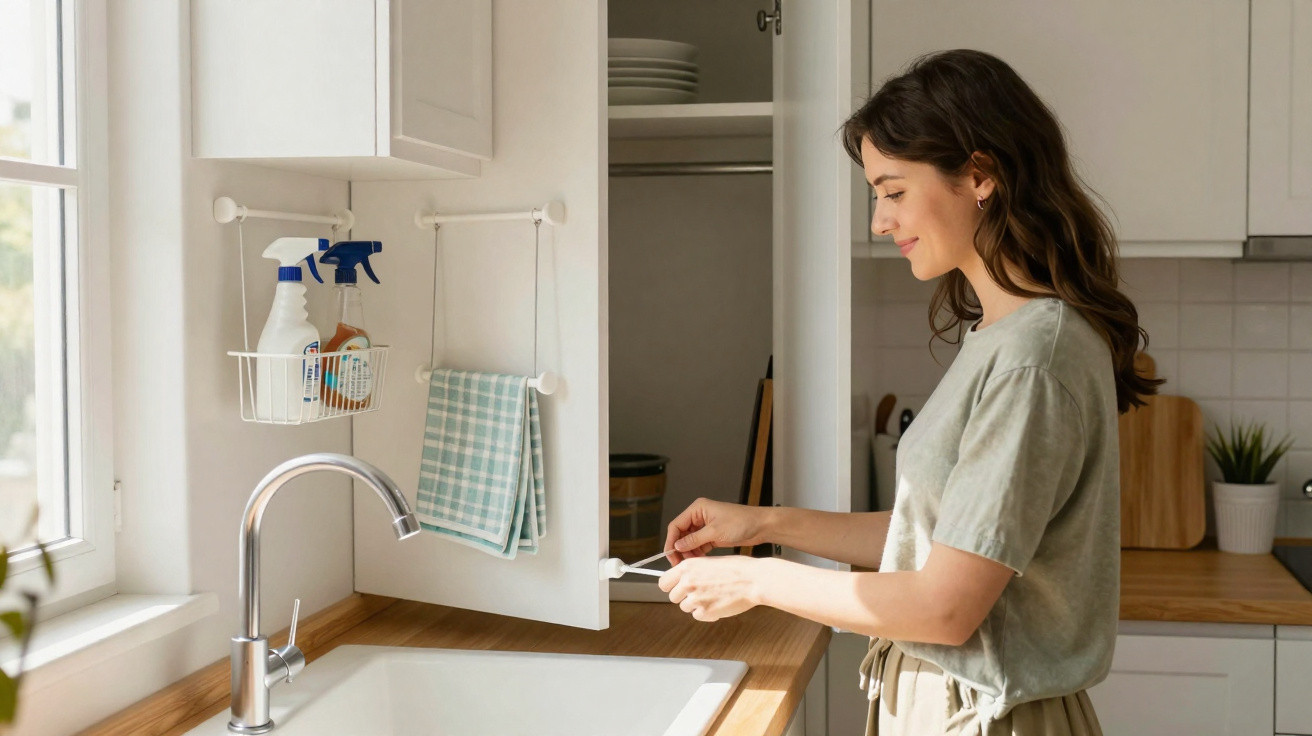
A friend visited, glanced at the scene and produced a small white tension rod from her bag like a household magician. “Trust me,” she said. Within five minutes, the cupboard door closed properly, nothing came crashing out, and I felt mentally lighter.
That was when it clicked: tension rods are about far more than curtains.
Why tension rods quietly tackle modern clutter
Tension rods are the inexpensive spring-loaded poles most often seen valiantly supporting a flimsy shower curtain. You twist them to extend them, wedge them into position, and they somehow remain put. Most of us purchase one, use it for a single job, then forget they are there. That is a missed opportunity.
Their appeal is not merely their low cost. They fit into the unused parts of a home: peculiar gaps and tight corners that conventional furniture cannot reach. They work like an “edit” button for cupboards and wardrobes, allowing you to redraw the unseen boundaries inside them.
When you begin to view your home as a collection of vertical surfaces rather than just horizontal shelves, tension rods seem less like bits of hardware and more like possibilities.
I first understood this fully at a neighbour’s home: a compact Victorian terrace containing more people than available storage. She had made a mini mudroom in a shallow hallway alcove using two staggered tension rods: a high one for coats and a lower one for the children’s backpacks.
There was no drilling, no wall plugs and no irritated emails from a landlord. Two white bars ran across an awkward opening and suddenly brought order to the daily heap by the front door. Her teenage son had claimed another corner, using a rod and S-hooks to hang skateboards neatly with their wheels off the floor.
When she said the whole arrangement had cost under a tenner, it seemed almost unfair. She had effectively cracked city living with something you might normally pick up absent-mindedly in a supermarket aisle.
There is a simple reason these rods work so effectively. Conventional furniture demands commitment: large, weighty, costly items that must accompany you through house moves and redecorating. Tension rods suggest the reverse: “Try this. See how it feels. Move me tomorrow if you hate it.”
They section off space without any fuss. They suit rented homes where drilling involves negotiation, as well as unusually shaped properties where no dimensions are standard. You can trial an idea with a £4 rod rather than a £400 wardrobe.
In a world where so much feels fixed and difficult to alter, that modest, adjustable control inside a cupboard can be remarkably empowering.
10 clever ways to use tension rods you may not have considered
Begin in the kitchen. Position a short, strong tension rod vertically inside a deep cupboard and chopping boards, baking trays and cooling racks will no longer collapse into a noisy metal jumble. Put another rod a few centimetres beside it to form a narrow upright “filing” section for lids and trays.
Next, tackle the space beneath the sink. Fit a rod across the cabinet and suspend spray bottles from their triggers. What was once a tacky bog of toppled containers becomes an open area where spare sponges and dishwasher tablets are easy to spot. One little pole can change the whole feeling of the space.
Then cast your eyes upwards. A longer rod over a washing machine can serve as an emergency drying rail. A short rod placed at the rear of a fridge can prevent bottles from rolling about and damaging your food. These are not Instagram-perfect transformations; they are small, hidden changes that make Tuesday evenings less frustrating.
Bathrooms are ideal territory for tension rods. A narrow rod installed in the shower parallel to the wall can support hanging baskets for shampoo, razors and soap, leaving the ledge uncluttered. In a rental with little storage, a rod fitted across the rear of the door can hold towel hooks and a laundry bag.
I have watched a single small bathroom change completely with just three rods: one above the radiator for towels, another behind the basin for a hanging organiser, and a third beneath it to keep spare loo roll in a tidy row. No drilling, no worries about landlord inspections and no disputes over where everyone’s things belong.
Bedrooms and wardrobes are where tension rods can become rather addictive. A rod fixed near the top of a wardrobe can store seasonal clothing in vacuum bags, leaving your main hanging rail free. A miniature rod lower down makes a shoe “bar”, preventing heels from ending up in a muddy mound. In children’s bedrooms, an additional low rail gives them access to their own clothes and subtly encourages independence.
The key is to consider them movable architecture rather than permanent fittings. Measure the internal width of the area, then choose rods that extend slightly beyond it. Twist them until they are secure, but avoid tightening them so much that thin walls or tiles become distorted. They perform best with light to medium-weight items.
For heavier loads, such as damp clothing or weighty storage baskets, distribute the weight. Two short rods will often cope with greater pressure than one long rod drooping in the centre. Arrange them so their ends press against a sturdy surface - tiles, timber or thick plaster - rather than fragile edges.
Let’s be honest: nobody really does this every day. Most people fit the rod, pile everything onto it and hope gravity is feeling generous. Yet spending one minute checking its position by hand - a gentle push followed by a gentle pull - could stop you being woken at 3 am by the sound of everything falling down in the dark.
“The day I realised a £3 tension rod could stop my toddler emptying the under-sink cupboard was the day I stopped dreaming about a bigger house,” laughed Emma, a mum of two I spoke to in Leeds. “I just blocked off the back half and left a safe basket at the front. He thinks he’s won. I get my cleaning stuff back.”
That is the emotional heart of these modest solutions: they are not really about appearing clever on social media. They are about feeling slightly less at odds with your own home. On a pressured morning, opening a cupboard and seeing everything where you left it is a small, quiet act of kindness towards yourself.
- Use rods to:
- Make mini wardrobes in alcoves or beneath the stairs
- Separate drawers so clothing does not merge into one large heap
- Suspend plants in front of a window without drilling
- Create a temporary curtained “door” in shared flats
- Stop pets accessing certain shelves or cupboards
Tension rods and living differently with small, movable ideas
Once you begin, it becomes difficult not to notice every small area that could discreetly do more. That unused gap over the fridge? A rod and fabric curtain can make it a concealed store for unattractive appliances. The empty space at the back of a desk? A rod can act as a cable corral, raising wires from the floor where pets and dust gather.
One London renter told me she had used three black tension rods to create a “fake wall” in one corner of her studio flat. Two rods held lightweight linen curtains, while another at mid-height supported a string of photographs and a clip-on lamp. At night, it becomes a cosy sleeping nook; during the day, the curtains open and the room can breathe again.
On a recent train journey, I overheard two students exchanging ideas: one had made a shoe rack inside a wardrobe with rods positioned at different heights, while the other had fashioned a makeshift pantry in a corridor cupboard using labelled baskets suspended from rods. None of it is glamorous, but it is exactly this approach that can make a small life feel more spacious.
Tension rods will not solve the housing crisis. They cannot conjure up an extra room or turn a chaotic family into minimalists. What they can offer is a way to reduce everyday friction. They let you experiment without drilling, long-term commitment or anyone else’s permission.
We tend to believe that altering the way we live requires major choices: moving home, renovating or spending money we do not have. These thin, mildly unattractive poles point to a different option. Subtle adjustments. Reversible decisions. An afternoon spent carefully rearranging the invisible framework of your cupboards and corners.
We have all had the point when clutter wins and we quietly shut a door rather than face it. Now picture opening the same door to discover that one inexpensive, adjustable line has rewritten the entire story.
| Key point | Detail | Benefit for the reader |
|---|---|---|
| Vertical thinking | Use rods to separate height rather than only width in cupboards and wardrobes | Reveals hidden storage without purchasing new furniture |
| Temporary by design | No drilling required; fully removable and adjustable within minutes | Ideal for renters, indecisive decorators and changing requirements |
| Micro-zones | Transform awkward corners into purposeful “stations” for bags, shoes, cleaning supplies or laundry | Makes everyday routines easier and homes feel more peaceful |
FAQ:
- Can tension rods really hold heavy items like coats or wet clothes? Yes, but within reason: select thicker, well-made rods, keep them below roughly 1.5 m, and distribute the weight across several hangers or two rods if you are unsure.
- Will tension rods damage my walls or tiles? If they are over-tightened against delicate surfaces, they may leave marks or small dents; choose models with rubber ends, avoid winding them too tightly, and check with a light push before adding weight.
- What size tension rod should I buy for most home hacks? A small set (30–50 cm) for cupboards and drawers, plus a medium set (70–120 cm) for wardrobes and door frames, will handle almost every task.
- Do cheap supermarket rods work as well as more expensive ones? They are suitable for lightweight tasks such as tea towels or fridge bottles, but a sturdier brand is worth a few extra pounds for bathrooms, laundry and heavy baskets.
- How do I stop a tension rod from slipping down over time? Clean and fully dry the contact points, install the rod with a very slight upward angle, and, if necessary, apply small transparent adhesive pads where its ends meet the surface.



Comments
Процесс изготовления съёмных зубных протезов включает несколько этапов: Первичный осмотр и планирование лечения https://adentalab.ru/
Стоматолог оценивает состояние дёсен, оставшихся зубов (если они есть), а также общий объём работы https://adentalab.ru/
После осмотра составляется план лечения, где указывается тип протеза, материалы, которые будут использоваться, и необходимые этапы работы https://adentalab.ru/
Точную цену можно уточнить в стоматологической клинике https://adentalab.ru/
• Металлокерамика — сочетание металла и керамики: металл используется в качестве каркаса, а сверху придаёт форму и цвет коронке — керамика https://adentalab.ru/
4 https://adentalab.ru/
Финальная обработка и установка протеза https://adentalab.ru/
Когда восковая модель удовлетворяет требованиям, начинается изготовление окончательной версии протеза из выбранного материала https://adentalab.ru/
После окончательной полировки протез готов к установке https://adentalab.ru/
Врач-стоматолог устанавливает съёмный зубной протез в полость рта пациента, давая рекомендации по уходу и корректировке https://adentalab.ru/
2 https://adentalab.ru/
Изготовление гипсовой модели https://adentalab.ru/
На основе слепков изготавливаются гипсовые модели, на которых техник начинает работать над будущей конструкцией протеза https://adentalab.ru/
Leave a Comment